

For years, the script was simple.
Work hard. Stay late. Be available. Grind now, rest later.
It shaped how organisations rewarded performance, how managers were promoted, and how ambition was measured. Long hours were proof of commitment. Exhaustion was almost a badge of honour.
But something has shifted. Quietly at first. Then all at once.
Teams are delivering less energy, even when they’re working more hours. Attrition is no longer limited to poor performers. High-potential talent is disengaging without drama. And leaders across industries are asking the same question, sometimes out loud, sometimes privately:
Why does effort no longer translate into performance the way it used to?
The short answer is uncomfortable. The old model has stopped working. And the longer answer asks organisations to rethink what productivity, engagement, and leadership actually mean in 2025.
The Cracks Were Always There. We Just Ignored Them.
The traditional 9–5 model, and its louder cousin, hustle culture, were built for a different workforce. One that was more homogeneous, more hierarchical, and far less vocal about mental load.
It assumed people had predictable energy, linear careers, and clear separations between work and life. It also assumed that pressure, applied consistently, would produce results indefinitely.
That assumption doesn’t hold anymore.
Burnout rates aren’t rising because people have become fragile. They’re rising because work has become cognitively heavier. Fewer routine tasks. More ambiguity. Constant context-switching. Endless communication. Always-on expectations masked as “flexibility.”
The body keeps score, even when calendars pretend otherwise.
And when organisations respond to this fatigue with surface-level fixes, another wellness webinar, another engagement survey, the gap between intent and lived experience widens.
The Great Detachment Isn’t About Laziness

A lot has been said about younger employees “not wanting to work hard.” It’s a convenient narrative. It’s also inaccurate.
What’s actually happening looks more like a recalibration.
Younger professionals aren’t rejecting effort; they’re rejecting effort without meaning. They question systems that reward presence over contribution, noise over impact, and endurance over effectiveness.
They’ve watched older colleagues burn out quietly. They’ve seen loyalty go unrewarded. And they’ve learned, early on, that constant hustle doesn’t guarantee growth, only depletion.
So they disengage differently. Not with rebellion, but with boundaries. Not with noise, but with distance.
This is what many leaders now refer to as the “great detachment.” People still show up. They still deliver. But they stop giving discretionary energy. And that’s where innovation, ownership, and culture actually live.
Performance Was Never About Hours. We Just Pretended It Was.
Here’s the part organisations rarely say out loud.
High performance has always been uneven. Some people think their best work is done early in the morning. Others hit clarity late at night. Some thrive in deep focus. Others create momentum through conversation.
Yet most workplaces continue to reward sameness.
Same schedules. Same expectations. Same definitions of commitment.
The problem isn’t that people want fewer hours. The problem is that they want better use of their energy.
When work consistently drains people without replenishing them, output suffers, slowly at first, then suddenly. Creativity flattens. Decision quality drops. Collaboration becomes transactional.
Sustainable performance doesn’t come from asking people to do more. It comes from helping them work in ways that are more natural to their thought process, decision-making, and leadership.
That distinction matters.
Managers Are Stuck in the Middle of a Broken Equation
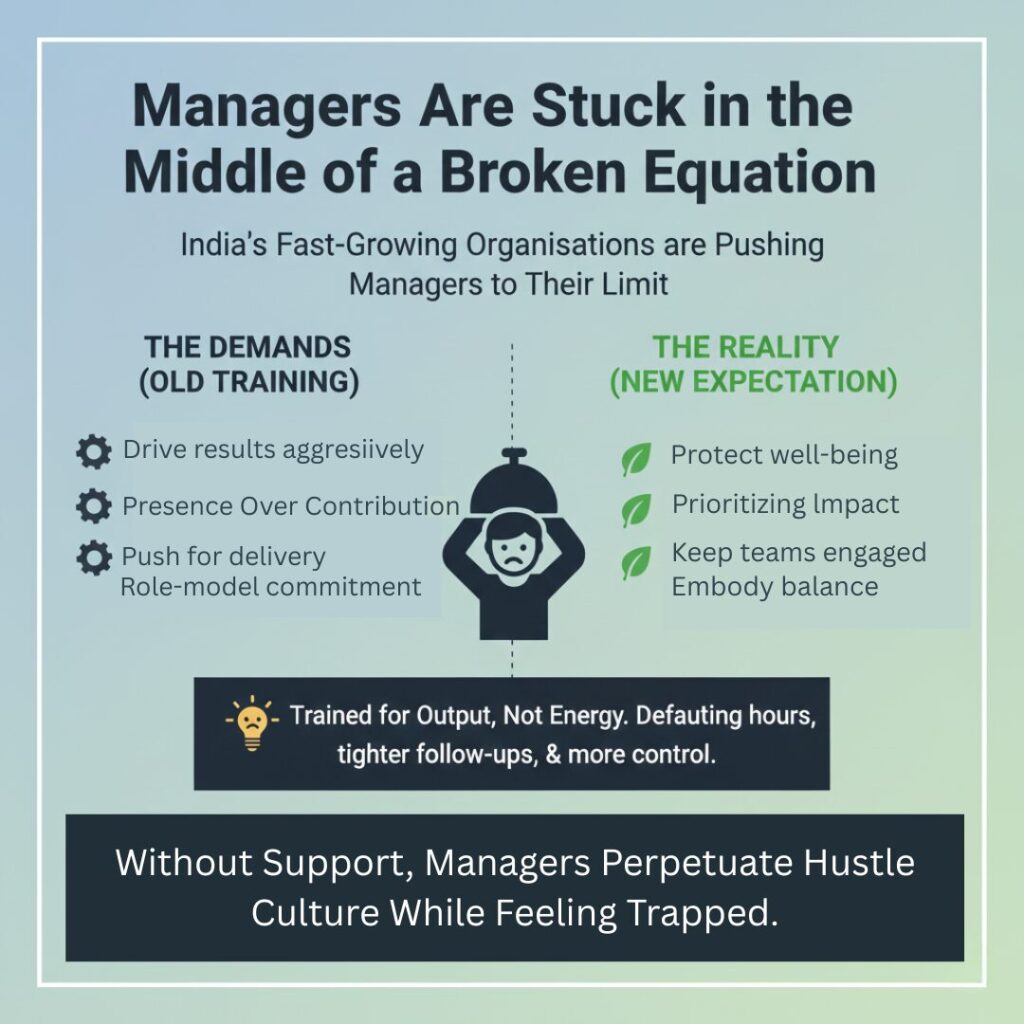
Managers, especially in India’s fast-growing organisations, are carrying the heaviest load of this transition.
They’re asked to drive results aggressively while also protecting well-being. To push for delivery while keeping teams engaged. To role-model balance without being seen as “less committed.”
Many of them are exhausted, not because they lack skill, but because the system demands contradiction.
They weren’t trained to manage energy. They were trained to manage output.
So they default to what they know: longer hours, tighter follow-ups, more control. Not because it works, but because it feels safer than uncertainty.
Without support, even well-intentioned managers unintentionally perpetuate hustle culture while privately feeling trapped by it themselves.
Why Well-Being Initiatives Alone Don’t Fix the Problem
There’s a reason many well-being programs feel disconnected from daily work.
They sit outside the flow of performance.
Meditation sessions don’t change how deadlines are set. Mental health days don’t alter how meetings stack up. Flexible policies don’t help when managers still reward visibility over value.
Well-being can’t be an add-on. It has to be embedded into how work is designed, how leaders lead, and how success is defined.
Otherwise, employees experience a strange contradiction: being told to take care of themselves in systems that punish them when they do.
Work–life balance strategies for managers, it’s serious, not soft
Okay, so you’re convinced the old model is dying, but what comes next? Here are some work-life balance strategies for managers that actually make a difference:
- Rethink time, not tasks. It’s not about punching clocks, it’s about outcomes. When you judge contributions by results, people can deliver great work without sacrificing themselves.
- Normalise rest. Encourage breaks. Respect leave. Actually mean it when you say “unplug after hours.”
- Model behaviour from the top. Leaders who send midnight emails and expect instant replies create silent pressure. If you want balance, you have to live it first.
- Focus on individual strengths. People contribute most when they’re doing what energises them. (You don’t need a fancy label for this, just pay attention.)
These aren’t trendy buzzwords; they’re practical adjustments that keep people engaged and productive. And they signal something deeper: that the organisation values people, not just outputs.
Don’t confuse toughness with torment.
Here’s something leaders sometimes miss: promoting well-being doesn’t mean lowering standards. It means being smart about how you manage energy and attention. People can be challenged and supported at the same time. Those aren’t opposite things.
Think about athletes. They train intensely, but they also rest. They measure recovery as seriously as reps. Why? Because performance isn’t sustainable without recovery. Workplaces need the same logic. Long hours aren’t proof of commitment; they’re sometimes proof of inefficiency.
The rising importance of well-being and mental health
Companies that ignore mental health do so at their own peril. Stress isn’t just a “personal issue”; it affects cognition, collaboration, morale, and revenue. There’s a domino effect: stress undermines sleep, which undermines focus, which undermines creativity, which undermines performance. It doesn’t take a PhD to see the pattern.
More organisations are investing in well-being initiatives. Not because it’s fashionable, but because it’s effective. People who feel valued show up more (in both presence and engagement), innovate more, and stay longer. It’s simple economics: healthier teams cost less in turnover, absenteeism, and lost productivity.
Strengths-based leadership over long hours, a gentle shift with a big impact
Now let’s talk leadership. Leaders who focus on people’s strengths, what energises them, and what they do naturally well, create environments where people thrive. This isn’t about sentimentality. It’s about productivity that lasts.
When leaders lean into what each person does best, teams become more effective with less friction. People spend time on work they’re good at, not just work they’re stuck doing because of tradition. The result? Higher morale, deeper engagement, better outcomes. And guess what, that’s the opposite of the burnout treadmill.
What this means for CHROs, CEOs, and decision makers
If you’re in a leadership seat, this isn’t academic; it’s strategic. The metrics you care about, retention, engagement, and performance, are all tied to how people experience work every day. Sticking with the old hustle model may yield short-term benefits, but it erodes human capital over time.
You don’t fix culture with slogans. You fix it by:
- Asking real questions about how work feels for people
- Measuring engagement in ways that actually reflect human experience
- Giving managers tools and authority to change how teams work
- Celebrating deep work and focus, not just long hours
Real change feels a bit messy at first, like trying to steer a big ship in shallow water. But once you find the current, it actually gets easier.
A quick story because numbers alone don’t tell the whole tale
I once worked with a leader who insisted long hours were essential. “No pain, no gain,” he’d say. However, his teams were slipping, missing deadlines, quitting, and losing their spark. We shifted the conversation: what if we cared as much about rest as we do about output?
We tried simple experiments. Shorter meetings. No email after 7 pm. Team rituals that honoured personal time. Within a few months, something surprising happened: productivity didn’t di, it rose. People felt heard. They took initiative. They stuck around.
Not because we preached work–life balance, but because we practised it.
So what’s the takeaway?
Long story short: the old hustle doesn’t work anymore. The traditional 9–5 grind or worse, the glorified hustle culture, is fading because human beings aren’t machines. We don’t perform well under constant strain. We perform well when we’re engaged, supported, and given room to breathe.
Decision makers who get this aren’t being soft; they’re being smart. Sustainable performance in the workplace in India and everywhere thrives on thoughtful human engagement, not exhaustion. The future of work isn’t about longer hours, it’s about better hours.
Ask yourself: in 2025 and beyond, do you want a workforce that’s barely hanging on, or one that’s showing up, fully present, and equipped to do meaningful work? The choice you make now shapes your organisation’s resilience and success for years to come.
Let’s stop glorifying the grind. Let’s start building work that works for people.