
In many leadership rooms, the question quietly sits there:
Are some people simply born with greater potential?
It’s a fair question. Some employees appear naturally confident. Others think strategically from day one. A few seem wired for influence, resilience, or analytical clarity. Science tells us genetics does influence temperament, cognitive style, emotional regulation, and even baseline energy.
But here’s what we see consistently in organisations:
Potential doesn’t become leadership because of biology. It becomes leadership because of the environment.
For organisations, the more relevant question isn’t “Who is genetically gifted?”
It’s “Are we creating the conditions where strengths can consistently translate into contribution?”
That’s where the real work begins.
The Truth About Natural Ability (And Why It’s Not Enough)
Yes, genetics shapes certain tendencies.
Some individuals naturally:
- Process information quickly
- Stay calm under pressure
- Show strong social confidence
- Display high levels of drive and conscientiousness
These traits often show up early and can signal High-Potential Talent.
But natural advantage alone does not build High-Potential Leadership.
We’ve worked with organisations where individuals with remarkable raw ability plateaued. Not because they lacked talent but because the system didn’t help them channel it productively.
Conversely, we’ve seen quieter employees, those not immediately obvious as “stars”, flourish under structured Strengths-Based Development.
The difference wasn’t DNA.
It was designed.
Before Identifying High-Potential Talent, Build the Right Foundation
Organisations that are serious about identifying High-Potential Employees must pause before jumping into labels or leadership tracks.
The first question isn’t: “Who has potential?”
It’s: “Have we created the conditions where strengths can surface clearly?”
Start with the basics:
- Are systems employee-friendly and transparent?
- Are policies encouraging growth, not just compliance?
- Is learning valued alongside delivery?
If these elements are weak, potential gets misread.
When mistakes are penalised harshly, experimentation disappears. When performance conversations focus only on quarterly output, behavioural strengths remain invisible. When managers lack a common language for capability, identification becomes subjective.
And in today’s workforce, where burnout, retention challenges, and evolving expectations around well-being are real, development without psychological safety becomes counterproductive.
High-potential employees don’t disengage because they lack ambition.
They disengage when growth feels extractive rather than enabling.
Here’s the subtle shift.
Before introducing formal Strengths-Based Leadership, organisations must first build strengths awareness. Leaders need clarity about:
- What natural patterns of thinking and behaving exist in their teams
- How those patterns show up in performance
- Which strengths create energy versus drain it
When strengths are recognised and discussed openly, performance reviews become richer. Talent conversations become more objective. Managers stop comparing people to a single leadership prototype.
Only then does Strengths-Based Leadership become meaningful.
Because Strengths-Based Leadership is not pressure to perform differently.
There is clarity about how to perform effectively.
And that clarity is what allows High-Potential Talent to emerge consistently, not accidentally.
Rethinking Performance Reviews: Patterns Over Moments
Most organisations conduct performance reviews annually. Promotions are discussed. Compensation is adjusted. The document is archived.
However, when we work with leadership teams, we often ask them to examine the last three or four years of performance data, not for ratings, but for patterns.
Consistent performance tells a deeper story.
High-Potential Talent typically shows:
- Reliable decision quality
- Repeatable collaboration behaviour
- Adaptability across changing contexts
- Steady contribution, not sporadic brilliance
This is where genetics meets behaviour.
Natural traits may explain why someone tends toward strategic thinking or relationship-building. But it’s the sustained application of strengths that signals leadership readiness.
A thoughtful performance and potential matrix helps distinguish between:
- Temporary performance spikes
- Long-term capability development
That distinction protects succession planning from becoming overly reactive.
The Invisible Attributes That Matter Most
Some of the most important indicators of leadership potential are difficult to quantify.
- Ownership
- Integrity
- Judgement
- Constructive dissent.
We’ve seen organisations where managers define these differently. One leader rewards assertiveness. Another labels it aggression. One values collaboration. Another equates it with indecisiveness.
Without shared criteria, identifying high-potential employees becomes subjective.
A structured High-Potential leadership framework should include clearly defined observable behaviours:
- Does the employee take responsibility beyond role boundaries?
- Do they question outdated practices respectfully?
- Do they elevate team thinking without diminishing others?
- Do they stay composed under ambiguity?
These behaviours reflect applied strengths, not just personality.
When organisations define them clearly, talent conversations shift from opinion to insight.
The Quad Lens: A Balanced View of Potential
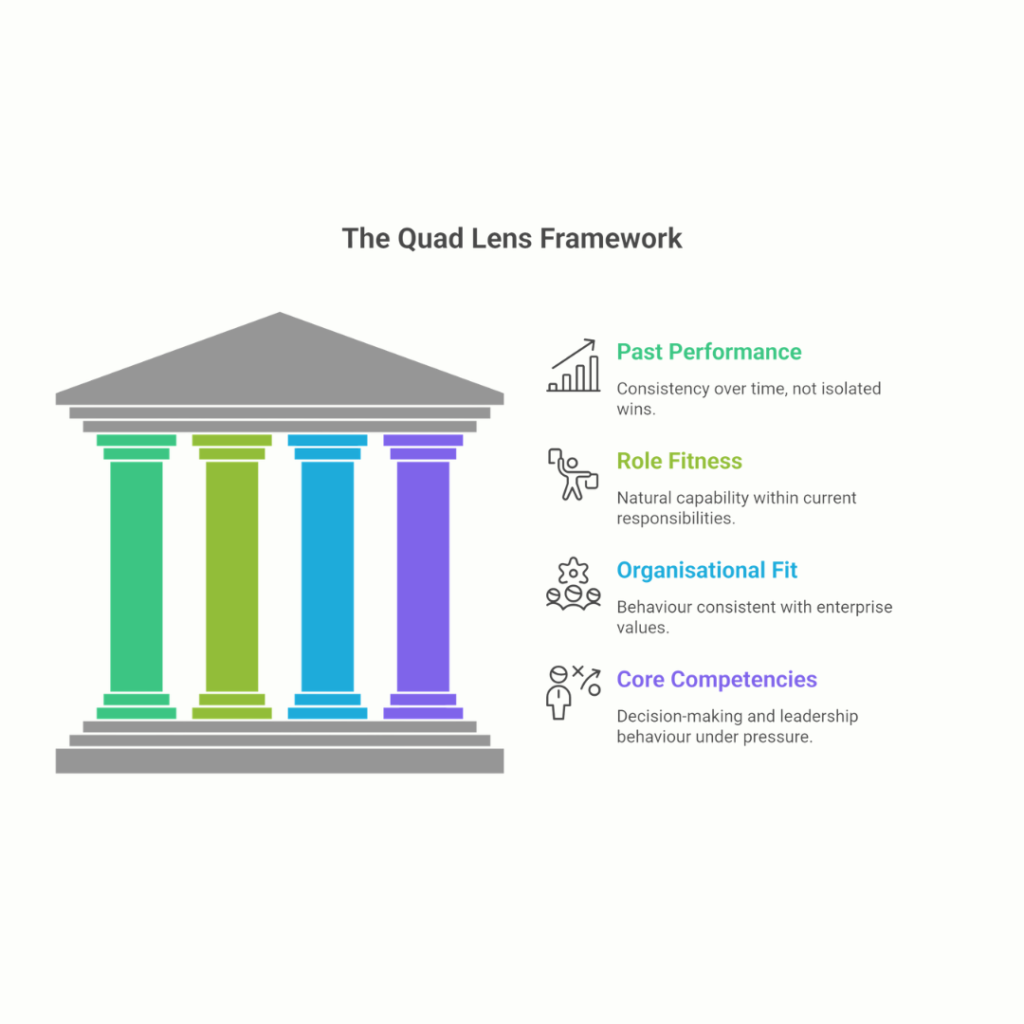
Anyone being considered for larger responsibilities deserves a holistic evaluation. A simple but powerful structure includes four dimensions:
Past Performance
Consistency over time, not isolated wins.
Role Fitness
Natural capability within current responsibilities.
Organisational Fit
Behaviour consistent with enterprise values.
Core Competencies
Decision-making and leadership behaviour under pressure.
Assigning weightage to each dimension introduces fairness and rigour. It also prevents the common error of promoting high performers who may lack broader leadership readiness.
This approach supports data-driven talent decisions while remaining human-centred.
And importantly, it recognises that potential is multi-dimensional.
Where Strengths-Based Development Changes the Equation
Genetics may influence baseline tendencies, but Strengths-Based Leadership determines whether those tendencies become assets.
When individuals understand their natural patterns of thinking, feeling, and behaving, something shifts. They stop trying to lead like someone else. They begin refining what they already do well.
In our work with organisations, we often observe this subtle transition:
A technically strong manager learns that their strength lies in structured thinking. Instead of overextending into high-emotion mediation, they build complementary partnerships.
A relationship-driven leader recognises their influence strength and intentionally mentors emerging talent.
This is not about labelling.
It is about clarity.
Strengths-based leadership development helps individuals apply their natural capabilities intentionally rather than accidentally.
Over time, that intentionality compounds into High-Potential Leadership.
Involvement as a Real-World Laboratory
Classroom learning has limits. Potential becomes visible in action.
Organisations can strategically involve select employees in cross-functional or organisation-wide initiatives. Observing how individuals behave in complexity reveals far more than static evaluations.
Senior leaders should pay attention to:
- Quality of strategic thinking
- Willingness to shoulder responsibility
- Collaboration across hierarchy
- Energy and resilience during uncertainty
High-potential employees often emerge from these environments—not because they hustle harder, but because their strengths translate effectively under pressure.
The key is not exclusivity, but structured exposure.
Addressing Burnout Without Diluting Ambition
Here’s a contradiction worth acknowledging:
Many high-potential individuals are highly driven. That drive, if unmanaged, leads to burnout.
Today’s workforce, especially younger professionals, values growth alongside well-being. They are less willing to sacrifice mental health for title acceleration.
Strengths-based organisational culture addresses this tension thoughtfully.
When people operate from their natural strengths:
- Work feels more energising
- Effort feels purposeful
- Contribution feels authentic
Leadership strengths coaching often reveals where individuals are overcompensating. Sometimes, burnout is not about workload; it’s about working against one’s natural style.
Sustainable leadership development respects human variation. It doesn’t glorify overextension.
From High-Potential Employees to High-Potential Leadership
High-Potential Employees are identified through structured observation and multi-year performance patterns.
High-Potential Leadership, however, requires:
- Self-awareness
- Strengths clarity
- Organisational perspective
- Responsible influence
High-Potential Leadership development programs grounded in strengths psychology support this transition deliberately.
They do not promise an overnight transformation.
They build durable capability.
When integrated thoughtfully into a broader talent development strategy, strengths-based talent management strengthens succession planning, reduces bias, and builds high-performance teams organically.
So, How Much Does Genetics Really Matter?
Genetics influences predisposition. It shapes tendencies. It explains why individuals differ.
But it does not decide leadership impact.
Organisational systems, structured evaluation frameworks, strengths-based development practices, and thoughtful involvement opportunities determine whether natural potential matures into meaningful leadership.
For organisations, the strategic insight is simple:
You cannot control biology, but you can design development.
And when development is grounded in clarity, consistency, and strengths-based leadership principles, potential becomes predictable, not accidental.
That is not promotional optimism. It is a disciplined people strategy.
Potential may begin with nature. Leadership, however, is built with intention.