
A Strengths Spotlight Conversation with Deepika Kinger
Introduction: Why Trust and Impact Are the Core of Today’s Teams
In today’s workplaces, trust and impact aren’t nice-to-have outcomes; they’re the very foundation of high performance. Without trust, collaboration becomes fragile. Without impact, work feels empty. And yet, many organizations struggle to cultivate both at scale.
This is where strengths-based development steps in, not as a tool, but as a lens. By helping people see and use what’s best in themselves and others, strengths create an environment where trust builds faster and performance multiplies.
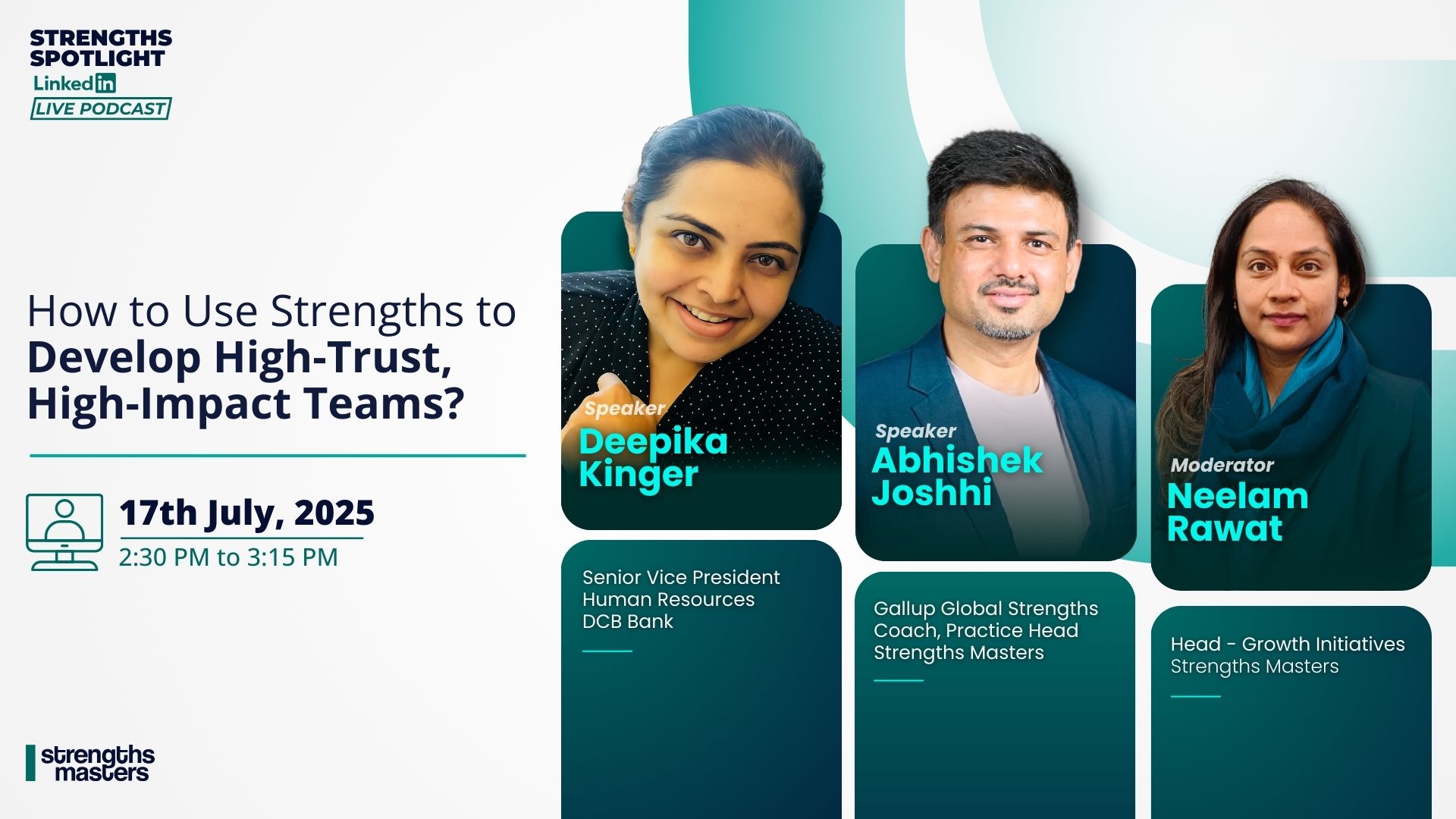
That was the heart of our July 17th Strengths Spotlight LinkedIn Live conversation, where we explored “How to Use Strengths to Develop High-Trust, High-Impact Teams” with Deepika Kinger, Senior Vice President – HR at DCB Bank, alongside Gallup Global Strengths Coach, Abhishek Joshi.
Introducing the Speaker: Deepika Kinger
With over two decades of experience spanning Sales, Investment Advisory, and Human Resources, Deepika Kinger brings a rare ability to connect business depth with people strategy.
At DCB Bank, she has been instrumental in shaping the organization’s talent and leadership landscape. As Senior Vice President – HR, Deepika has led initiatives in leadership development, HR tech, and organisational culture, contributing to DCB’s recognition among India’s Top 100 Great Places to Work. Her impact includes driving more than 500,000+ learning hours, embedding digital HR innovation, and influencing strategic direction in partnership with the CEO.
Her work reflects a central belief: transformation is only sustainable when people grow along with the business.
Unpacking the Discussion: From Strengths to Trust to Impact
The conversation began with a reflection on the personal journey of discovering strengths. Deepika shared that what shifted her mindset was seeing firsthand how strengths conversations brought authenticity into the workplace.
“When people start seeing what’s right with them, and not just what needs fixing, it changes the energy in the room. They open up, they trust each other more, and collaboration becomes easier,” she said.
She recalled the initial rollout of Strengths at DCB Bank, where reactions ranged from curiosity to scepticism. Some wondered if this was “just another HR initiative.” But over time, employees realized it wasn’t about labeling them, it was about empowering them. Leaders, too, came on board once they saw how strengths-based conversations deepened trust during tough transitions.
When asked what high trust looks like in practice, Deepika explained: “It shows up in everyday behaviour. When teammates assume good intent, when they don’t second-guess each other, when they step in to cover without being asked, that’s trust. Strengths accelerate this because they help people understand not just what someone does, but why they do it.”
She also shared a story where her strengths helped a team navigate conflict. Two colleagues often clashed, one driven by precision, the other by speed. Through a strengths lens, they began to see each other’s intent rather than flaws: one ensured quality, the other ensured momentum. That shift turned tension into complementarity.
Abhishek added that this is where many organisations stumble: they stop at a one-off workshop instead of embedding strengths into daily rhythms. “The magic isn’t in knowing your Top 5, it’s in using them, again and again, in how you collaborate, lead, and solve problems.”
Five Key Lessons from Deepika Kinger
- Trust is Built on What’s Right, Not What’s Wrong
Teams thrive when individuals feel seen for their strengths, not constantly judged for their weaknesses. By naming and valuing what’s unique in each person, leaders create psychological safety, the bedrock of trust. - Rollouts May Start Slow, but Impact Compounds
Strengths journeys often meet early resistance or scepticism. But once people experience the authenticity and ease it brings to conversations, adoption accelerates. As Deepika observed, “What starts as curiosity becomes conviction.” - Leadership Buy-In is the Turning Point
For any cultural shift, leaders must model it. Deepika emphasised that once senior leaders began using strengths in decision-making and talent conversations, teams mirrored the behaviour. It moved Strengths from being an “HR program” to a “business language.” - Conflict Becomes Collaboration When Seen Through Strengths
Friction in teams often comes from misunderstood intent. Strengths reveal that what looks like opposition is often complementarity. This reframing not only resolves conflict but also drives better outcomes by harnessing diverse approaches. - Sustained Culture > One-Time Workshops
Embedding strengths requires ongoing conversations, team reflections, leadership dialogues, and integration into L&D and performance systems. It’s not a checkbox activity; it’s a mindset that compounds over time, creating high-trust, high-impact cultures.
Final Thoughts: From Strengths to Culture
The Strengths Spotlight with Deepika Kinger reminded us that trust and impact aren’t abstract leadership buzzwords; they’re daily practices shaped by how people see themselves and each other. Strengths provide a shared language that transforms suspicion into understanding, competition into collaboration, and effort into impact.
Deepika’s biggest takeaway was simple yet profound:
“When people feel strong, they give their best. And when they give their best together, trust becomes natural, and impact follows.”
For HR leaders and CEOs alike, this conversation was a call to move beyond viewing strengths as an assessment tool. It’s about embedding them into the DNA of the organization, into how leaders lead, how teams collaborate, and how culture is lived every day.
In the end, building high-trust, high-impact teams isn’t about perfection. It’s about presence, leaders showing up with empathy, teams leaning into their strengths, and organisations committing to a culture where people can thrive.
Quotable Highlights
- “Trust shows up in everyday behaviour, assuming good intent, stepping in without being asked.”
- “What starts as curiosity becomes conviction.”
“When people feel strong, they give their best. And when they give their best together, impact follows.”
[Note: The views expressed by the speaker are their own and do not represent those of their organization.]