
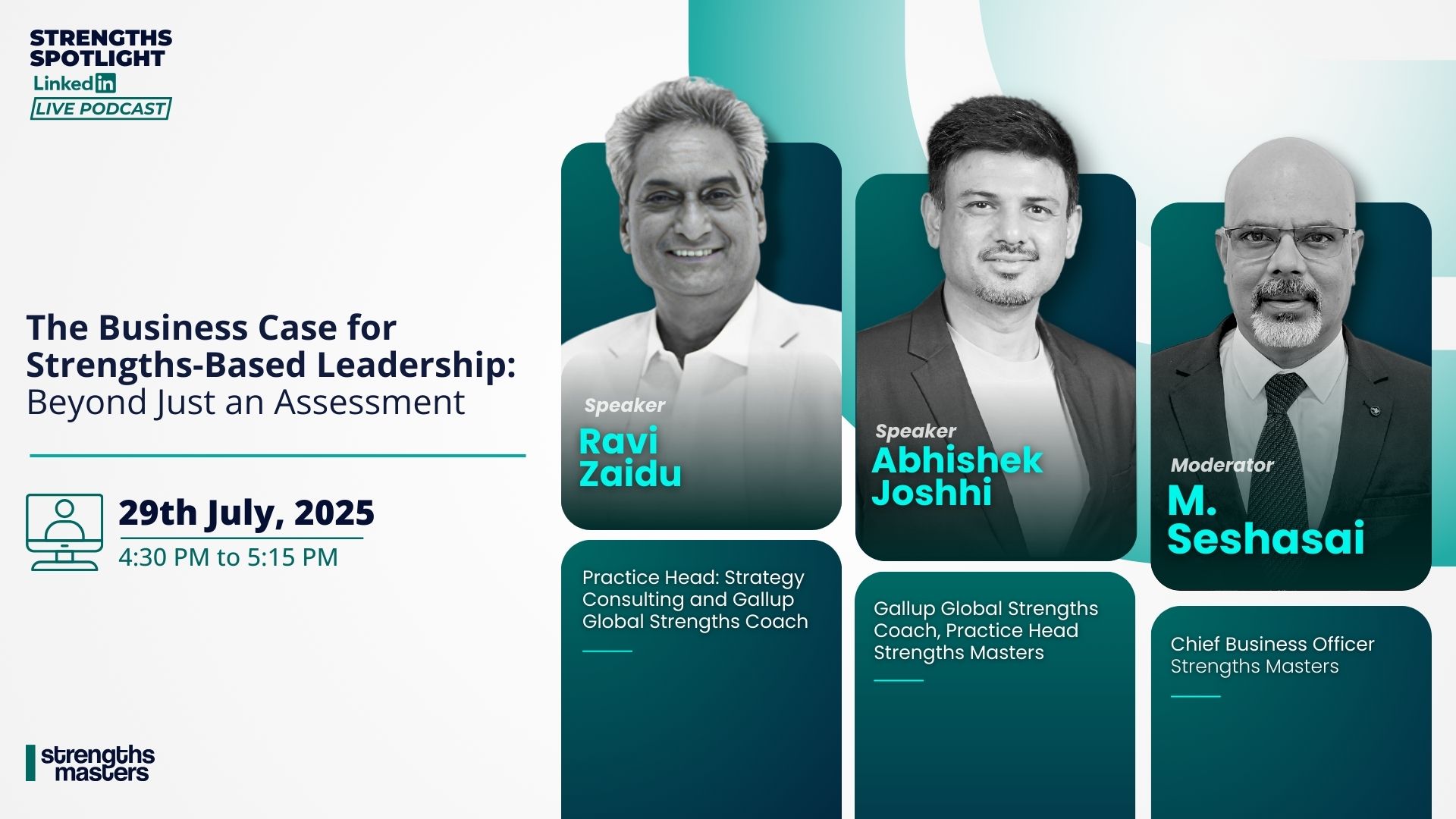
A Strengths Spotlight Conversation with Ravi Zaidu
Introduction: Why Strengths Must Go Beyond the Test
In many organisations, the journey with Strengths stops at the assessment. Leaders hand out results, employees glance at their Top 5, and then everyone moves on. The exercise is remembered as a “feel-good workshop,” not a game-changing strategy.
But what if Strengths could do more? What if they could reshape leadership philosophy, unlock team performance, and directly improve retention, engagement, and business outcomes?
That was the focus of our July 29, Strengths Spotlight LinkedIn Live conversation, “The Business Case for Strengths-Based Leadership: Beyond Just an Assessment”, with Ravi Zaidu, Gallup Global Strengths Coach and Practice Head – Strategy Consulting. With three decades of leadership experience across sales, marketing, P&L, and consulting, Ravi brought sharp business insight into why the real ROI of Strengths lies not in self-awareness, but in leadership application.
Introducing the Speaker: Ravi Zaidu
Ravindra Nath Zaidu is where three decades of business leadership meet the science of Strengths.
Currently Practice Head – Strategy Consulting and a Gallup Global Strengths Coach, Ravi has led over 50 organisational transformation projects, delivered more than 100 leadership workshops, and coached senior leaders across India and South Asia.
His career spans leadership roles in Sales, Marketing, and P&L before moving into consulting, giving him the rare ability to connect operational realities with human potential. This blend of business acumen and coaching expertise makes him uniquely positioned to bridge the gap between Strengths theory and business impact.
Unpacking the Discussion: Strengths as a Strategy, Not a Slogan
Ravi began by addressing one of the most common misconceptions about Strengths-Based Leadership: that it’s “soft” or “feel-good.”
“The biggest myth,” he explained, “is that Strengths is just about making people happy. In reality, it’s about unlocking performance by aligning talent with outcomes. It’s not soft, it’s smart business.”
He drew a clear distinction between using Strengths as an assessment versus adopting it as a leadership philosophy. An assessment provides data; a philosophy transforms behaviour. “The difference is visible,” he said. “When Strengths stay on paper, nothing changes. But when leaders apply it in delegation, feedback, and strategy, you see cultural and business impact.”
Ravi shared examples from his consulting work where Strengths helped leadership teams address concrete challenges, whether restructuring after market shifts or boosting innovation in low-morale teams. By shifting focus from fixing weaknesses to leveraging what people do best, organisations found both agility and resilience.
Importantly, he emphasised the ROI of Strengths-Based Leadership. “This is not anecdotal,” Ravi noted. “When managers lead with Strengths, engagement scores rise, attrition drops, and productivity increases. There are hard metrics behind this.”
He also spoke about the role of managers as the true activators of Strengths. While assessments create awareness, it’s the daily micro-habits of managers, delegating based on talent, giving feedback that affirms Strengths, and designing teams with complementarity, that bring the philosophy alive.
But there are pitfalls too. Ravi warned leaders against overusing dominant Strengths, misapplying them, or ignoring blind spots. “Self-awareness is the starting point,” he said, “but without reflection and discipline, Strengths can turn into derailers.”
Perhaps his most powerful message was about sustainability: “Organisations often stop at a workshop. That’s like planting seeds and never watering them. To build a Strengths culture, you need rhythm, ongoing conversations, leadership modelling, and integration into systems.”
Five Key Lessons from Ravi Zaidu
- Strengths is Not Soft, It’s Strategic
The biggest misconception is that Strengths is about “feeling good.” In truth, it’s about aligning people’s natural talents to business outcomes. Leaders who use Strengths strategically unlock measurable performance improvements. - Assessment is the Start, Not the Finish
Strengths assessments create awareness, but transformation happens only when leaders embed Strengths into daily leadership, how they delegate, coach, resolve conflict, and design teams. - Managers Are the Multipliers
The success of a Strengths-based culture depends on managers. Through everyday actions, like assigning work based on strengths or giving feedback through a Strengths lens, they activate engagement and performance. - ROI is Real and Measurable
Strengths-Based Leadership impacts metrics like retention, engagement, innovation, and productivity. Organisations that commit to this approach see business outcomes improve alongside culture. - Sustainability Requires Culture, Not Events
A one-off workshop won’t shift culture. Strengths must be built into ongoing conversations, leadership behaviours, and organisational systems to become a lived philosophy rather than a one-time initiative.
Final Thoughts: Beyond Awareness, Into Action
The Strengths Spotlight with Ravi Zaidu made one thing clear: the true business case for Strengths lies not in the assessment but in the application. Awareness is valuable, but it is action, sustained, intentional, and leader-led, that creates transformation.
As Ravi summed it up:
“When leaders make Strengths part of everyday leadership, not just a tool, but a lens, they don’t just build better teams. They build better businesses.”
For CEOs, HR leaders, and managers, the takeaway is unmistakable: Strengths is not a side project. It’s a strategy. Done right, it drives engagement, reduces attrition, fuels innovation, and anchors trust. And in today’s volatile business environment, those are not “soft” wins; they are the hard edges of competitive advantage.
Quotable Highlights
- “Strengths is not soft, it’s smart business.”
- “An assessment gives data; a philosophy drives change.”
- “Planting seeds without watering them is not culture. Sustainability requires rhythm.”
[Note: The views expressed by the speaker are their own and do not represent those of their organization.]