

Leadership conversations have matured.
Organisations are no longer debating whether leadership matters at the middle level. That question is settled. What’s changing is how leadership is developed, especially in complex environments, distributed, and constantly evolving.
Middle-level leaders sit at a fascinating intersection. They translate strategy into action, shape day-to-day culture, and influence how work actually feels for teams. Their impact is immediate and visible. When they lead well, organisations move faster, collaborate better, and adapt more easily.
The challenge isn’t a lack of effort or intent. It’s that traditional leadership development often assumes a narrow model of what good leadership looks like.
This is where strengths psychology leadership development brings a fresh, practical perspective, one that helps middle-level leaders become more effective, confident, and intentional in how they lead.
Why Strengths Psychology Is Important in Modern Leadership
Leadership today requires more than technical competence or positional authority. It demands judgment, adaptability, and the ability to work with people who think, work, and communicate differently.
Strengths psychology starts with a simple but powerful idea: people perform best when they understand and apply what comes naturally to them, especially in complex roles.
Rather than asking leaders to fit into predefined leadership templates, strengths psychology helps them:
- Understand their natural patterns of thinking and decision-making
- Recognise how they influence others.
- Use their energy more deliberately.
- Develop leadership presence that feels authentic.
This approach is particularly relevant in organisations where leaders must operate across functions, cultures, and expectations. A positive psychology leadership approach doesn’t dilute standards; it sharpens them by working with human behaviour rather than against it.
Middle Level Leaders: The Engine Room of Leadership Execution
Middle-level leaders are often described as the bridge between strategy and execution. That description is accurate, but incomplete.
They are also:
- Interpreters of intent
- Designers of everyday work experience
- Multipliers of leadership behaviour
Their influence shapes how strategy lands, how change is received, and how teams perform over time.
As organisations grow and distribute globally, middle managers are expected to exercise greater judgement rather than follow instructions. They’re no longer just managing tasks; they’re managing context.
This makes leadership mindset development essential. Strengths psychology provides a language and framework for leaders to understand how they operate and how to lead effectively without mimicking others.
The Science Behind Strengths-Based Leadership
Strengths psychology is grounded in behavioural science and positive organisational research. At its core, it studies what enables people and systems to function at their best.
Research consistently shows that leaders who operate from their strengths demonstrate:
- Higher engagement and consistency
- Stronger relationships with teams
- Better decision quality under pressure
- Greater adaptability in complex situations
This doesn’t suggest ignoring development areas. Instead, it reframes development as something that builds from existing capacity.
In leadership contexts, this distinction matters. Leaders who understand their strengths can stretch themselves thoughtfully, rather than forcing change that feels unnatural or unsustainable.
That’s why strengths psychology in organisations has become a foundational element of leadership development rather than a supplementary one.
How Strengths Psychologists Help Middle-Level Leaders Grow
The role of a strengths psychologist is not to prescribe leadership behaviour, but to increase leadership clarity.
Here’s how that support typically shows up for middle-level leaders.
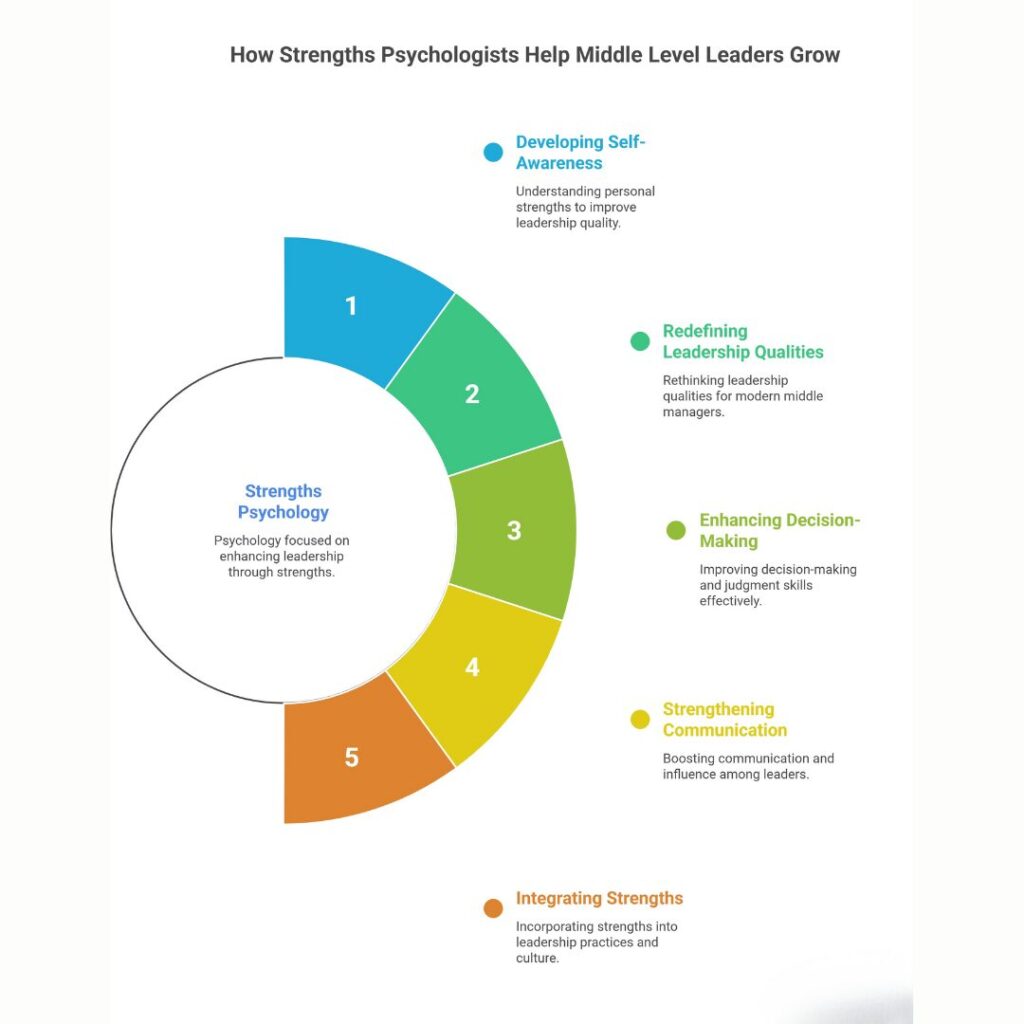
1. Developing Self-Awareness That Improves Leadership Quality
Many middle managers are skilled operators. What they often lack is a structured way to reflect on how their thinking patterns shape their leadership behaviour.
Strengths psychology helps leaders gain insight into:
- How they approach decisions
- How they process complexity
- How they naturally motivate others
- How they respond when the stakes are high
This awareness allows leaders to be more deliberate. They begin to lead with intention rather than habit, which directly improves leadership effectiveness through strengths.
2. Redefining the “10 Qualities of a Good Leader”
Leadership literature often lists universal traits: vision, empathy, resilience, and decisiveness.
Strengths psychology doesn’t dispute these qualities. It expands the definition.
It recognises that leadership qualities express themselves differently depending on the individual. Two leaders can demonstrate decisiveness in entirely different ways and be equally effective.
This reframing helps middle managers stop comparing themselves to an idealised leader profile and instead focus on leading well in their own style. The result is leadership that feels grounded rather than performative.
3. Enhancing Decision-Making and Judgement
Middle-level leaders make decisions daily, often with incomplete information and competing priorities.
Strengths psychologists help leaders understand how their cognitive preferences influence:
- Risk assessment
- Speed of decision-making
- Comfort with ambiguity
- Consultation versus autonomy
This insight improves decision quality, especially in complex environments. Leaders learn when to lean into their natural tendencies and when to pause or seek complementary perspectives.
This is one of the most tangible ways of improving leadership effectiveness using psychology.
4. Strengthening Communication and Influence
Leadership effectiveness is closely tied to how messages land, not just what is said.
Strengths psychology helps leaders recognise:
- How they communicate naturally
- How others may experience their style
- Where misunderstandings are likely to occur
With this awareness, leaders adapt communication without losing authenticity. This is particularly valuable in cross-cultural or globally distributed teams, where influence depends on clarity and respect rather than authority.
5. Integrating Strengths Into Leadership Practices and Culture
Leadership development becomes meaningful when it shows up in daily work.
Strengths psychologists support organisations in embedding strengths thinking into:
- Performance conversations
- Team interactions
- Feedback and coaching
- Role design and delegation
When leaders consistently use strengths language, teams gain clarity about expectations and contributions. Collaboration improves because differences are understood rather than judged.
This is how integrating strengths into leadership practices and culture creates sustained impact.
Growing With Strengths Psychology in Evolving Organisations
Workforce expectations are changing. People want leaders who are clear, credible, and human. They value environments where contribution is recognised, and growth feels possible.
Middle-level leaders shape this experience more than anyone else.
When leaders grow with strengths psychology, they tend to:
- Build trust more easily
- Encourage ownership rather than compliance.
- Create psychologically safe environments.
- Enable consistent performance
This directly supports retention and engagement, not through policies, but through leadership behaviour.
Strengths-Based Programs for Managers: What Makes Them Effective
Effective strengths-based programs for managers share some common characteristics.
They are:
- Developmental, not corrective
- Ongoing rather than episodic
- Embedded into real work
- Supported by reflection and dialogue
Most importantly, they respect individuality while maintaining organisational coherence. Leaders aren’t asked to become something else; they’re supported in becoming more effective versions of themselves.
This approach scales well in large organisations because it adapts to context without losing its core principles.
Behavioural Science and the Longevity of Strengths Psychology
Leadership development often suffers from short lifecycles. What works briefly fades when pressure returns.
Strengths psychology endures because it aligns with how behaviour actually changes. People sustain behaviours that feel natural, meaningful, and reinforcing.
From a behavioural science perspective, this makes strengths-based leadership particularly effective. It builds capability without creating dependence on constant intervention.
This is why applied strengths psychology in leadership development continues to gain relevance in complex, fast-moving organisations.
A Strategic Advantage Hidden in Plain Sight
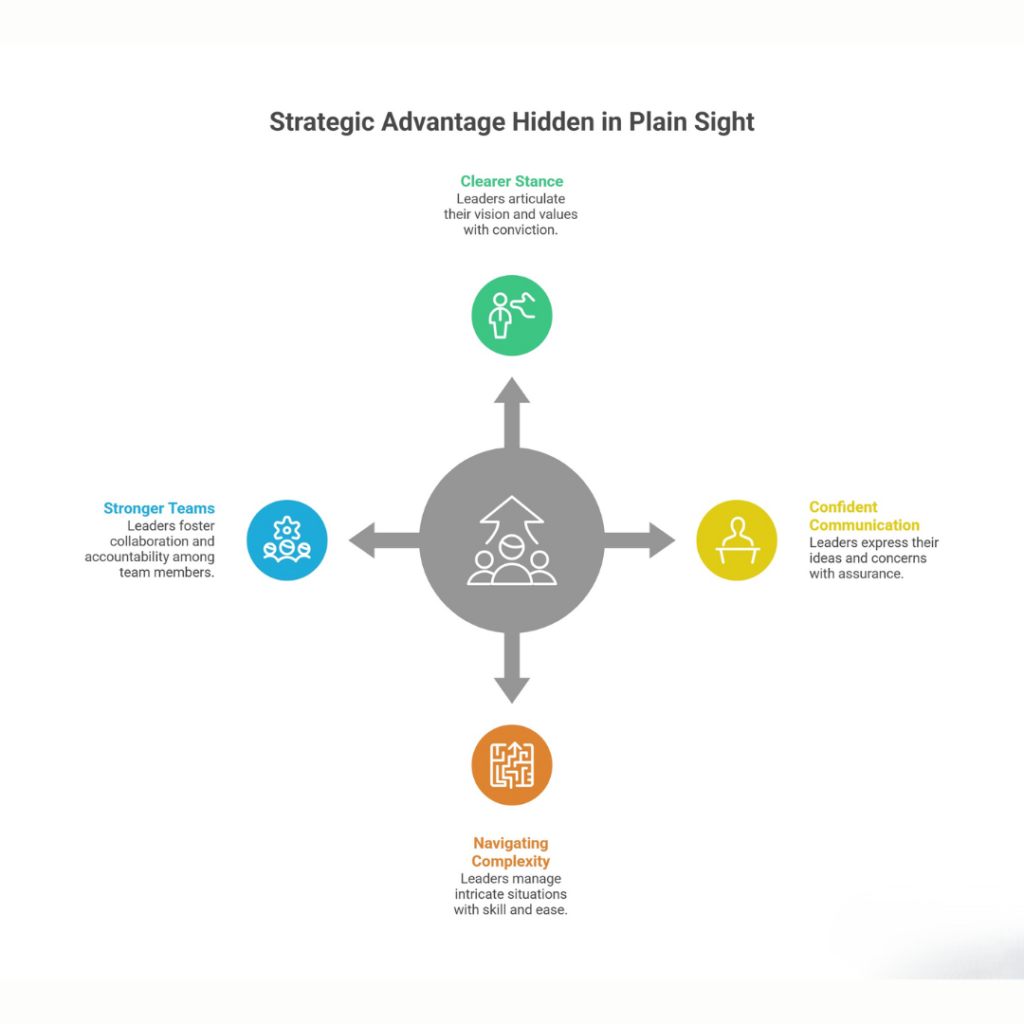
Organisations that invest in strengths-based psychology leadership often notice a subtle shift before they see measurable outcomes.
Middle managers:
- Become clearer in their leadership stance
- Communicate with more confidence.
- Navigate complexity with greater ease.
- Build stronger, more accountable teams.
The organisation benefits not through dramatic change, but through steady improvement in leadership quality.
Conclusion: Leadership That Grows From the Inside Out
Strengths psychology leadership isn’t about fixing leaders. It’s about equipping them with insight.
For middle-level leaders, this approach offers clarity, confidence, and consistency. It helps them lead in ways that feel natural while meeting the demands of complex roles.
For organisations, it builds leadership depth without rigidity. It creates cultures where leadership is expressed in multiple ways, all aligned with purpose and performance.
Because the most effective leadership doesn’t come from imitation.
It comes from understanding and using what already works.