


Let’s start with what students are actually struggling with
Ask a student in Class 9, 10, or even 11 a simple question: “What do you want to do?”
You’ll rarely get a clear answer. Not because they aren’t thinking about it. In fact, most of them are. Quite a lot.
They’ve heard about engineering, medicine, CA, design, business, and maybe even newer fields like data science or psychology. They’ve watched videos, spoken to friends, maybe even attended a seminar or two.
And still, there’s hesitation.
Part of it is obvious. There are too many options now. But that’s not the full story. The real issue is this: students are expected to make decisions without first understanding themselves well enough to do so. That gap creates confusion. And once confusion sets in, everything that follows becomes reactive.
So what is career planning for students, really?
Let’s keep this simple.
Career planning for students is not about picking a job title early in life. It’s not about deciding “doctor vs engineer” or “commerce vs science” in isolation.
It is a structured process of understanding the student first, and then making educational and career decisions based on that understanding.
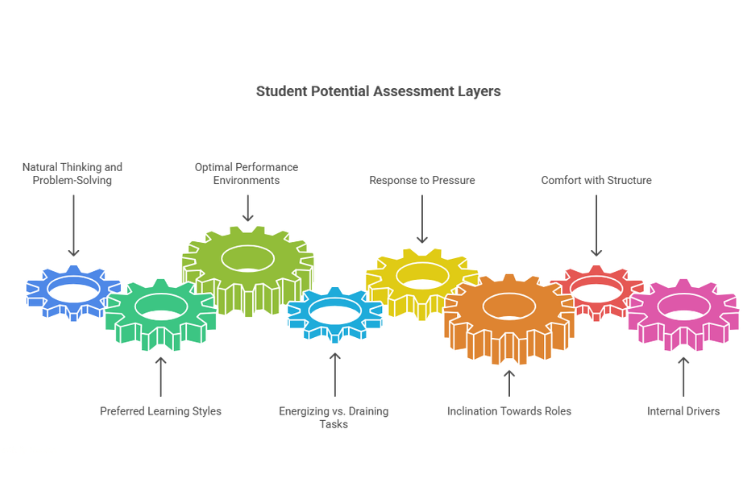
That includes several layers:
- How the student naturally thinks and solves problems
- Their preferred ways of learning and processing information
- The kind of environments in which they perform best
- The types of tasks that energise them versus those that drain them
- How they respond to pressure, deadlines, and expectations
- Their inclination towards people, ideas, execution, or systems
- Their comfort with structure versus ambiguity
- Their internal drivers, whether they are motivated by achievement, curiosity, stability, or impact
When you look at career planning this way, something shifts.
It stops being about “Which career is best?”
And becomes “Which direction fits this student best?”
That distinction matters more than most people realise.
Why most students get career planning wrong
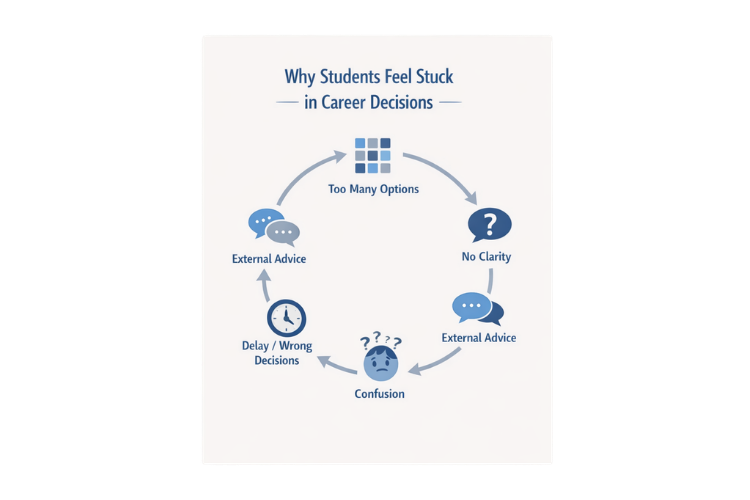
Now here’s where things get interesting. Most students are not making poor decisions because they lack ability or ambition. They’re making them because the process is structured around them.
Let’s look at the pattern.
The common approach (and why it quietly fails)
In most cases, career planning starts with external factors.
Students are guided by:
- Popular trends or emerging industries
- Perceived job security
- Social validation and comparison
- Advice from peers, relatives, or coaching institutes
- Cut-offs, entrance exams, and college rankings
- The belief that certain streams “keep more options open”
- Short-term academic performance rather than long-term fit
- Fear of missing out on “better” opportunities
- Pressure to make quick decisions without full clarity
At first glance, these don’t seem unreasonable. In fact, some of them are important.
But here’s the problem.
None of these starts with the student.
So decisions get made like this:
- Science has more scope, so I’ll take science.
- Everyone is preparing for this exam, so I should too.
- This college is good, so I’ll go for this course.
And then, somewhere down the line, doubts begin.
Do I actually enjoy this?
Is this the kind of work I want to do?
Why does this feel harder than it should?
This is not failure. It’s a misfit.
The marks myth (and why it confuses decisions)
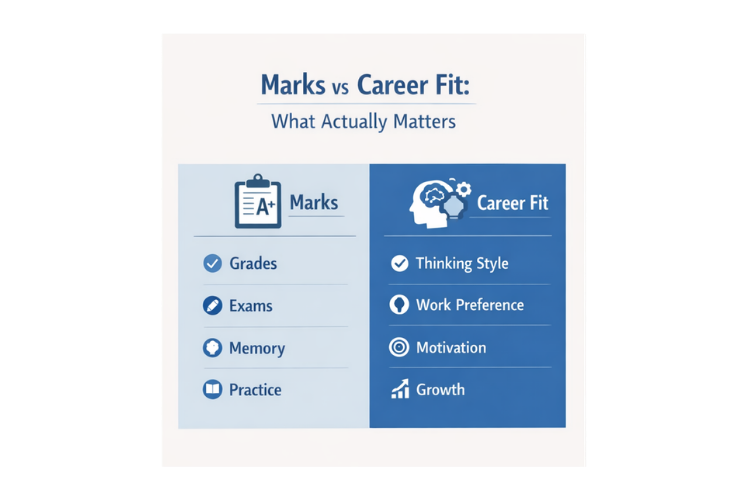
Another major reason students get career planning wrong is the over-reliance on marks.
Marks are important. They reflect discipline, effort, and academic performance. But they are often treated as if they can answer a question they were never meant to answer. Marks tell you how well a student performed in a subject. They do not tell you whether that subject, or the careers linked to it, are a natural fit.
Two students scoring similar marks in mathematics can have completely different relationships with the subject. One might enjoy solving problems deeply, even beyond the syllabus. Another might perform well through practice but feel mentally drained by it.
If both choose the same path purely based on marks, their long-term experience will likely differ. This is where career planning needs more depth.
A better way to think about career planning
If the common approach starts with options, a more effective approach starts somewhere else. It starts with the student. Not in a vague, “follow your passion” kind of way. But in a structured, observable way.
Every student has patterns. You can see them in how they approach tasks, how they interact with people, how they deal with challenges, and what kind of work holds their attention.
Some students naturally organise and execute.
Some analyse and question.
Some communicate and influence.
Some create and explore.
These patterns are not random. They show up consistently across situations. When career decisions are made without considering these patterns, even good options can feel misaligned. When decisions are based on them, clarity improves.
This is where a strengths-based approach to career planning becomes useful.
What a structured career planning process looks like
Instead of relying on scattered advice, a structured process brings clarity step by step.
At its core, effective career planning can be understood in four stages.
1. Self-awareness (the foundation most people skip)
This is where everything begins.
Understanding how a student naturally thinks, learns, and behaves creates a base for all future decisions.
This is not just about interests. Interests can change.
Patterns are more stable.
- Does the student enjoy structured tasks or open-ended ones?
- Do they prefer working independently or with people?
- Are they drawn to logic, creativity, organisation, or influence?
When these patterns are identified clearly, decision-making becomes more grounded.
2. Exposure (because awareness without context is incomplete)
Once there is some clarity about the student, the next step is to understand the world of careers properly.
Most students know only a limited set of options. And even those they know, they understand only at the surface level.
Real exposure means:
- Understanding what different roles actually involve
- Knowing the skills required, not just the degrees
- Seeing how careers evolve over time
For example, “business” is not one path. It includes finance, marketing, operations, entrepreneurship, consulting, and more.
Without exposure, choices remain narrow.
3. Fit (where clarity starts forming)
This is where things begin to come together.
The question here is simple: Where is the strongest overlap between the student’s patterns and real-world roles?
Not a perfect overlap. That rarely exists. But strong enough that the student can sustain effort, stay engaged, and grow over time.
This is also where misconceptions get corrected. A student who thinks they are “bad at a subject” may actually struggle with the way it is taught, not the subject itself.
4. Decision (without panic)
When the earlier stages are done properly, the decision itself becomes less stressful. It is no longer based on trends or pressure. It is based on understanding. Even if there are multiple good options, the reasoning behind each one is clear.
That clarity reduces second-guessing later.
Where most families get stuck
Interestingly, many parents and students already do parts of this process informally. They observe. They discuss. They explore options. But the process lacks structure.
Without structure:
- Conversations repeat without reaching conclusions
- Students keep changing preferences
- Parents feel unsure about guiding decisions
- Choices get delayed or rushed
What’s missing is not effort. It’s a clear framework.
The role of parents in career planning
Parents play a critical role here, whether they realise it or not.
Most parents want stability and long-term security for their child. That’s natural. But sometimes, this leads to early conclusions.
“This stream is better.”
“That field is risky.”
These views come from experience, but they may not always reflect the student’s natural fit.
A more effective approach is to shift from directing to guiding.
- Observe patterns over time
- Ask questions instead of giving immediate answers
- Encourage exploration without quick judgment
- Stay involved, but not controlling
When students feel understood, they engage more honestly in the process.
Why getting this right early matters
Career planning is not about locking a student into one path forever. But the early decisions do shape the journey.
Choosing the right stream after Class 10 affects subject exposure.
Choosing the right course after Class 12 affects skill development.
When these decisions are made thoughtfully, the student builds confidence. When they are made randomly, the student often ends up correcting the course later, sometimes at the cost of time and motivation.
Bringing it all together
So, what is career planning for students?
It is not a one-time decision.
It is not a list of career options.
And it is definitely not something that should be based only on marks or trends.
It is a process of understanding the student deeply, exploring the world meaningfully, and making decisions that connect the two. Most students get it wrong not because they lack potential, but because they start from the wrong place.
They start with options.
When they should be starting with themselves. And once that shift happens, even complex decisions begin to feel clearer, calmer, and far more intentional.
Frequently Asked Questions:
1) What is career planning for students?
Career planning for students is the process of understanding a student’s strengths, interests, and learning patterns, and using that insight to make informed decisions about subjects, courses, and future career paths.
2) Why is career planning important for students?
Career planning helps students make clear, confident decisions instead of choosing based on trends or pressure. It reduces confusion, avoids wrong career choices, and builds long-term direction and confidence.
3) When should students start career planning?
Students should ideally start career planning from Class 8 to 10. This is the stage where they begin making important decisions, such as stream selection, which affects future opportunities.
4) How do students choose the right career?
Students can choose the right career by:
- Understanding their strengths and thinking patterns
- Exploring different career options deeply
- Finding the best fit between themselves and their career
- Making decisions based on clarity, not pressure
5) Are marks enough to decide a career?
No, marks alone are not enough. Marks show academic performance, but they do not reflect a student’s strengths, interests, or long-term career fit. Career decisions should consider multiple factors.
6) What is the biggest mistake students make in career planning?
The biggest mistake is starting with career options instead of understanding themselves first. This often leads to confusion, wrong choices, and a lack of satisfaction later.