

Why this guide exists (and why most advice doesn’t help enough)
Career planning for students is often treated as a decision-making problem. Pick a stream. Choose a course. Select a college. Move forward.
But if you’ve ever actually sat with a Class 9, 10, 11, or 12 student while they’re trying to figure this out, you’ll notice something else entirely. The confusion is rarely about a lack of options. It’s about a lack of clarity.
Students today are exposed to more possibilities than any previous generation. Engineering is no longer just mechanical or civil. Business is no longer limited to a CA or MBA. Entirely new paths like product design, behavioural science, data analytics, and content ecosystems have opened up. On paper, this should make things easier.
In reality, it makes decision-making heavier.
Parents sense this, too. They see potential in their child, but translating that potential into a concrete direction feels uncertain. There is also a quiet pressure running in the background. Board exams, competitive exams, timelines, comparisons. None of it is explicitly overwhelming at first, but it builds.
And somewhere in this mix, career planning becomes reactive instead of thoughtful.
This guide is designed to change that.
Not by giving you a list of “best careers” or “top options,” but by helping you understand how career decisions actually work when they are made well. The goal here is not to simplify the decision artificially. It is to make it clearer, more structured, and more grounded in the student.
The real problem: Why do students feel confused even when they are capable
If you ask most students why they feel stuck about their future, their answers tend to sound similar.
“I’m good at multiple things, but I don’t know what to choose.”
“I don’t know what different careers actually involve.”
“I’m scared of choosing something and regretting it later.”
These are not signs of indecision. They are signs of incomplete information.
One of the biggest misconceptions in career planning is the belief that academic performance should naturally lead to career clarity. A student scoring high in science is expected to move towards engineering or medicine. A student doing well in accounts is expected to consider commerce pathways.
But performance is only one part of the equation.
Marks indicate how well a student has adapted to the current academic system. They do not necessarily reveal how a student thinks, what kind of work energises them, or what environments they thrive in. Two students with similar marks can have completely different working styles, preferences, and long-term satisfaction in the same field.
This is where confusion begins.
When decisions are made using incomplete indicators, the student may still move forward, but often with underlying doubt. This is why many students start questioning their choices midway through Class 11, during entrance preparation, or even in the first year of college.
The issue is not a lack of intelligence or effort. It is the absence of a structured way to understand oneself before choosing a direction.
What career planning actually means (beyond definitions)
Career planning is often explained in formal, almost textbook-like terms. It is described as a process of setting career goals and identifying steps to achieve them.
That definition is technically correct, but it misses something important.
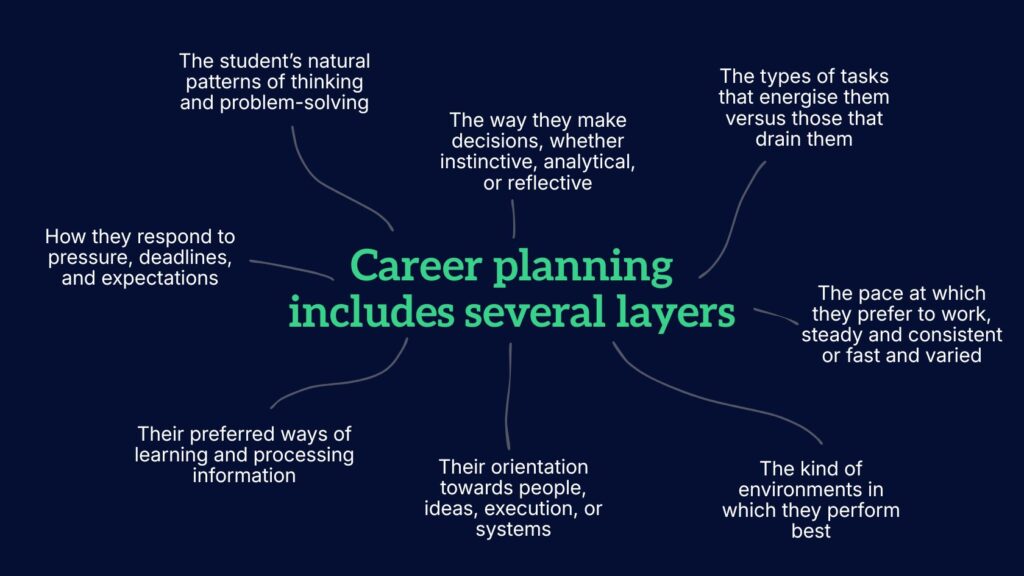
For a student, career planning is less about setting distant goals and more about answering a series of present questions with increasing clarity.
What kind of work suits me?
What kind of problems do I enjoy solving?
What environments help me perform well?
What subjects or activities hold my attention even when they are difficult?
When these questions are explored properly, career decisions begin to feel less like guesses and more like informed choices.
It is also important to understand that career planning is not a one-time event. It is a staged process. The decisions made in Class 10, Class 12, and college are connected, but they are not final in the absolute sense. What matters is whether each step is taken with clarity relative to that stage.
A well-planned path does not guarantee that everything will remain unchanged. What it does ensure is that each decision is made with awareness, reducing unnecessary detours and confusion.
The conventional approach (and where it falls short)
Most career decisions in India still follow a fairly predictable pattern.
The student reaches Class 10 and chooses a stream based on a mix of marks, perceived “scope,” and advice from family or peers. In many cases, science is seen as the safest option because it keeps more doors open. Commerce and humanities are often chosen either by preference or by elimination.
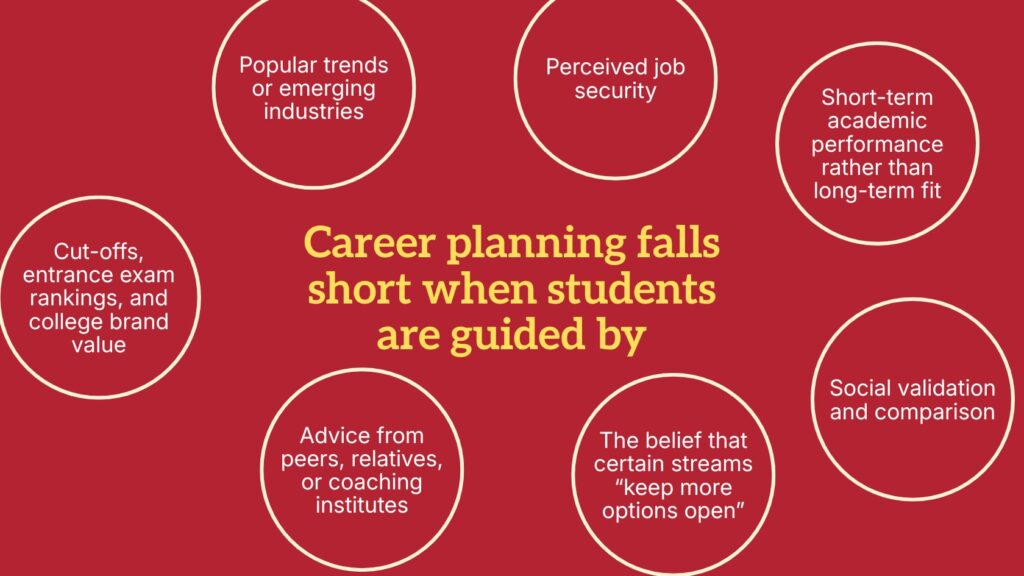
After Class 12, the decision shifts towards courses and colleges. At this stage, entrance exams, cut-offs, and rankings take centre stage. The focus becomes securing admission into a “good” institution, often with less attention given to whether the course itself is the right fit.
This approach works for some students, especially those who have a strong, early inclination towards a specific field. However, for a large number of students, it creates friction.
The friction shows up in different ways.
A student may feel disengaged from subjects despite performing adequately. Another may struggle with motivation during preparation phases. Some may complete their degree and still feel unsure about what kind of work they actually want to do.
The underlying issue is consistent. The process prioritises external factors first and internal understanding later, if at all.
A more grounded approach: Starting with the student (and staying there)
A more reliable way to approach career planning is to reverse the order most people follow.
Instead of beginning with options, begin with the student.
That sounds simple, but it changes everything. Because when you start with options, you’re already narrowing possibilities without understanding for whom the decision is being made. When you start with the student, the options don’t shrink; they become clearer.
This does not mean ignoring practical realities like job markets, income potential, or future demand. Those factors matter. But they should come after there is clarity about the individual who will eventually step into that career.
Every student carries a set of natural patterns. You can see them if you observe closely.
Some students instinctively organise, plan, and bring structure. Others question, analyse, and break things down. Some are drawn to people, conversations, and influence. Others prefer working quietly with ideas, systems, or creative output.
These are not surface-level preferences. They are recurring ways of thinking and responding. And over time, they shape how a student learns, performs, and grows.
When career decisions ignore these patterns, even “good” choices can feel heavy. When decisions respect them, even challenging paths feel manageable.
This is the foundation of a strengths-based approach to career planning.
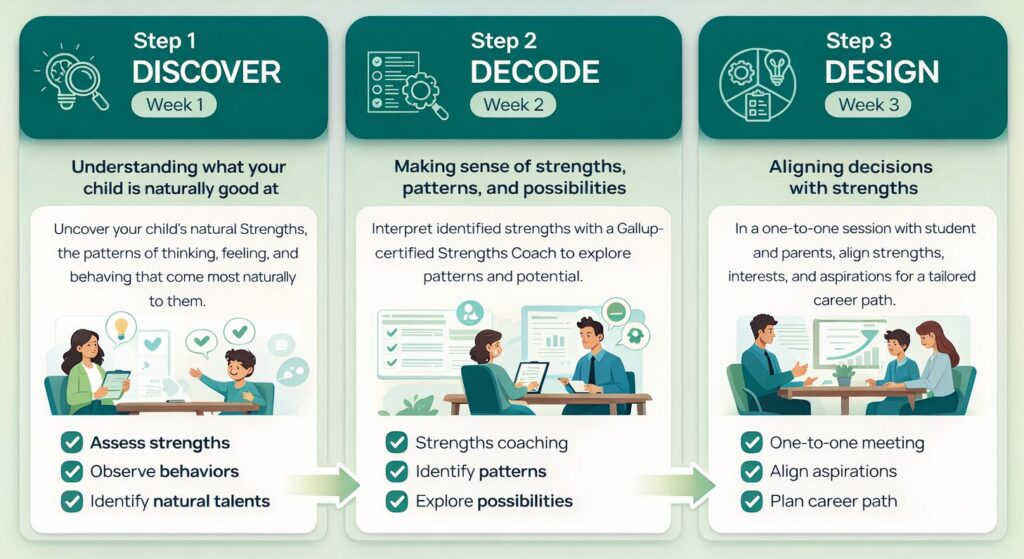
At Strengths Masters, this approach is not left as a broad idea. It is built into a structured three-step process: Discover, Decode, and Design. Each stage plays a specific role in moving from confusion to clarity.
Discover: Understanding what comes naturally
The first step focuses on uncovering how the student is naturally wired.
This is done through a combination of structured assessments and guided reflection. One of the core tools used here is the CliftonStrengths framework, developed from decades of research in strengths psychology, created by the father of strengths psychology, Don Clifton, and used by over 30 million people worldwide, top leading universities and 90% Fortune 500 companies. It helps identify patterns in how a student thinks, makes decisions, and approaches challenges.
Alongside this, aptitude-based evaluations are used to understand academic inclinations and potential fit areas. Not in a limiting way, but as directional indicators. For example, whether a student is more inclined towards analytical reasoning, abstract thinking, verbal expression, or applied problem-solving.
What emerges from this stage is not just a list of strengths, but a clearer picture of how the student operates across situations.
Parents often find this stage surprisingly revealing. Things they had observed over the years suddenly make sense in a structured way. Students, on the other hand, begin to see themselves with more clarity and language.
Decode: Making sense of strengths in the real world
Identifying patterns is useful, but by itself, it is not enough.
The second step focuses on interpretation.
In this stage, the student’s profile is analysed by a certified strengths psychologist, trained to understand how these patterns translate into real-world behaviour, learning styles, and career tendencies.
This is where depth comes in.
For instance, two students may both show strong analytical ability. But one may prefer structured environments with clear systems, while the other thrives in exploratory, research-driven settings. On the surface, both might consider similar fields, but their long-term fit could differ significantly.
The decoding process looks at combinations of strengths, not isolated traits. It examines how different patterns interact and what that means for:
- Academic choices
- Career directions
- Work environments
- Decision-making styles
This stage bridges the gap between “who the student is” and “what that could mean in the real world.”
Design: Bringing clarity into decisions
The final step brings everything together.
In a guided one-to-one session involving both the student and parents, insights from the earlier stages are translated into a clear direction.
This is where practical considerations are reintroduced, but now with context.
Possible streams, courses, and career paths are discussed not as generic options, but as aligned choices based on the student’s strengths, interests, and academic realities.
There is also space here for conversation. Parents can share concerns or expectations. Students can express preferences or hesitation. The goal is not to force agreement, but to arrive at clarity that both sides understand and feel confident about.
What emerges is not just a decision, but a reasoned direction. One that the student can move forward with, without constant second-guessing.
The difference in this approach is subtle, but important.
Instead of trying to fit the student into a predefined path, the path is shaped around the student, while still respecting real-world constraints.
And that tends to make decisions feel not just clearer, but also more stable over time.
The four-layer framework of effective career planning
If we step back and simplify the entire process, effective career planning can be understood through four interconnected layers. Each layer builds on the previous one, and skipping any of them usually leads to confusion later.
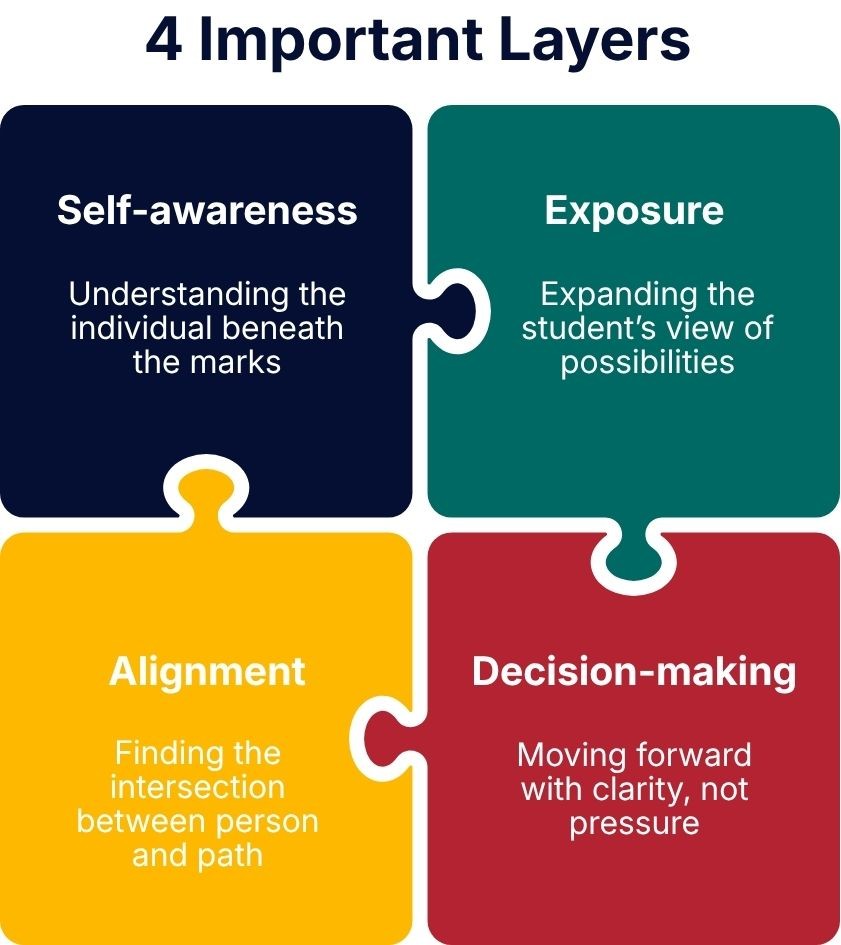
1. Self-awareness: Understanding the individual beneath the marks
This is the foundation, yet it is often the most overlooked.
Self-awareness goes beyond identifying interests. Interests can change. They are influenced by exposure, environment, and even peer groups. What is more stable are patterns.
How does the student approach a new problem?
Do they prefer depth or variety?
Are they naturally inclined towards leadership, analysis, creativity, or execution?
These are not questions that can be answered in a single conversation. They require observation, reflection, and often structured guidance.
When this layer is strong, it becomes much easier to evaluate options realistically.
2. Exposure: Expanding the student’s view of possibilities
Once there is some clarity about the student, the next step is to understand the world of opportunities in a meaningful way.
Exposure is not about listing careers. It is about understanding them.
What does a typical day in that role look like?
What kind of thinking does it require?
What skills are essential, beyond academic knowledge?
For example, a student interested in “business” may not realise the difference between roles in finance, marketing, operations, or entrepreneurship. Each of these requires a different combination of skills and preferences.
Without this level of clarity, choices remain superficial.
3. Alignment: Finding the intersection between person and path
This is where career planning starts becoming more precise.
Alignment involves evaluating how well a particular path fits the student’s natural patterns, interests, and capabilities, while also considering external realities such as academic requirements and career trajectories.
Perfect matches are rare. The goal is not perfection but strong compatibility.
A well-aligned path allows the student to sustain effort over time. It reduces friction, improves engagement, and increases the likelihood of long-term satisfaction.
4. Decision-making: Moving forward with clarity, not pressure
By the time a student reaches this stage, the decision itself becomes less overwhelming.
Instead of choosing from a place of confusion or urgency, the student is choosing from a place of understanding. Even if there are multiple viable options, the reasoning behind each option is clear.
This does not eliminate uncertainty completely. No career decision can do that. But it replaces blind guessing with informed judgment.
Moving from understanding to action (where most families get stuck)
Up to this point, the process might seem conceptually clear. Start with the student, build self-awareness, explore options, and then make decisions that fit.
But this is usually where a practical question comes up.
How does this actually play out in real life, especially when there are school timelines, exams, and constant academic pressure running in parallel?
Because clarity is one thing, applying it consistently is another.
In most families, the intention to guide the child thoughtfully is already there. What is often missing is structure. Without structure, even well-meaning conversations become repetitive or inconclusive. The same questions come up again and again, without leading to clear answers.
This is where tools, guided processes, and structured conversations begin to matter.
Not as shortcuts or quick fixes, but as ways to make thinking more concrete.
For instance, a well-designed assessment can surface patterns that are otherwise hard to articulate. A guided discussion can help connect those patterns to real decisions. Exposure to actual career pathways can replace assumptions with clarity.
Individually, each of these helps a little. When combined in a structured way, they create momentum.
And that momentum is important. Because career planning is not solved in a single conversation. It builds over a series of small, connected steps.
The next sections will take this further into specifics. We will look at the tools and methods that genuinely help, how parents can participate without adding pressure, and how career planning shifts across key stages like Class 10, Class 12, and college.
From there, the focus will move towards bringing all of this together into a direction that is not just clear on paper, but workable in real life.
Tools and methods that actually build clarity (not just more information)
Once the foundation is clear, the next step is execution. And this is where many families unintentionally drift back into confusion. Not because they lack effort, but because they rely on scattered inputs rather than a structured process.

Career planning becomes much more effective when the right tools are used in the right sequence.
1. Structured assessments (when used properly)
There’s a lot of noise around assessments today. Students take random online quizzes and end up with generic labels that sound interesting for a moment but don’t really help with decisions.
But when assessments are grounded in research and interpreted properly, they can become one of the most useful starting points in career planning.
A strengths assessment, for example, doesn’t just tell a student what they are “good at.” It identifies recurring patterns in how they think, how they make decisions, what kind of environments they prefer, and how they respond to challenges. These are not temporary traits. They tend to stay relatively stable over time and show up across different situations.
One of the most practical ways this becomes useful is through identifying a student’s Top 5 strengths, by a framework created by the father of strengths psychology, Don Clifton, and used by over 30 million people worldwide, top leading universities and 90% Fortune 500 companies.
Instead of giving a long, overwhelming list, narrowing it down to the top five helps focus attention on the patterns that are most dominant. These are the strengths that are most likely to influence how the student studies, works, and makes decisions.
To make this more concrete, let’s look at a few examples.
A student with a strong Analytical strength tends to question information, break things down, and look for logic before accepting something. This student may do well in fields that require structured thinking, problem-solving, or working with data. But more importantly, they may struggle in environments where decisions are made without clarity or reasoning.
Another student with a strong Communication strength often thinks through expression. They may enjoy explaining ideas, storytelling, or engaging with people. This does not automatically mean they should pursue media or public speaking, but it does indicate that roles involving interaction, persuasion, or articulation may feel more natural to them.
Then there are students with strengths like Responsibility or Achiever, who tend to follow through, take ownership, and feel internally driven to complete tasks. These students often perform well in structured environments, but they may also put pressure on themselves if expectations are not managed properly.
Individually, each strength tells part of the story. But the real insight comes from how these strengths combine.
A student with Analytical and Communication, for instance, will approach the world very differently from a student with Responsibility and Empathy. Their ideal environments, career paths, and even decision-making styles will differ.
This is why simply knowing strengths is not enough. The interpretation matters.
Alongside strengths, aptitude assessments add another layer. They help identify areas where the student is likely to perform well academically, whether that leans towards numbers, language, abstract reasoning, or applied thinking.
The goal is not to box the student into a category. It is to build a clearer, more complete picture.
Because once you understand how a student naturally operates and where their academic inclinations lie, career planning stops being guesswork. It becomes a process of connecting patterns to possibilities in a much more deliberate way.
Similarly, aptitude assessments help identify areas where a student is likely to perform well academically. Not as rigid boundaries, but as signals. For instance, whether a student is more inclined towards quantitative reasoning, language-based thinking, or applied problem-solving.
The key is not the assessment itself, but how it is interpreted and connected to real decisions.
2. Reflection (simple, but often skipped)
You would think students naturally reflect on themselves. Most don’t, at least not in a structured way.
They experience things, they have preferences, but they rarely pause to connect those experiences into patterns.
A few well-placed questions can change that.
What kind of work feels satisfying even when it is difficult?
When do you feel most engaged while studying or working on something?
What kind of feedback do you usually receive from teachers or peers?
What kind of tasks do you tend to avoid, even if you can do them?
These questions are not meant to be answered quickly. In fact, the value comes from thinking about them over time.
When students start noticing their own patterns, decision-making becomes more grounded.
3. Real exposure (beyond surface-level awareness)
Exposure is often misunderstood as “knowing about careers.”
But knowing that a career exists is very different from understanding what it actually involves.
Real exposure means going one layer deeper.
Understanding what a typical day looks like in that role.
Knowing what skills are actually used, not just what is studied.
Seeing how people grow in that field over time.
For example, a student might say they are interested in psychology. But psychology as a field includes clinical practice, research, organisational behaviour, user experience, and more. Each of these paths requires a different working style.
Without this clarity, choices remain broad and sometimes misleading.
4. Conversations that move things forward
This is where many families struggle, even when intentions are right.
Parents want to guide. Students want to be understood. But conversations often turn into advice sessions or debates.
What actually helps is a shift in how these conversations happen.
Instead of starting with conclusions, start with curiosity.
“What did you enjoy about this subject?”
“What part of this activity felt interesting to you?”
“What do you think made this difficult?”
When students feel heard, they open up more. When parents understand the reasoning behind a student’s thinking, their guidance becomes more relevant.
Over time, these conversations build shared clarity rather than conflict.
The role of parents (support without pressure)

This part deserves attention because parental involvement can either strengthen the process or unintentionally complicate it.
Most parents are trying to do the right thing. They are thinking about stability, long-term security, and opportunities their child might have.
But sometimes, the pressure to “get it right” leads to early conclusions.
The child should take science.
This field has more scope.
That career is too uncertain.
These thoughts come from a place of concern, but they can limit exploration before understanding is complete.
A more effective role for parents is not to decide early, but to guide thoughtfully.
This includes:
- Observing patterns over time rather than reacting to short-term performance
- Encouraging exploration without immediately judging it
- Asking questions that help the child think, instead of telling them what to think
- Balancing realism with openness
There is also another layer here.
Students often hesitate to express what they are truly thinking if they feel it may not be accepted. This creates a gap between what the student feels and what the parent assumes.
Closing this gap does not require perfect agreement. It requires clarity and trust.
When both sides understand the reasoning behind a decision, even if there are concerns, the process becomes more collaborative.
Career planning at different stages (because timing changes the questions)
Career planning is not the same at every stage. The questions evolve, and so should the approach.
After Class 10: The first real fork
This is usually the first structured decision a student makes.
Science, Commerce, or Humanities.
But the real question is not which stream has more “scope.” It is the stream that creates the right learning environment for the student over the next two years.
Classes 11 and 12 are academically demanding. If the subject combination does not fit the student’s natural way of thinking, it creates constant friction.
At this stage, the focus should be on:
- Understanding subject preferences beyond marks
- Evaluating how the student approaches different types of problems
- Keeping future flexibility in mind, but not at the cost of present fit
A well-chosen stream does not lock the future. It creates a stronger foundation for the next step.
After Class 12: Direction begins to take shape
This is where decisions start feeling heavier.
Courses, colleges, entrance exams, timelines.
By this stage, students often feel the need to finalise something concrete. But it is important to approach this phase with perspective.
Choosing a course is not the same as choosing a lifetime career.
Many fields today allow movement across roles. A student studying economics may move into consulting, analytics, finance, or policy. A student in engineering may transition into management, design, or entrepreneurship.
What matters here is direction, not rigidity.
The focus should be on:
- Understanding what each course actually leads to
- Evaluating fit based on strengths and working style
- Considering long-term flexibility
During college: Where clarity is either built or delayed
College is often seen as a continuation of academics. But in reality, it is a transition phase into the professional world.
Students who actively engage during this phase tend to gain much more clarity than those who simply complete their degree.
This includes:
- Internships to understand real work environments
- Projects that build practical skills
- Exposure to different roles within a field
- Conversations with people already working in those areas
It is also the stage where students begin to see how their strengths play out in real situations.
Some discover that they enjoy execution more than theory. Others realise they prefer working with people over working with systems, or vice versa.
These insights are valuable. They refine direction.
Bringing it all together (from confusion to clarity)
If you step back and look at the entire process, career planning becomes less about a single decision and more about a sequence.
Understanding the student.
Exploring possibilities.
Finding the right fit.
Making informed choices.
Each step builds on the previous one.
When this sequence is followed, decisions tend to feel calmer. There is less second-guessing, fewer abrupt changes, and more confidence in the path being taken.
And importantly, the student feels involved in the process, not carried through it.
What you can do next (without overcomplicating it)
If you are a parent reading this, you already care enough to go beyond surface-level advice. That matters.
If you are a student, and you see parts of your own confusion reflected here, that is a good starting point.
The next step is not to rush into decisions, but to build clarity in a structured way.
A strengths-based approach helps do exactly that.
At Strengths Masters, the Discover–Decode–Design process brings together everything discussed in this guide into a clear, guided journey:
- Understanding how the student naturally thinks and learns
- Interpreting those patterns with the help of a certified strengths psychologist
- Designing a practical career direction that fits both the student and the real-world pathways
It is not about telling a student what to do. It is about helping them understand why a particular direction makes sense for them.
Because when that clarity is in place, decisions stop feeling like risks and start feeling like steps.
Frequently Asked Questions:
1) What is career planning for students?
Career planning for students is a structured process of understanding a student’s strengths, interests, thinking patterns, and academic inclinations, and using that insight to make informed decisions about streams, courses, and future career paths.
2) Why do students feel confused about career choices?
Students feel confused mainly because they have too many options but lack clarity about themselves. Without understanding their strengths and preferences, decisions become overwhelming and uncertain.
3) Is choosing a career after 10th grade too early?
No, but it should not be treated as a final decision. Choosing a stream after Class 10 is about selecting the right direction based on the student’s natural fit, not locking them into a lifelong career.
4) How can students identify the right career path?
Students can identify the right career path by:
- Understanding their natural strengths and thinking style
- Exploring real career options in depth
- Matching their profile with suitable fields
- Making decisions based on clarity, not trends
5) What is the role of strengths in career planning?
Strengths play a key role because they reflect how a student naturally thinks, learns, and performs. When career choices are aligned with strengths, students tend to perform better and stay more engaged long term.
6) Are aptitude tests useful for career planning?
Yes, aptitude tests can be helpful when used correctly. They provide direction about areas where a student is likely to perform well academically, but they should be combined with strengths and interests for better decisions.
7) What is the biggest mistake parents make in career planning?
The most common mistake is focusing only on external factors like job security, trends, or marks, without fully understanding the child’s natural abilities and preferences.
8) How can parents support their child in career planning?
Parents can support by:
- Observing their child’s patterns over time
- Encouraging open conversations
- Avoiding early judgment or pressure
- Helping them explore options before deciding
9) Can a student change their career path later?
Yes, career paths today are flexible. However, starting in the right direction reduces confusion, saves time, and helps build confidence early in the journey.
10) What is the ideal age to start career planning?
The ideal time to start is between Classes 8 and 10. This allows enough time for self-awareness, exploration, and making informed decisions before major academic choices.