
Grooming high-potential employees isn’t a checklist you tick off once. It’s a mindset shift built on culture, clarity, and commitment. If an organisation truly wants to groom a high-potential employee, the first thing to realise is this: talent doesn’t emerge by accident. It shows up where the environment genuinely supports growth, where policies are fair, systems are friendly, and leaders care about people beyond numbers.
You know what? I’ve seen well-intentioned companies identify potential, then stall because they didn’t build the soil before they planted the seeds. Let’s fix that.
What Does It Mean to Groom a High-Potential Employee?
Before we go deeper, let’s anchor a clear meaning. Grooming a high-potential employee means helping someone with the capability, drive, and adaptability to take on bigger, more complex roles in the future. It’s not about rushing them through promotions like a conveyor belt. It’s about shaping skill, confidence, insight, and resilience, the internal qualities that make someone ready for leadership, not just another title.
You might wonder: Isn’t that just employee development? Not quite. Grooming high-potential talent development is intentional, strategic, and personalised. It isn’t the same as general training. It’s tailored for individuals who could shape the organisation’s future.
Now, you might be thinking: Well, if we know it’s important, why don’t more companies do it well? The answer often lies in how organisations think about performance versus potential, and we’ll get into that next.
Performance vs Potential
Let me explain this clearly: performance is about how someone is delivering now. It’s measurable, familiar, and often tied to rewards and promotions. But potential is about what someone could do in the future, with growth, stretch, and a bit of support.
Here’s a simple way to look at it:
- If performance answers “How well are you doing today?”
- Potential asks, “Who are you becoming tomorrow?”
It’s a shift from certainty to possibility. And here’s why it matters: traditional performance systems reward consistency within a role. That’s fine until you need leaders who can think differently, navigate ambiguity, and help teams adapt in a world where people are rethinking work, meaning, and balance.
Especially now, when burnout and the “great detachment” are realities, leaders must know: someone who consistently meets targets but collapses under pressure may not be a good fit for high-impact roles later.
Characteristics of High-Potential Employees
Grooming begins with knowing what talent looks like in motion. High-potential employees often display a cluster of behaviours and attitudes that go beyond task execution. They demonstrate:
1. Consistent Performance Across Contexts
They do well not just in familiar conditions, but also when priorities shift or stress increases.
2. Curiosity and Learning Agility
Instead of just repeating what worked before, they ask better questions, absorb feedback, and adapt.
3. Emotional Intelligence
They sense others’ perspectives, build meaningful connections, and lead without demanding attention.
4. Ownership and Accountability
They treat outcomes as their responsibility, not someone else’s problem to fix later.
5. Resilience Under Pressure
Work isn’t a sprint; it’s a marathon with hurdles. That doesn’t mean always staying late, but staying engaged.
6. Collaboration that Multiplies Impact
They lift others, bridge teams, and help ideas find traction.
You could say performance shows what someone does. Potential shows who someone becomes, and that’s why distinguishing the two is vital.
How to Identify High-Potential Employees
Before grooming, you must first identify. Most organisations already have performance review systems, but let’s be honest, many of those reviews are dusty by the time bonuses are decided. Here’s how to make the process more insightful:
Performance Review Retrospective
Look beyond the current cycle. Review the last 3 to 4 years of performance using your own defined criteria.
- Who has delivered consistently?
- Who has shown growth across roles or changing goals?
- Who maintained quality even when the road got rocky?
This isn’t about perfect scores. It’s about patterns of progress, not one brilliant year followed by silence.
Criteria for Observable Attributes
Certain valuable traits like integrity, ownership, courage, or adaptive thinking can’t be captured neatly in columns. Yet they matter.
The problem? Managers often define them differently. One manager’s “takes initiative” might be another’s “breaks the rules.”
Create shared criteria. Define clearly what ownership looks like, what strategic thinking sounds like, and what collaboration feels like. When everyone uses a common language, potential becomes easier to spot and harder to overlook.
The Quad Assessment System
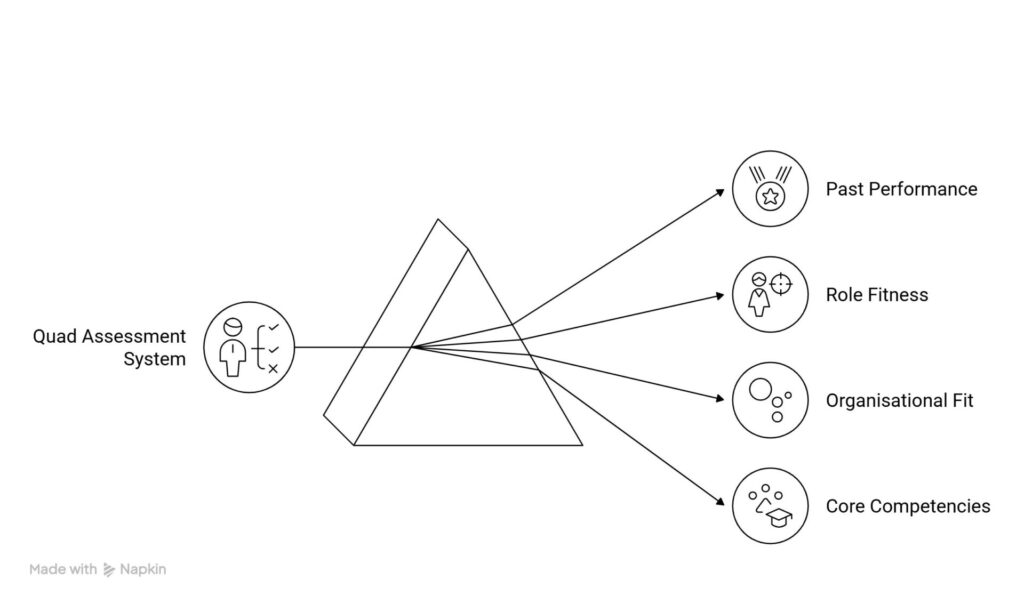
A practical way to assess high-potential employees is through a broad framework that considers:
- Past Performance
- Role Fitness
- Organisational Fit
- Core Competencies
Assign criteria and weightage under each category. Discuss candidates in leadership forums, not in isolation. That way, quantification doesn’t override context.
Engagement and Initiative Mapping
Sometimes, high-potential talent hides in plain sight, especially in larger organisations. Look at:
- Who volunteers for cross-functional initiatives?
- Who proposes new ideas without waiting for permission?
- Who stays curious even in repetitive or stressful phases?
This involvement indicator is powerful, especially when combined with direct observation and manager insights.
Tools to Identify High-Potential Employees
You can’t groom what you can’t recognise. Beyond reviews, here are methods that help identify high-potential talent (without mentioning competitors by name):
Behavioural Interview Techniques
Use structured questions to explore how employees respond to challenges, conflict, and uncertainty.
Work Simulations
Real-life scenario exercises where individuals solve business problems. It reveals thinking patterns, collaboration style, and decision agility.
Manager Observation Journals
Encourage managers to document examples of leadership behaviour throughout the year, not just at appraisal season.
Peer & Supervisor Feedback Programs
360° feedback helps uncover leadership qualities that formal reviews might miss.
Engagement Analytics
Pulse surveys, initiative participation, and project ownership metrics show who remains committed even when challenges mount, all without forcing long hours or burnout.
When combined, these methods give a textured picture of not just how someone works but how they think, adapt, and lead.
How to Groom High-Potential Employees
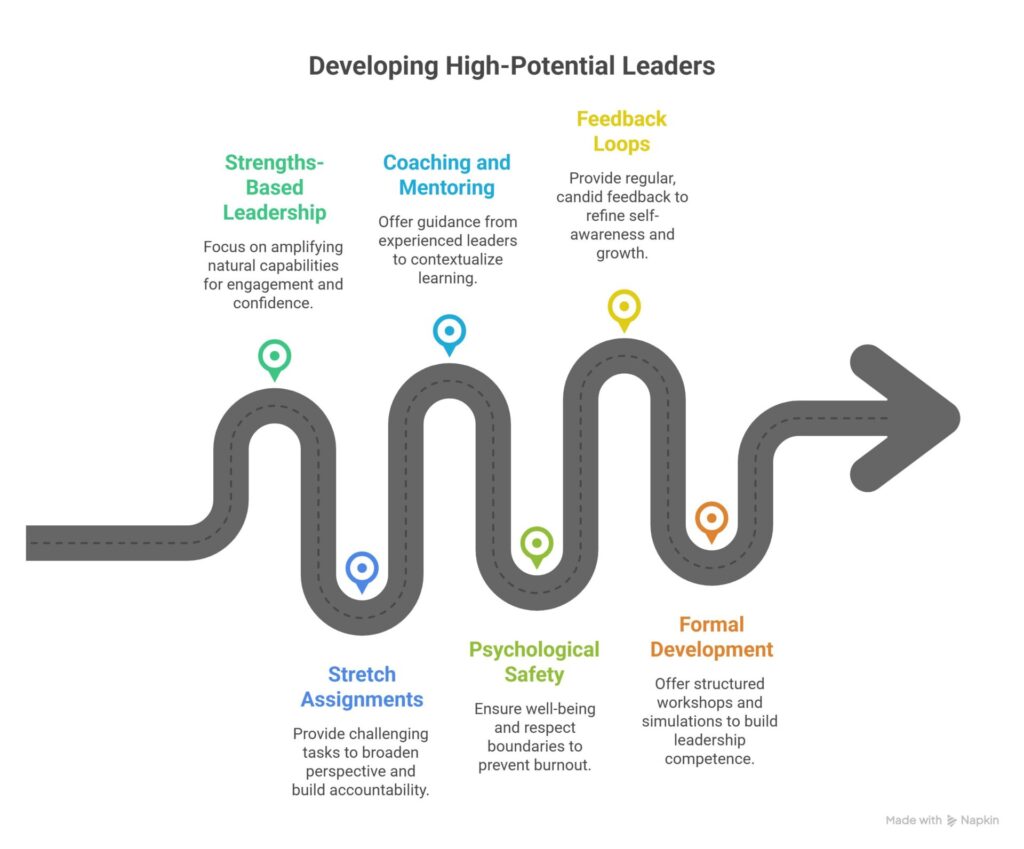
Now we’re getting to the heart of the matter. Once you’ve identified high-potential talent, the next step is to help them become capable, confident leaders. Here’s how.
1. Strengths-Based Leadership for High-Potential Employees
Everyone has innate strengths, ways of thinking and working that energise them. When leaders help employees lean into those strengths, growth becomes less about fixing weaknesses and more about amplifying natural capabilities.
Strengths-Based Leadership Program for High-Potential Employees. This approach benefits employees by helping them work in ways that feel natural, energizing, and fulfilling. When people spend more time using their strengths, they experience higher engagement, reduced burnout, and stronger confidence in their abilities.
For high-potential talent, this approach creates momentum. They’re not just performing tasks; they’re performing in ways that feel authentic and sustainable.
You know what’s interesting? Two people might be equally capable on paper, but one who’s placed in strength-aligned work grows faster, with less friction and far less risk of burnout.
2. Stretch Assignments
People learn most when they are slightly outside their comfort zones. Assign meaningful challenges, not busywork:
- Leading a cross-functional task force
- Owning a strategic pilot project
- Managing change communication
- Representing the team in senior leadership forums
These opportunities broaden perspective, increase accountability, and build confidence.
But don’t just toss those challenges. Pair these assignments with feedback and coaching.
3. Coaching and Mentoring
High-potential employees benefit immensely from mentors who are a bit further along the leadership journey. The goal isn’t to shadow or imitate, but to see how seasoned leaders think, decide, and respond under pressure.
Structured mentoring accelerates development because it contextualises learning. It’s not theoretical; it’s real work, real insights.
4. Psychological Safety and Well-Being
Want to know the irony? Some organisations groom talent while ignoring the early warning signs of burnout. That’s like building a roof while ignoring a shaky foundation.
High-potential employees are often high-energy. If they’re constantly pushed without balance, they exhaust. Which is exactly what the younger workforce refuses to tolerate, leading to disengagement or the “great detachment.”
So make well-being part of development. Respect boundaries. Encourage recovery. Measure impact by energy, not hours. When we talk about how to develop high-potential talent, this isn’t optional; it’s fundamental.
5. Feedback Loops
Regular, candid feedback accelerates growth. Not annual comments, but ongoing conversations grounded in behaviour and impact:
- “Here’s what I saw.”
- “Here’s what worked.”
- “Here’s what I’d like to see next.”
This helps high-potential employees refine their self-awareness and chart a conscious growth path.
6. Formal Leadership Development Experiences
Offer structured leadership workshops, business simulation labs, and peer learning circles. These help potential leaders form a mental model of what leadership feels like before they step into bigger roles.
The combination of practical experience and reflective learning builds deep competence, not just confidence.
Grooming in the Workplace (Real Examples)
Let’s make it concrete. Consider these examples of effective employee grooming:
- A high-potential team member leads a cross-region initiative, gets real feedback, and iterates on strategy weekly with senior sponsors.
- A promising engineer is rotated through customer success, product design, and operations, deepening business context.
- An aspiring manager participates in leadership labs where they practise real scenarios with peers and coaches.
In each case, growth isn’t accidental. It’s structured, supported, and meaningful.
Conclusion
Grooming high-potential employees is both an art and a science. It’s not a one-off training program. It’s a blend of thoughtful identification, intentional stretch, strengths-based leadership, consistent feedback, and a culture that values both performance and well-being.
In a landscape where work isn’t just about output but about sustainable impact, strengthening your future leadership pipeline means doing more than ticking boxes. It means designing experiences that help people grow without wearing them down.
Remember, developing high-potential employees isn’t about shaping clones of existing leaders. It’s about creating a diverse bench of confident, curious, resilient thinkers who can navigate change with grace.
If you nurture them with authenticity and purpose, they’ll do more than just carry the torch, and they’ll light new ones.