
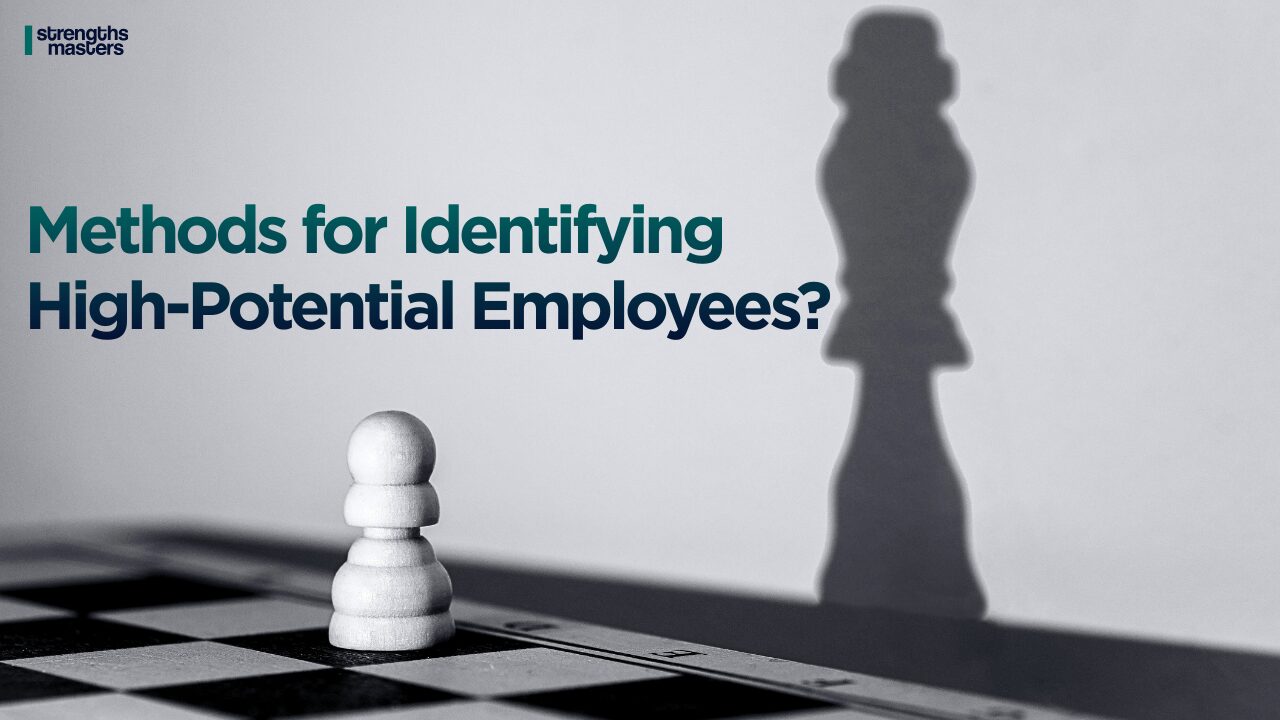
In every organisation, a few employees stand out not just for what they do, but for how they think, learn, and adapt. These are the people who often become the next generation of leaders. Yet, identifying such high-potential employees (Hi-Pos) is far from straightforward.
As workplaces evolve toward sustainability, balance, and well-being, the definition of “potential” has shifted. It’s no longer about who works the longest hours, but about who can drive results without burning themselves or their teams.
What Are High-Potential Employees?
High-potential employees are those who demonstrate the ability, aspiration, and commitment to take on more complex, larger roles in the future. They’re not just consistent performers, they have the capacity to grow faster, think broader, and influence deeper.
Unlike traditional “top performers,” high-potential employees show a mix of drive, emotional intelligence, adaptability, and resilience. They learn quickly from experience, seek feedback, and often bring fresh ideas to existing challenges.
In essence, potential reflects not only what someone is capable of doing today but also what they can do tomorrow, if given the right environment, coaching, and opportunities.
But before organisations can identify high-potential talent, they need to ask: Do we have the right culture for potential to thrive?
A high-pressure, hustle-driven environment may yield short-term performance but often hides or burns out real potential. For high-potential talent to emerge, organisations must foster psychological safety, autonomy, and a sense of shared growth.
Potential vs. Performance
Performance is about the present, potential is about the future. The two are related but not identical.
A top performer might consistently deliver results within a defined role but may not necessarily have the appetite or flexibility for leadership. Conversely, someone with moderate performance today might be a high-potential employee if they possess learning agility, emotional maturity, and a strong sense of purpose.
In short:
- Performance answers the question: “Who is delivering now?”
- Potential answers the question: “Who will lead us next?”
Many organisations confuse the two and end up promoting strong performers who struggle in leadership roles. Sustainable performance workplace, especially in India’s evolving talent landscape, is learning to differentiate between the two through better systems of evaluation, observation, and coaching.
Characteristics of High-Potential Employees
While every organisation has its own leadership DNA, high-potential employees often share a few common characteristics:
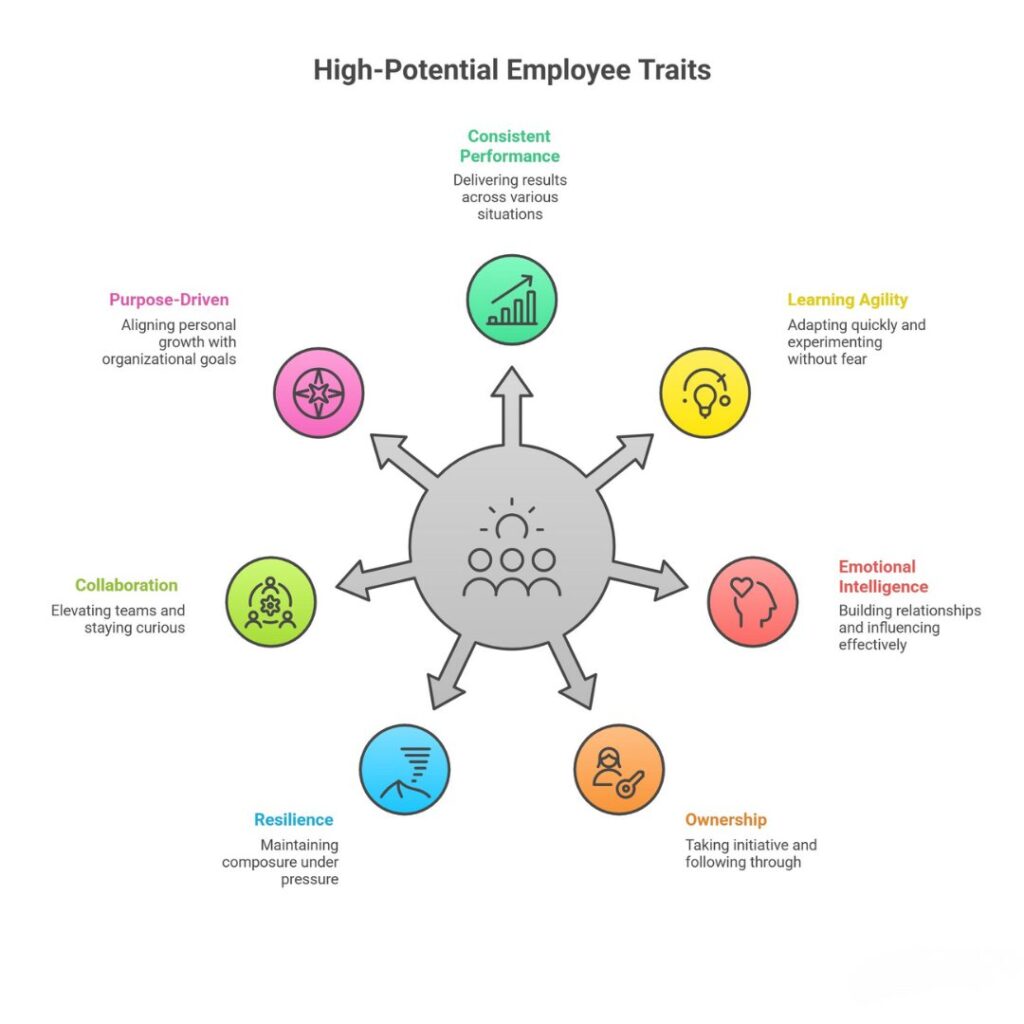
- Consistent and broad performance: They deliver results repeatedly across diverse situations, not just within their comfort zone.
- Learning agility: They absorb new information quickly, adapt to change, and experiment with different approaches without fear of failure.
- Emotional intelligence: They build strong relationships, manage conflict constructively, and influence without authority.
- Ownership and accountability: They think and act like business owners, showing initiative and follow-through.
- Resilience: They maintain composure and focus under pressure, balancing ambition with self-awareness.
- Collaboration and curiosity: They elevate teams, not just themselves, helping peers succeed while staying curious about the broader business context.
- Purpose-driven motivation: They seek meaning in their work, aligning personal growth with organisational goals.
These traits often become visible through behaviour, who volunteering for new challenges, supporting others during crises, and turning frustration into solutions.
How to Identify High-Potential Employees
Spotting potential requires both structure and intuition. Organisations that rely solely on gut feeling risk bias, while those that depend only on data miss human nuance. The most effective systems blend both.
1. Analyse Performance Over Time
Start with what you already have historical performance data. But don’t just look at annual ratings; look for consistency and growth trajectory.
Who performs well across changing business cycles? Who maintains standards even when priorities shift or leaders change? Reviewing 3-4 years of data helps reveal those who sustain excellence, not just spike occasionally.
2. Look Beyond Metrics
Many defining traits of potential integrity, ownership, and empathy aren’t captured in performance dashboards. Develop shared organisational definitions for these qualitative attributes so that managers evaluate with common criteria.
Regular calibration sessions among leaders can help ensure fairness. Discuss specific examples rather than impressions. For instance, instead of saying, “She’s a team player,” describe the behaviour: “She mentored two peers to handle client escalations independently.”
3. Use the Quad System for Evaluation
A balanced assessment framework like the Quad System brings clarity and structure to potential evaluation:
- Past Performance: How strong and consistent have their results been?
- Role Fitness: Do their natural talents align with more complex or strategic roles?
- Organisational Fit: Are their values aligned with the company’s purpose and culture?
- Core Competencies: Do they demonstrate critical thinking, collaboration, adaptability, and leadership capacity?
Assign weightage to each category and use it to guide discussions rather than dictate decisions. It keeps evaluations grounded while leaving room for managerial judgment.
4. Observe Engagement and Initiative
Potential isn’t silent; it shows up in how employees engage. High-potential individuals don’t just do their jobs; they expand them.
Watch for those who:
- Volunteer for cross-functional initiatives.
- Contribute ideas beyond their domain.
- Exhibit curiosity about how different parts of the business connect.
- Support others’ success without external reward.
These small, consistent behaviours reveal ownership and leadership maturity often before titles or promotions do.
5. Gather 360° Feedback
Use structured feedback mechanisms to gain multiple perspectives. Ask peers, direct reports, and senior leaders questions like:
- “Who consistently helps others improve?”
- “Who demonstrates calm and clarity in uncertain situations?”
- “Who would you trust to represent your team in a critical meeting?”
Feedback adds texture to your evaluation, highlighting how potential is perceived, not just measured.
Tools to Identify High-Potential Employees
While traditional performance reviews and calibration discussions are essential, several modern methods can supplement them without relying on external competitor tools.
- Behavioural Interviews: Structured interviews that explore how individuals handle ambiguity, conflict, and growth challenges.
- Situational Judgment Scenarios: Present employees with complex workplace situations and assess their thought process and choices.
- Development-Centred Assessments: Internal simulations, project assignments, or leadership “labs” where employees face real business problems.
- Managerial Observation Journals: Encourage managers to document examples of initiative, collaboration, and innovation throughout the year rather than during appraisal season.
- Engagement Analytics: Employee pulse surveys, project participation data, and feedback metrics can indicate who remains motivated and connected, even under stress.
When used together, these approaches offer a rounded picture of both potential and readiness, helping avoid bias or tunnel vision.
How to Develop High-Potential Employees
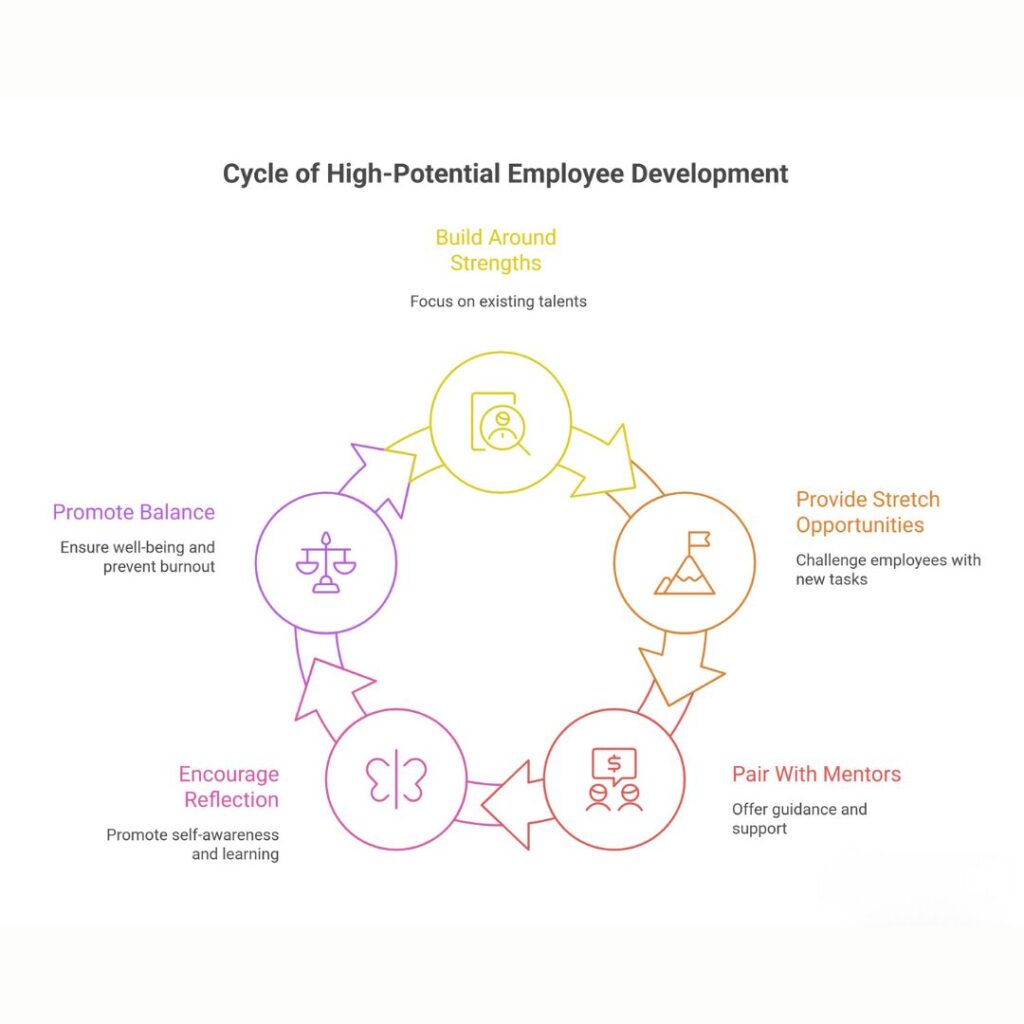
Identifying high-potential talent is only half the job; nurturing them is what truly builds future leadership capacity. Unfortunately, many organisations stop at identification tagging someone as “high potential” without providing a tailored development path.
The goal isn’t to accelerate them through titles but to expand their thinking, resilience, and self-awareness. That’s where strengths-based leadership becomes invaluable.
1. Build Development Around Strengths, Not Weaknesses
People grow faster when they work from their natural energy zones. A strengths-focused approach encourages employees to refine what they already do well and apply those strengths to new challenges. It creates momentum, confidence, and sustainable growth without the burnout associated with constant correction.
2. Provide Stretch Opportunities
Give high-potential employees challenging projects that test their adaptability and collaboration skills, leading a cross-functional team, managing ambiguity, or representing the company externally. Ensure these opportunities come with coaching, not just pressure.
3. Pair With Mentors and Coaches
High potentials need sounding boards who can challenge their thinking and broaden their perspective. Structured mentoring programs, particularly with leaders from different functions, expose them to diverse viewpoints and decision-making styles.
4. Encourage Reflection and Feedback
Learning happens through reflection. Create rituals of self-review after major projects or milestones. Encourage open conversations about lessons learned, what energized them, and what drained them. Over time, this reflection helps them develop leadership maturity rooted in self-awareness.
5. Promote Balance and Well-Being
It’s easy to overburden high-potential employees with additional responsibilities. But sustainable performance depends on balance. Encourage boundaries, rest, and recovery. A burnt-out Hi-Pot is a lost investment.
In 2025’s work environment, where burnout, mental health, and the “great detachment” are real, the most successful organisations will be those that grow leaders who thrive with energy, not despite exhaustion.
Conclusion
Identifying high-potential employees is not about filling a succession chart, it’s about future-proofing your organisation. The real challenge isn’t spotting raw talent, it’s creating an ecosystem where potential can surface, be nurtured, and grow sustainably.
High-potential talent are the people who combine curiosity with courage, results with reflection, and drive with empathy. They are the ones who ask better questions, lead quietly when needed, and build others as they rise.
In a world moving beyond hustle culture and toward sustainable performance, these individuals represent the true competitive advantage.
Stop merely identifying potential and start cultivating it. Build workplaces where people can bring their best energy, use their unique strengths, and grow into leaders who last.
Because the future of leadership isn’t about working harder, it’s about working wiser and helping others do the same.