


Stepping into a managerial role for the first time is exciting but also quietly overwhelming.
One day, you’re responsible for your own work. The next day, you’re expected to guide a team, align people, and deliver outcomes through others. And somewhere in between, a simple task like setting goals suddenly feels complicated.
Most first-time managers don’t struggle because they lack intent. They struggle because the way they’ve learned to work so far no longer fully applies.
As an individual contributor, goals were straightforward: complete tasks, meet deadlines, and deliver results.
But as a manager, goals are no longer just about what needs to be done. They are about how people work, grow, and take ownership while achieving those outcomes.
And that shift is where many new managers feel stuck.
Why Goal Setting Feels Difficult for First-Time Managers
The challenge isn’t goal-setting itself; it’s the change in responsibility.
For the first time, managers have to:
- balance team expectations with business outcomes
- guide people instead of doing the work themselves
- handle different personalities and working styles
- ensure consistency without micromanaging
In this phase, many managers either:
- become too controlling (trying to ensure everything is perfect), or
- step back too much (hoping the team will figure it out on their own)
Both approaches create confusion.
The real role of a manager is not control but clarity and direction.
The Shift That Changes Everything
A powerful mindset shift can simplify goal setting:
You are no longer responsible for doing the work.
You are responsible for enabling others to do their best work.
This means your goals should not only define outcomes, but they should also:
- guide how work happens
- build confidence within the team
- create ownership among team members
When goals are set this way, they don’t just drive results; they build stronger teams.
How to Set Goals as a First-Time Manager
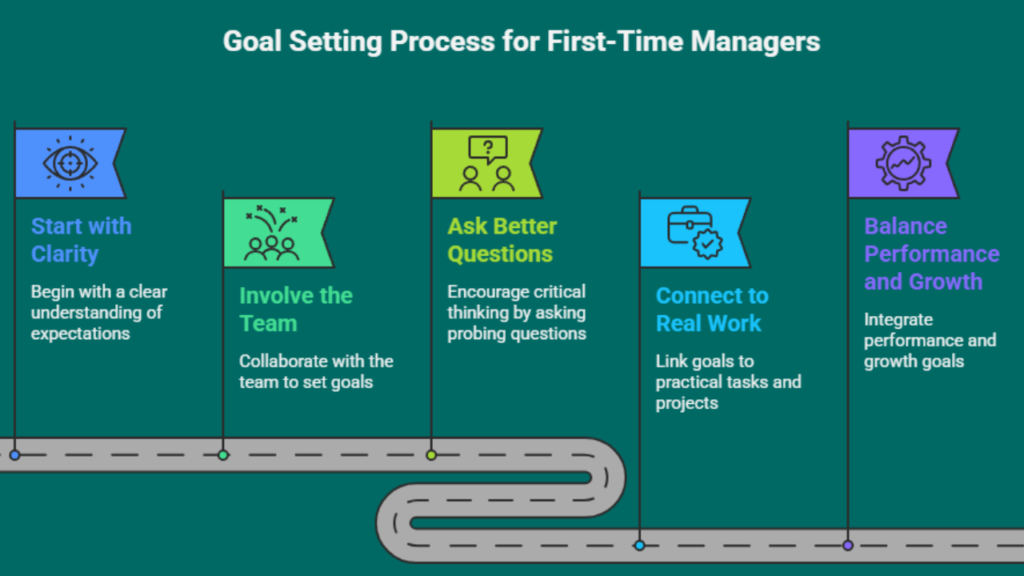
Now, let’s get into the practical side of how you can actually set goals that work.
Instead of following complex frameworks, focus on simple, human-centred practices that clarify and make goals more effective.
1. Start with clarity, not perfection
Many first-time managers try to create “perfect” goals.
But your team doesn’t need perfect goals.
They need clear and understandable goals.
For example, instead of saying:
- “Improve performance”
Say:
- “Reduce client response time from 24 hours to 12 hours over the next quarter”
Clarity removes hesitation and helps teams move faster.
2. Set goals with your team, not for them
One of the most common mistakes is setting goals in isolation.
When goals are imposed, teams may follow them, but they rarely feel connected to them.
Involving your team changes that.
You can ask:
- What challenges are you currently facing?
- What do you think is achievable in the next quarter?
- Where do you need more support?
This approach builds:
- ownership
- accountability
- trust
And when people feel ownership, they perform differently.
3. Ask better questions instead of giving solutions
As a first-time manager, it’s natural to want to help by giving answers.
But growth doesn’t come from answers; it comes from thinking.
Instead of saying:
- “Do it this way”
Try asking:
- “What approach would you take here?”
- “What could be improved in this plan?”
This shift does two things:
- builds confidence in your team
- reduces dependency on you
Over time, your team becomes more capable and independent.
4. Connect goals to real work, not theory
Goals should not feel like abstract statements.
They should connect directly to what your team actually experiences every day.
For example:
- handling difficult client conversations
- managing deadlines under pressure
- collaborating across teams
When goals reflect real challenges, they become more meaningful and easier to act on.
5. Balance performance goals with growth goals
Many first-time managers focus only on outcomes.
But strong teams are not built on results alone; they are built on development.
Along with performance goals, include goals like:
- improving communication skills
- handling feedback conversations better
- building decision-making confidence
This ensures your team doesn’t just deliver results, but they grow while doing it.
Where Most First-Time Managers Need Support
Even with the right intent, many first-time managers struggle to apply these ideas consistently.
Not because they don’t understand them, but because they haven’t practised them in real situations.
In our experience working with organisations, we’ve seen that new managers often need support in areas like:
- guiding team members through challenges instead of solving everything themselves
- asking the right questions to build thinking and ownership
- developing confidence in leading people conversations
- encouraging continuous growth within the team
These are not theoretical skills; they require practice, reflection, and the right environment to develop.
A Practical Approach to Building These Skills
This is exactly why we created the 5 Skills for First-Time Managers Program at Strengths Masters.
The focus is simple:
to help new managers handle real people situations, not just understand concepts.
The program is built around five core skills that every first-time manager needs early in their journey:
Role Modelling, Goal Setting, Review, Feedback, and Coaching.
Instead of long theory sessions, the program focuses on:
- practical scenarios
- real conversations managers face
- strengths-based development led by certified coaches
The idea is not to “train” managers, but to prepare them for what actually happens when they start leading people.
Conclusion: Start Simple, Grow Consistently
Setting goals as a first-time manager doesn’t have to feel overwhelming.
You don’t need complex frameworks or perfect plans.
What you need is:
- clarity in what matters
- Involvement from your team
- the ability to guide rather than control
Because at the end of the day, goal setting is not just about achieving targets.
It’s about building a team that:
- understands expectations
- feels confident in their role
- takes ownership of outcomes
And that’s what truly defines a strong manager.
Final Thought
Great managers are not created the moment they are promoted.
They are developed through small, consistent shifts
in how they think, communicate, and lead.
And goal setting is one of the first and most important steps in that journey.
Frequently Asked Questions:
1. What are the biggest challenges first-time managers face in goal setting?
First-time managers often struggle to translate organisational strategy into clear team goals. Common challenges include unclear priorities, vague expectations, and difficulty defining measurable outcomes, which lead to confusion and inconsistent team performance.
2. How should first-time managers set clear goals for their teams?
First-time managers should break down business objectives into simple, actionable team goals, define success criteria, assign clear ownership, and limit priorities to maintain focus and direction.
3. Why do teams struggle when goals are not clearly defined?
When goals are unclear, teams experience confusion, misaligned efforts, and reduced accountability. Employees may stay busy but fail to deliver meaningful outcomes due to a lack of direction.
4. What is the role of a manager in creating goal clarity?
A manager’s role is to translate strategy into clear team priorities, communicate expectations, remove ambiguity, and regularly reinforce goals to ensure alignment and consistent execution.
5. How do the five key management skills support goal setting?
The five skills: Role Modelling, Goal Setting, Review, Feedback, and Coaching, work together to create clarity, maintain focus, guide performance, and help teams stay aligned with goals over time.
6. How can organisations improve goal setting for first-time managers?
Organisations can improve goal setting by providing structured development, practical frameworks, and continuous support that help managers build clarity, communication, and leadership skills early in their journey.



I started writing down one thing at the end of every day — what I actually managed to do. Not a to-do list, not plans. Just one small win. It’s surprising how quickly it shifts your perspective.
[…] Goal setting […]