


Teams Don’t Need Constant Communication. They Need Clear Direction.
Modern workplaces are filled with communication. Meetings happen daily, messages keep flowing across Slack and Teams, emails arrive every hour, and managers constantly share updates with their teams. On the surface, communication has improved significantly in today’s corporate environment.
Yet despite all this interaction, many teams still struggle with confusion. Employees are unclear about priorities, ownership gets blurred, deadlines slip, and managers often feel frustrated because “everything was already communicated.”
This is one of the biggest leadership challenges organisations face today. The problem is not a lack of communication; it is a lack of clarity.
And there is a major difference between the two.
Communication shares information.
Clarity creates understanding, alignment, and execution.
This is why some teams stay focused and productive even in fast-moving environments, while others feel overwhelmed despite constant discussions and meetings. Effective managers understand that leadership communication in teams is not about saying more. It is about helping people understand what matters most, what success looks like, and how their work connects to larger goals.
That ability to create clarity in everyday work has become one of the most important leadership skills for managers today.
Why Teams Struggle Even When Communication Is Constant
One of the biggest workplace communication challenges is information overload. Most employees are not struggling because nobody talks to them. In fact, many employees feel the opposite; they receive too much communication without enough direction.
Managers often share updates continuously, but teams still struggle to answer important questions like:
- What should we prioritise first?
- Which goals matter most right now?
- Who owns the outcome?
- What does success actually look like?
- Why is this work important?
When these answers are unclear, teams start making assumptions. Assumptions create inconsistency, delays, and frustration.
According to the Asana Anatomy of Work Report, employees spend nearly 60% of their time coordinating work rather than doing skilled, strategic work. A major reason behind this is communication overload combined with unclear priorities. Teams spend enormous amounts of time clarifying expectations, attending unnecessary meetings, and trying to align on decisions that should already be clear.
Similarly, the Grammarly Workplace Communication Report found that ineffective communication costs businesses billions globally due to productivity loss, misunderstandings, and repeated work.
This is why communication gaps between managers and employees remain one of the biggest hidden reasons behind low productivity and disengagement in organisations today.
The Difference Between Communication and Clarity
Many managers assume communication automatically creates alignment. But communication and clarity are not the same thing.
For example, a manager might say:
“We need this completed urgently.”
That sounds clear on the surface. But for employees, several questions immediately appear:
- What is considered urgent?
- What should be deprioritised because of this?
- Who makes final decisions?
- What level of quality is expected?
- What happens if timelines conflict?
Without clarity, teams interpret instructions differently. One employee may focus on speed, another on perfection, while someone else waits for more direction before acting. This creates confusion even when communication is frequent.
That is why effective managers focus not just on delivering information, but on creating shared understanding.
This shift is critical because team clarity and alignment directly influence execution quality, accountability, and performance.
How Effective Managers Create Clarity in Everyday Work
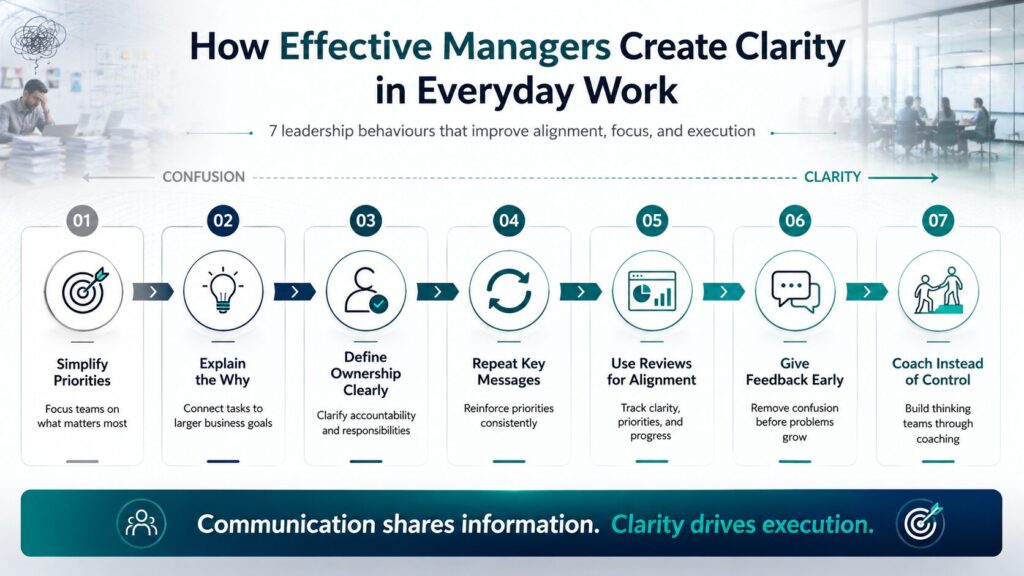
Strong managers do not simply communicate more than others. They communicate with structure, consistency, and intention. They understand that clarity is built through habits, not one-time conversations.
Here are the behaviours effective managers use to create clear communication for teams and improve everyday execution.
1. They Simplify Priorities
One of the fastest ways managers create confusion is by making everything sound equally important.
When teams hear that every task is urgent, they stop understanding what truly matters. Employees become reactive instead of focused. Work feels chaotic because priorities constantly compete with each other.
Effective managers reduce confusion in teams by simplifying priorities. Instead of overwhelming employees with endless updates, they clearly identify the most important goals and outcomes.
They consistently answer questions like:
- What are the top priorities this week?
- What matters most right now?
- Which work has the biggest impact?
This creates team direction and focus. Employees feel more confident because they know where to invest their energy.
2. They Explain the “Why” Behind the Work
Another major communication mistake managers make is explaining tasks without explaining the purpose.
Employees may understand what they are supposed to do, but they often do not understand why the work matters. Without context, motivation drops and decision-making weakens.
Effective managers create clarity by connecting everyday tasks to broader business goals. They explain how individual work contributes to customer outcomes, team success, or organisational priorities.
This is one of the biggest differences between managers who simply assign work and leaders who create alignment.
When employees understand purpose, they make smarter decisions independently because they know the bigger picture.
3. They Define Ownership Clearly
A surprising amount of workplace confusion comes from unclear ownership rather than unclear communication.
Sometimes tasks are discussed in meetings, but nobody knows who is ultimately responsible for driving them forward. Employees assume someone else owns the work, follow-ups get missed, and accountability weakens.
Strong managers avoid this by clearly defining:
- Who owns the outcome
- Who supports execution
- Who approves decisions
- Who needs updates
This level of clarity improves execution through clear communication and significantly reduces delays and misunderstandings.
4. They Repeat Key Messages Consistently
Managers often underestimate how much repetition is required for clarity.
Employees process information differently. Priorities also evolve quickly in modern workplaces. Important messages discussed once in a meeting can easily get lost among dozens of emails and conversations.
Effective managers repeat critical priorities consistently across reviews, team meetings, and one-on-one conversations. They reinforce expectations regularly instead of assuming everyone remembers everything perfectly.
This repetition does not create redundancy; it creates alignment.
Leadership effectiveness in communication is not about constantly introducing new information. It is about reinforcing what matters most.
5. They Use Reviews to Reinforce Clarity
Many managers treat reviews as performance tracking exercises only. Effective managers use reviews differently.
For them, reviews are opportunities to strengthen alignment, remove confusion, and ensure priorities still make sense.
Good review conversations include questions like:
- Are our priorities still clear?
- What obstacles are slowing execution?
- Is anyone unclear about expectations?
- What decisions need clarification?
This approach improves team productivity and clarity because employees leave reviews with stronger direction, not just status updates.
6. They Give Feedback That Reduces Confusion Early
One of the biggest reasons performance issues grow over time is delayed clarification. Employees continue moving in the wrong direction simply because nobody corrected misunderstandings early enough.
Strong managers understand that feedback is not only about performance evaluation, but it is also about reducing ambiguity.
When managers provide timely feedback, teams gain clarity faster. Employees understand what needs adjustment before small mistakes become major problems.
This is a critical part of how managers improve team clarity and focus in everyday work.
7. They Coach Teams Instead of Controlling Every Decision
Effective managers understand that clarity does not mean controlling every action.
Instead of solving every problem themselves, they guide teams through uncertainty by asking thoughtful questions and encouraging independent thinking.
This coaching-based approach builds confidence, ownership, and better decision-making over time. Employees stop depending on constant instructions because they begin understanding how to think through challenges themselves.
This directly connects to other leadership capabilities like role modelling, goal setting, reviews, and feedback, all of which contribute to stronger team alignment and execution.
The Real Business Impact of Team Clarity
Creating clarity is not just a communication skill; it is a business performance skill.
According to Gallup workplace research, employees who clearly understand expectations at work are significantly more engaged and productive than employees who lack direction. Clarity improves confidence, accountability, and execution speed.
On the other hand, confusion creates hidden organisational costs:
- Rework increases
- Meetings become longer
- Decision-making slows
- Managers become bottlenecks
- Employee burnout rises
A McKinsey report also highlighted that employees spend a substantial portion of their workweek simply searching for information or clarifying tasks. This means productivity losses often come not from lack of effort, but from lack of alignment.
That is why clarity has become one of the most valuable leadership capabilities in modern organisations.
A Simple Workplace Example
Imagine two managers leading similar teams during a busy quarter.
The first manager forwards every update immediately, changes priorities frequently, and assumes employees will “figure it out.” The team attends multiple meetings every week, but confusion continues growing because nobody knows what matters most.
The second manager filters information carefully. They communicate priorities clearly, explain why certain work matters, define ownership, and repeat expectations consistently.
Both teams work equally hard. But one feels overwhelmed, while the other feels focused.
That difference comes from clarity.
Where Structured Leadership Development Helps
Most managers are promoted because of technical expertise, not because they were trained to create clarity and alignment. As a result, many managers struggle to balance communication, expectations, feedback, and execution effectively.
This is why organisations are increasingly investing in leadership development programs focused on practical managerial capabilities. Programs like the 5 Skills for First-Time Managers by Strengths Masters help managers strengthen core leadership behaviours like role modelling, goal setting, reviews, feedback, and coaching, all of which directly improve team clarity and communication effectiveness.
The goal is not simply to increase communication frequency. The goal is to improve communication quality and leadership impact.
Final Thoughts
Teams rarely struggle because managers do not communicate enough. They struggle because communication often fails to create clarity. And in today’s fast-moving workplace, clarity has become one of the most powerful advantages a manager can provide.
When employees clearly understand priorities, expectations, ownership, and purpose, execution becomes faster, accountability stronger, and teams perform with greater confidence.
Communication shares information.
Clarity creates alignment, focus, and results.
That is what effective managers truly deliver in everyday work.
Frequently Asked Questions:
1) Why do teams stay confused even after regular communication?
Teams stay confused when managers share information without creating clarity around priorities, ownership, expectations, and outcomes. Communication without direction often leads to misunderstandings and low alignment.
2) How do managers create clarity in teams?
Managers create clarity in teams by simplifying priorities, defining responsibilities clearly, explaining the “why” behind tasks, and reinforcing expectations through reviews and feedback.
3) Why does communication alone not improve team performance?
Communication alone does not improve performance because employees also need clarity, alignment, and accountability. Without clear direction, teams struggle to focus and execute effectively.
4) How can managers reduce confusion in teams?
Managers reduce confusion in teams by setting clear expectations, prioritising important work, improving feedback conversations, and ensuring employees understand goals and responsibilities.
5) What causes communication gaps between managers and employees?
Communication gaps between managers and employees often happen when instructions are unclear, priorities keep changing, feedback is inconsistent, or employees lack context behind decisions.
6) How do leaders improve team clarity and focus?
Leaders improve team clarity and focus by communicating key priorities consistently, aligning work with business goals, and helping employees understand what success looks like.
7) Why do too many meetings create confusion in teams?
Too many meetings create confusion when discussions lack clear outcomes, priorities are not defined, and employees leave without actionable direction or accountability.
8) How does clear communication improve team productivity?
Clear communication improves team productivity by reducing misunderstandings, preventing repeated work, improving accountability, and helping employees focus on high-impact priorities.