
When Managers Solve Everything…Teams Stop Growing
Most first-time managers make this mistake without even realising it. Whenever a team member faces a problem, they step in with a solution. It feels efficient. It saves time. Work gets done faster. But slowly, something starts to change.
Team members stop thinking independently. They begin to rely on the manager for answers. Ownership reduces. Growth slows down.
What looks like “support” in the short term often becomes “dependency” in the long run. And that’s exactly where coaching becomes important.
Why Coaching Matters More Than Managers Think
Coaching is not about giving better answers. It’s about helping others find their own.
That’s the shift most managers struggle with. They move from being individual contributors whose value comes from solving problems to managers whose value comes from developing people.
Teams don’t grow because managers are smart.
Teams grow because managers make them think.
When managers coach effectively:
- Employees build confidence
- Decision-making improves
- Ownership increases
- Performance becomes more consistent
In simple terms, coaching turns teams from dependent executors into independent performers.
Managing vs Feedback vs Coaching (Clear the Confusion)
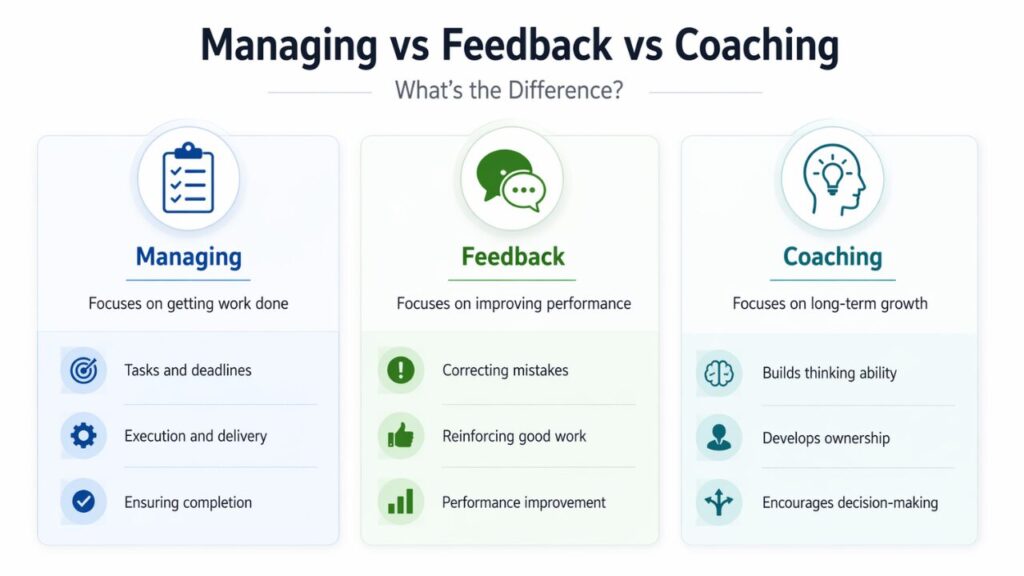
Many managers mix these three concepts, and that’s where clarity breaks.
- Managing focuses on getting work done. It’s about tasks, deadlines, and execution.
- Feedback focuses on improving performance. It corrects what’s not working and reinforces what is.
- Coaching focuses on long-term growth. It builds thinking, capability, and ownership.
Think of it like this:
Managing tells people what to do.
Feedback tells people what to improve.
Coaching helps people figure things out for themselves.
All three are important, but coaching is what creates sustainable growth.
How Managers Coach Their Teams Effectively
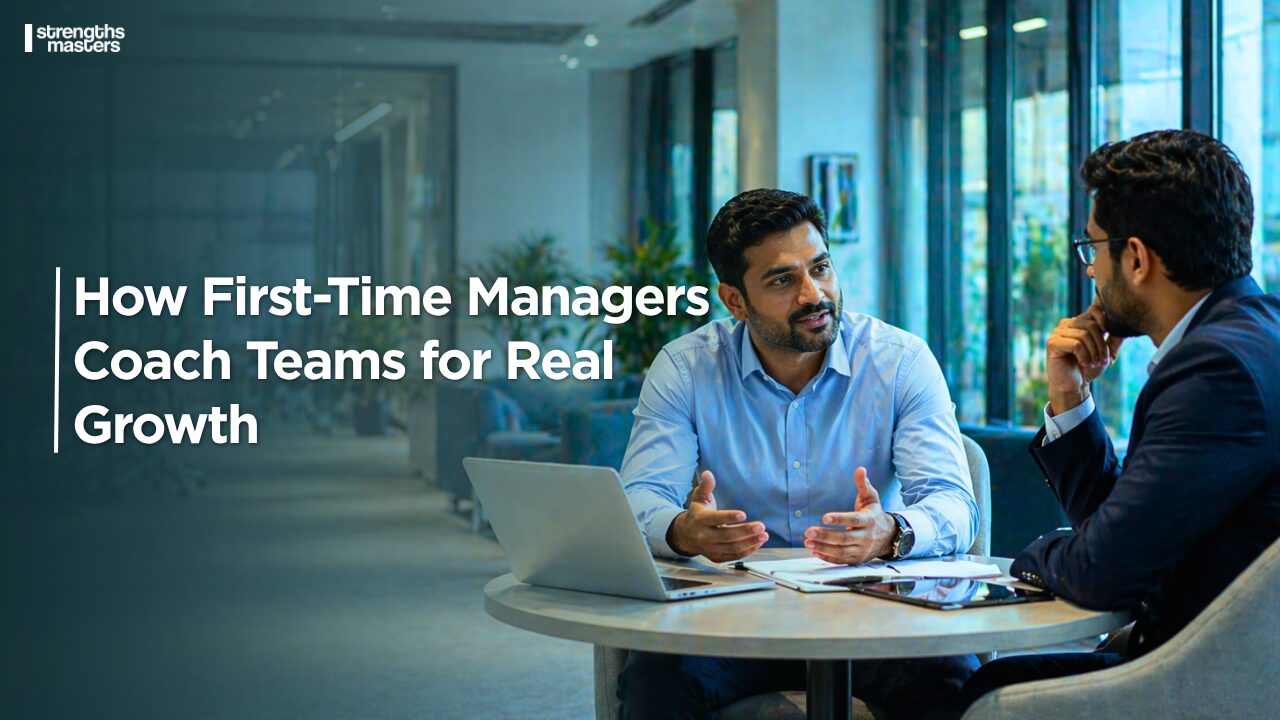
Coaching doesn’t require complex frameworks. It starts with small behavioural shifts. Instead of jumping in with answers, effective managers slow down and ask better questions. They listen more than they speak. They guide conversations rather than control them.
For example, instead of saying:
“Do it this way,”
A coaching manager asks:
“What approach do you think will work here?”
This one shift changes everything. It encourages thinking. It builds confidence. And over time, it reduces dependency.
Strong coaching also involves:
- Creating a safe space where employees can share openly
- Being patient, even when solutions seem obvious
- Guiding direction without taking control
It may take more time initially, but it saves far more time in the long run.
A Simple Coaching Framework Managers Can Use
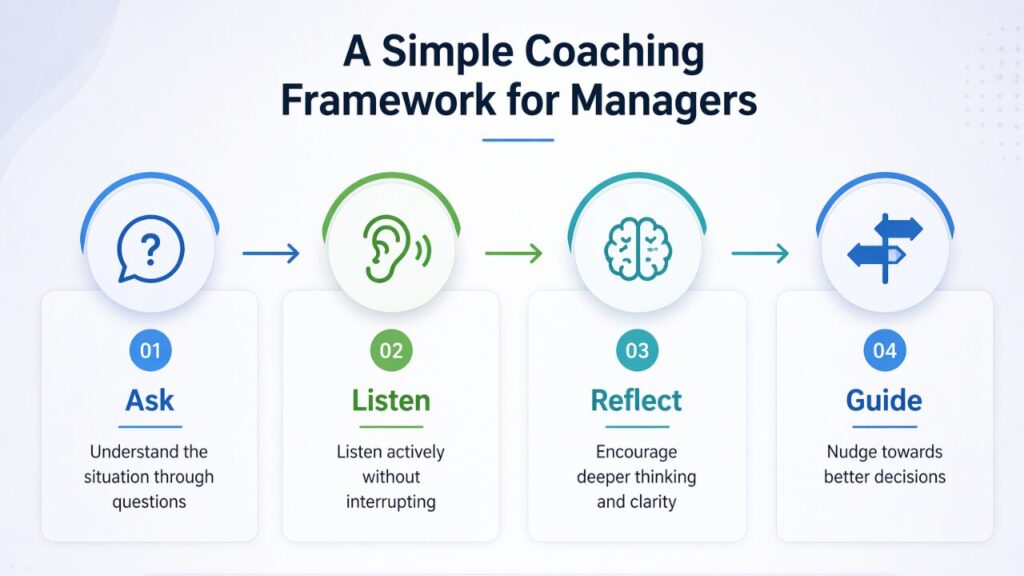
To make coaching practical, managers can follow a simple structure in conversations:
- Ask → Understand the situation through questions
- Listen → Pay attention without interrupting
- Reflect → Help the person think deeper
- Guide → Nudge them toward better decisions
This keeps coaching structured without making it complicated.
Over time, these conversations become natural, and teams start thinking independently.
A Real-Life Example (How Coaching Changes Behaviour)
Consider this situation.
Neha, a first-time manager, noticed that one of her team members, Rohan, kept coming to her for small decisions and approval on emails, minor client responses, and even basic planning steps.
Initially, she would quickly give answers. It felt faster. But over time, she realised Rohan wasn’t growing. He was becoming more dependent.
So she changed her approach.
The next time he came with a question, instead of answering directly, she asked:
“What do you think is the best way to handle this?”
At first, Rohan hesitated. He wasn’t used to thinking this way. But Neha stayed patient. She listened, asked a few follow-up questions, and helped him refine his thinking.
Within a few weeks, something shifted.
Rohan started coming up with solutions instead of questions. His confidence improved. He began taking ownership of decisions.
Neha didn’t give more answers.
She asked better questions.
That’s coaching in action.
How Coaching Improves Team Performance
Coaching has a direct impact on performance, but not in an obvious way. It doesn’t show up immediately as task completion does. Instead, it builds capability over time.
Teams that are coached well:
- Solve problems faster without escalation
- Take ownership of outcomes
- Collaborate more effectively
- Require less constant supervision
This connects closely with what we’ve already discussed in earlier areas.
For example:
- Without clear goals, coaching lacks direction
- Without regular reviews, managers don’t know where to coach
- Without feedback, improvement areas remain unclear
Coaching works best when combined with these elements.
Where Most Managers Struggle with Coaching
Even when managers understand coaching, applying it is not easy. The biggest challenge is habit. Managers are used to solving problems quickly. Coaching requires slowing down.
There’s also time pressure. Asking questions feels longer than giving answers. And sometimes, there’s a lack of patience. When managers already know the solution, it’s tempting to just say it. But the long-term impact of not coaching is much bigger: dependency, low ownership, and limited growth.
The shift is simple, but not easy:
From solving problems → to developing people who can solve them.
Connecting the Dots (Bringing All Skills Together)
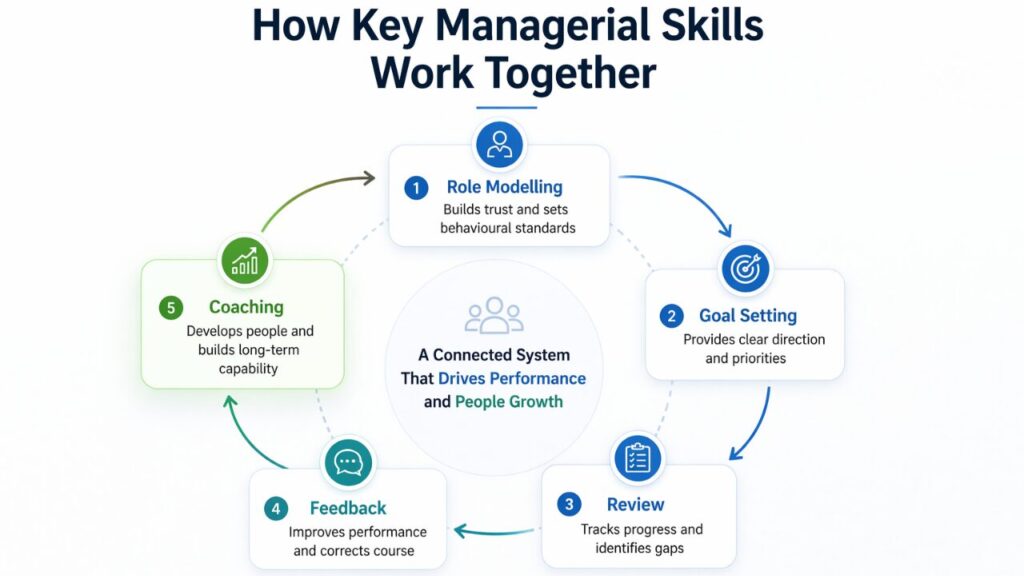
If you look at the bigger picture, coaching doesn’t stand alone; it connects deeply with other managerial capabilities.
- Role modelling builds trust, which makes coaching conversations open and honest
- Goal setting provides direction, so coaching stays focused
- Review helps identify where coaching is needed
- Feedback improves performance, while coaching builds long-term capability
Together, these create a complete system for effective management, not just execution, but growth.
Where Structured Development Helps
The reality is, most managers are never taught how to coach.
They learn through experience, often by trial and error. Some improve over time. Many continue to struggle quietly. That’s why structured learning journeys are becoming important.
Programs like the 5 Skills for First-Time Managers by Strengths Masters focus on building these capabilities step by step, covering role modelling, goal setting, review, feedback, and coaching in a practical, real-world context.
The focus is not on theory, but on helping managers apply these skills in everyday situations where it actually matters.
Final Thoughts
The shift from managing to coaching is one of the most important transitions a leader can make.
Managing ensures work gets done.
Coaching ensures people grow.
And in the long run, growth matters more than control.
Because the real strength of a manager is not how many problems they can solve but how many people they can develop to solve problems on their own.
Frequently Asked Questions:
1) Why is coaching important for first-time managers?
Coaching is important for first-time managers because it helps build employee confidence, ownership, and decision-making ability. Instead of creating dependency, coaching enables teams to think independently and perform consistently.
2) How do managers coach employees effectively?
Managers coach employees effectively by asking the right questions, listening actively, and guiding rather than giving direct solutions. This approach helps employees develop problem-solving skills and take ownership of their work.
3) How does coaching improve team performance?
Coaching improves team performance by building independent thinking, reducing reliance on managers, and encouraging accountability. Over time, teams become more confident, proactive, and capable of handling challenges.
4) How do managers build ownership through coaching?
Managers build ownership through coaching by involving employees in decision-making, encouraging them to suggest solutions, and supporting them in taking responsibility for outcomes.
5) What is the difference between coaching and feedback in management?
Feedback focuses on improving past performance by addressing gaps, while coaching focuses on future growth by developing thinking, capability, and decision-making skills.
6) How can managers develop employees through coaching?
Managers develop employees through coaching by creating regular conversations, asking reflective questions, and guiding them toward better solutions, which helps build long-term capability and growth.