


When Silence Feels Easier Than Speaking Up
In many teams, feedback doesn’t fail because it’s unimportant; it fails because it’s uncomfortable. Managers often find themselves holding back, unsure about how their words will be received. There’s always that hesitation: What if this creates friction? What if it demotivates the person? And so, instead of addressing issues directly, feedback gets delayed, softened too much, or avoided altogether.
But here’s where things start to break down. When feedback is missing, confusion quietly takes its place. Employees continue working, but not always in the right direction. Small mistakes repeat, expectations remain unclear, and performance starts plateauing without anyone clearly understanding why.
Interestingly, this hesitation isn’t what employees want. According to Harvard Business Review, 57% of employees prefer corrective feedback to no feedback at all. That tells us something important: teams aren’t resisting feedback. They’re waiting for it.
Why Feedback Is Central to Team Performance

Feedback is often treated like a soft skill, something “good to have” but not always essential. In reality, it plays a direct role in how teams perform, collaborate, and grow over time. Without feedback, even well-defined goals lose their meaning because there’s no ongoing check to see whether the work is moving in the right direction.
Research by Gallup highlights this clearly: employees who receive meaningful feedback are 3.6 times more likely to be engaged at work. Engagement, as we know, is closely linked to productivity, ownership, and retention. When people know how they are doing and where they can improve, they naturally take more responsibility for their work.
At the same time, the absence of feedback creates a silent gap. People start second-guessing their performance. They don’t know what’s working and what isn’t. Over time, this lack of clarity turns into disengagement, not because employees don’t care, but because they don’t feel guided.
What Effective Feedback Really Looks Like
One of the biggest misconceptions managers have is that feedback needs to be formal, structured, and reserved for specific moments like appraisals or quarterly reviews. In reality, feedback works best when it becomes part of everyday conversations.
Modern workplaces have already started shifting in this direction. According to PwC, 60% of employees prefer feedback on a daily or weekly basis, rather than waiting for formal review cycles. This is especially true for younger teams who are used to faster communication and quicker iterations.
Effective feedback, therefore, is not about formality; it’s about relevance. It happens close to the work, focuses on specific behaviours, and gives clear direction on what needs to improve. When feedback is timely and contextual, it feels like support. When it’s delayed, it often feels like criticism.
Types of Feedback (And When to Use Them)
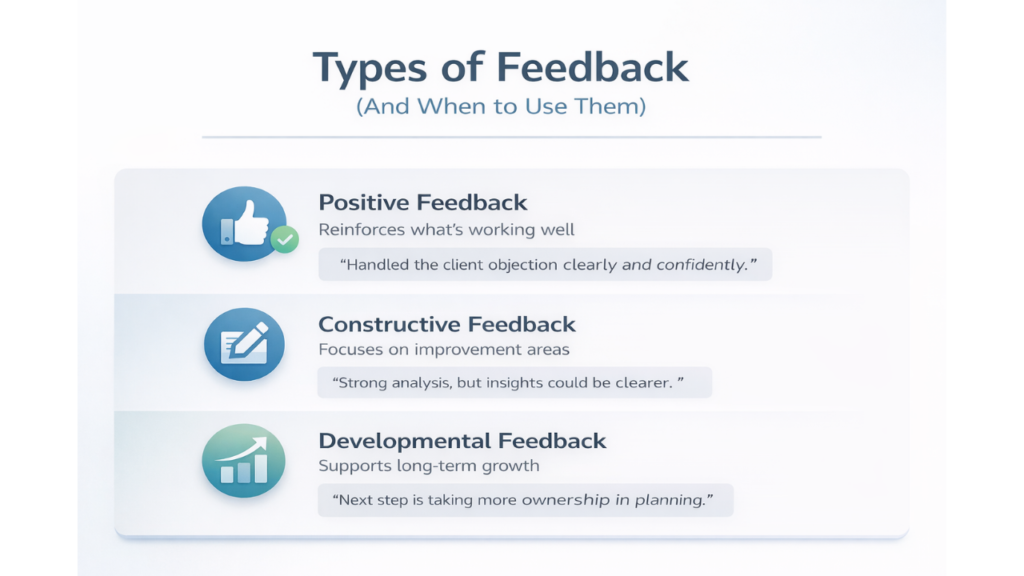
Not all feedback is the same, and honestly, treating it the same way is where many managers go wrong. Different situations demand different kinds of conversations, and understanding this makes feedback far more effective and natural.
At a practical level, managers usually operate with three core types of feedback.
1. Positive Feedback
This reinforces what’s working well. It’s not just appreciation, it’s direction. When a manager highlights specific behaviours that are effective, it helps the employee repeat them with confidence.
Example: “The way you handled that client objection was clear and structured, which really helped close the conversation well.”
2. Constructive Feedback
This focuses on improvement. It addresses gaps, but in a way that is solution-oriented rather than critical.
Example: “Your analysis was strong, but presenting the key insights more clearly would make it easier for stakeholders to act on it.”
3. Developmental Feedback
This goes beyond immediate tasks and focuses on long-term growth. It helps employees think ahead and build capability.
Example: “You’re doing well in execution, now the next step could be taking more ownership in planning and decision-making.”
When managers learn to balance these three types, feedback stops feeling like a difficult task and starts becoming a natural part of leadership communication.
Why Teams Fail Without Regular Feedback
When feedback is inconsistent or absent, teams don’t fail suddenly; they drift. Work continues, but alignment weakens. People interpret expectations differently, priorities start shifting, and accountability becomes unclear.
According to Officevibe, 65% of employees say they want more feedback than they currently receive. This gap between expectation and reality creates a disconnect inside teams. Employees are putting in effort, but without direction, that effort doesn’t always translate into results.
Over time, this leads to repeated mistakes, delayed outcomes, and frustration on both sides. Managers feel teams aren’t delivering. Teams feel they aren’t being guided. And all of this can often be traced back to one missing element: consistent, meaningful feedback.
How Managers Can Give Feedback That Actually Works

Giving feedback effectively is less about using the perfect words and more about building the right approach. Managers who do this well focus on clarity, intent, and consistency rather than overthinking every conversation.
Instead of vague statements like “this needs improvement,” effective managers anchor their feedback in real situations. They explain what they observed, why it matters, and what can be done differently moving forward. This creates a sense of direction rather than confusion.
At the same time, they avoid making feedback personal. The focus stays on behaviour and outcomes, not on the individual. This subtle distinction makes feedback easier to accept because it doesn’t feel like criticism; it feels like guidance.
Another important shift is turning feedback into a dialogue. When managers invite responses, ask questions, and listen actively, feedback becomes a shared process instead of a one-sided judgment. That’s where real improvement begins.
A Practical Way to Structure Feedback Conversations
For many managers, the challenge isn’t understanding feedback; it’s knowing how to structure it in real conversations. A simple approach can make this much easier.
Start by describing the situation clearly, what exactly happened or what was observed. Then explain the impact of that behaviour, especially in terms of team goals or outcomes. After that, shift the focus toward improvement by discussing what can be done differently next time.
Finally, open the conversation. Ask for the other person’s perspective. This not only makes feedback more balanced but also increases ownership. When people are part of the solution, they are more likely to act on it.
A Simple Feedback Checklist Managers Can Use
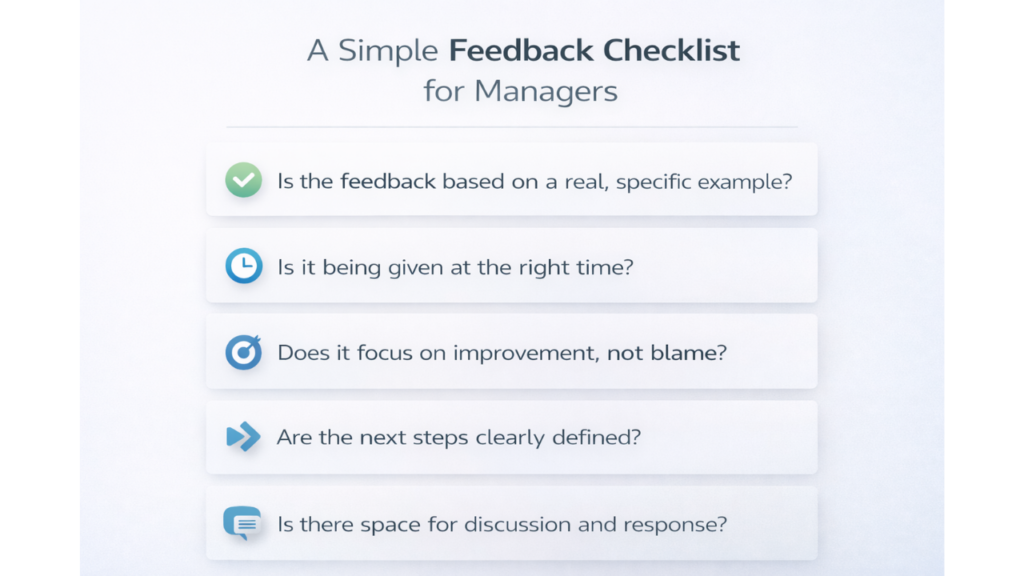
To make feedback consistent and effective, managers can keep a few key points in mind:
- Is the feedback based on a real, specific example?
- Is it being given at the right time, not too late?
- Does it focus on improvement rather than blame?
- Are the next steps clearly defined?
- Has the conversation allowed space for response and discussion?
This kind of structure removes guesswork and makes feedback a repeatable habit rather than an occasional effort.
Feedback That Works: 10 Do’s and Don’ts Every Manager Should Know
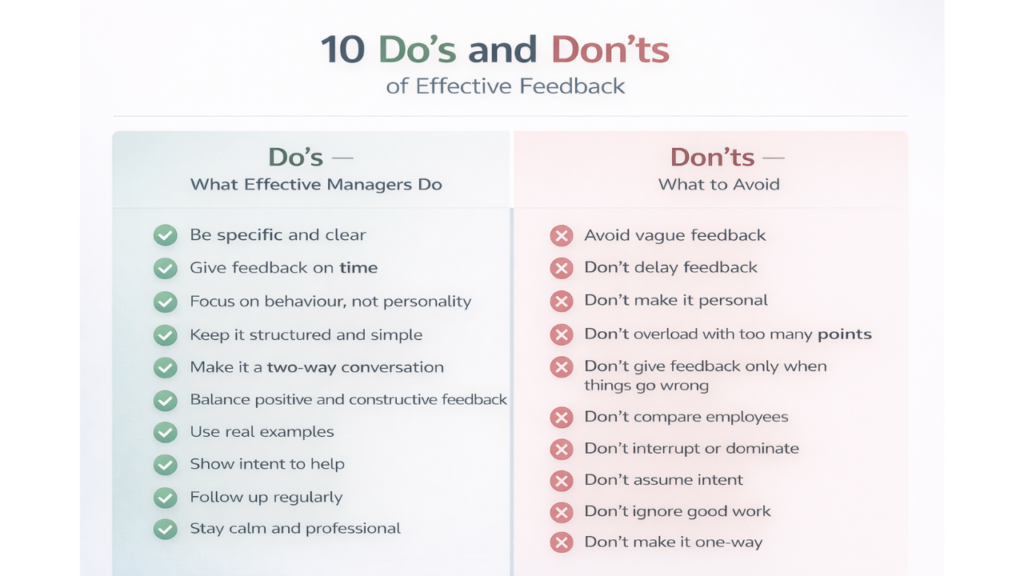
Even when managers understand feedback in theory, the real challenge is how it plays out in everyday situations. Small things like tone, timing, or clarity can completely change how feedback is received.
So instead of overcomplicating it, here are ten do’s and don’ts that actually make feedback work in real teams.
✅ Do’s (What Effective Managers Do)
- Be specific about what exactly you observed
- Give feedback as close to the situation as possible
- Focus on behaviour and outcomes, not personality
- Keep your message clear, simple, and structured
- Ask questions and make it a two-way conversation
- Balance appreciation with improvement areas
- Use real examples to explain your point
- Show intent to help, not to judge
- Follow up to check if improvement is happening
- Stay calm, neutral, and professional in tone
❌ Don’ts (What to Avoid)
- Don’t give vague feedback like “do better”
- Don’t delay feedback until it loses relevance
- Don’t make it personal or emotionally charged
- Don’t overload the person with too many issues at once
- Don’t give feedback only when something goes wrong
- Don’t compare employees with others
- Don’t interrupt or dominate the conversation
- Don’t assume intent without understanding context
- Don’t ignore positive behaviours worth reinforcing
- Don’t treat feedback as a one-way instruction session
Real-Life Example
Let’s make this real.
Rahul was recently promoted to a team manager in a mid-sized tech company. One of his team members, Ankit, had been consistently missing small but important details in client reports. Nothing major, but enough to create rework and delays.
Rahul noticed this pattern for a few weeks but didn’t say anything immediately. He didn’t want to come across as too critical. Eventually, when a client pointed out an error, Rahul felt he had to address it.
Now, this is where things could have gone wrong.
Instead of saying something generic like, “You need to be more careful,” Rahul approached it differently.
He sat down with Ankit and said,
“I’ve noticed in the last three reports that some data points were slightly off, which led to rework from the client side. I know your analysis is strong, but I think adding a quick final review step before submission could really help avoid this.”
Then he paused and asked,
“What do you think might help you catch these before sending them out?”
That changed the entire tone of the conversation.
Ankit didn’t feel attacked. He felt supported. He acknowledged that he was rushing toward deadlines and suggested creating a simple checklist before submission.
Rahul agreed and followed up the next week.
Within a month, the errors dropped significantly.
How Feedback Improves Team Results
Feedback plays a direct role in improving performance because it reduces uncertainty. When expectations are clear, and progress is continuously discussed, teams don’t have to guess what success looks like. They know it.
Research from Deloitte supports this, showing that organisations with strong feedback cultures experience up to 14.9% lower turnover. But beyond retention, the real impact is seen in execution. Teams move faster, correct mistakes earlier, and stay aligned with their goals.
In many ways, feedback acts as a real-time adjustment system. Instead of waiting until the end to evaluate results, managers and teams continuously refine their approach. This leads to better outcomes, not just better effort.
Connecting Feedback with Reviews and Daily Execution
Feedback becomes even more powerful when it is combined with regular reviews. While reviews help track progress and identify gaps, feedback helps improve performance within those gaps. Together, they create a system where work is not only monitored but also continuously improved.
This also connects back to earlier leadership behaviours like role modelling. Managers who demonstrate openness, consistency, and clarity make it easier for teams to accept and act on feedback. It creates an environment where communication feels natural rather than forced.
Where Structured Development Makes the Difference
Most managers are never formally trained to give feedback. They learn through experience, often figuring things out through trial and error. While some develop this skill over time, many continue to struggle with it silently.
This is where structured development can play a meaningful role. Programs like the 5 Skills for First-Time Managers by Strengths Masters focus on building practical capabilities such as role modelling, goal setting, review, feedback, and coaching. The emphasis is not on theory-heavy concepts, but on helping managers apply these skills in everyday situations.
When managers start understanding how their communication impacts performance, small behavioural shifts begin to create noticeable changes in team outcomes.
Final Thoughts
Feedback isn’t just a communication tool; it’s a performance driver. When done right, it creates clarity, builds trust, and helps teams improve consistently. When avoided, it creates confusion, misalignment, and missed opportunities.
The difference lies not in the intention, but in the execution. Managers who treat feedback as an ongoing conversation rather than a one-time activity are the ones who see real results.
So the next time you hesitate before giving feedback, it’s worth asking, “Are you holding back to avoid discomfort, or are you helping your team move forward?”
Because in the long run, clear feedback doesn’t create problems.
It solves them.
Frequently Asked Questions:
1) What is the role of managers in giving feedback to employees?
The role of managers in giving feedback is to guide, support, and develop employees. They ensure clarity, correct mistakes early, and help individuals grow through continuous and structured feedback.
2) Why do teams fail without regular feedback?
Teams often fail without regular feedback because employees don’t know if they are on the right track. Lack of feedback creates confusion, delays corrections, and reduces accountability, leading to poor performance over time.
3) How do managers give feedback effectively to teams?
Managers give feedback effectively by being specific, timely, and focused on behaviour rather than personality. Clear examples, constructive tone, and actionable suggestions help teams understand and improve performance.
4) How can managers conduct effective feedback conversations?
To conduct effective feedback conversations, managers should prepare examples, create a safe space, encourage two-way discussion, and clearly define next steps to ensure improvement and clarity.
5) How do managers improve team performance through feedback?
Managers improve team performance through feedback by identifying gaps early, reinforcing positive behaviour, and guiding employees with clear direction, which leads to consistent progress and better results.
6) How does feedback build team trust and accountability?
Feedback builds team trust and accountability by creating open communication, setting clear expectations, and encouraging ownership, which helps teams work more confidently and responsibly.



Its a really helpful course for the FLM role.