

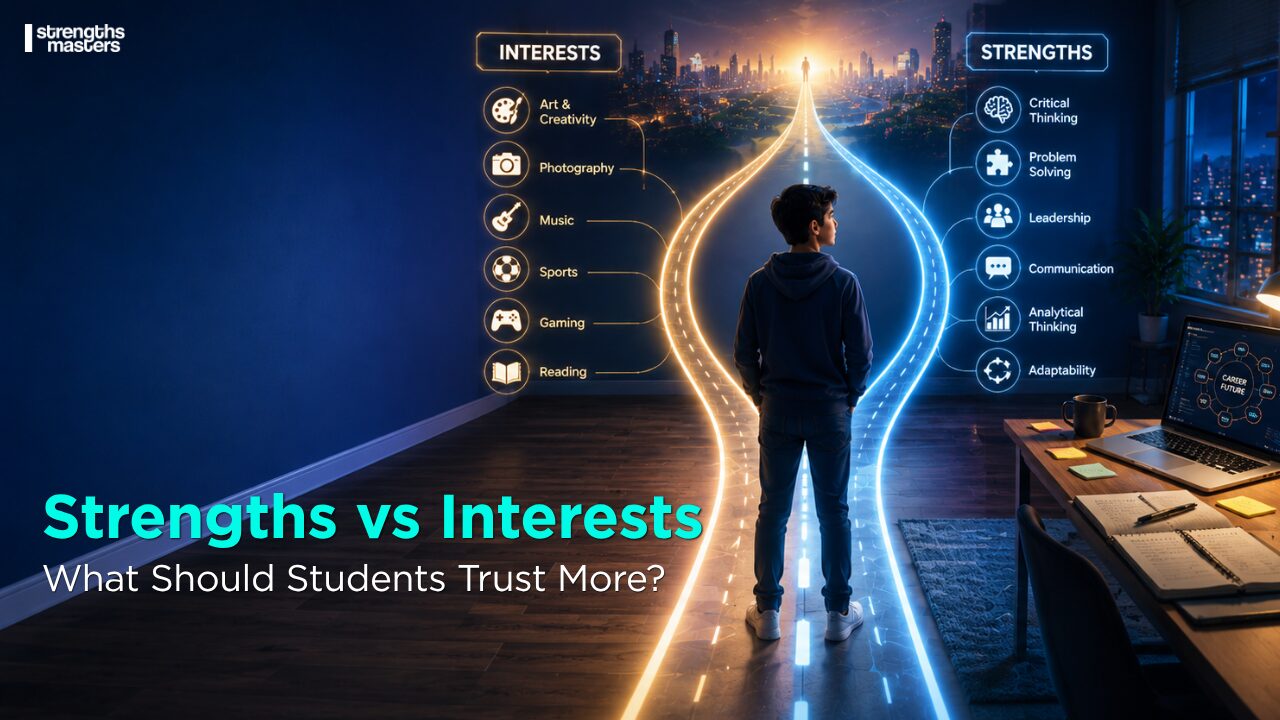
Choosing a career has become more confusing than ever before. Students today are exposed to hundreds of career options, countless success stories on social media, and advice from parents, teachers, relatives, and friends. Amid all this information, one question keeps coming up:
Should I choose a career based on my interests or my strengths?
Many students believe that following their interests will automatically lead to career satisfaction. Others are told to focus only on what they are naturally good at. The reality is more nuanced.
While interests can inspire exploration, they are often temporary and influenced by new experiences, trends, or exposure. Strengths, on the other hand, reflect the natural patterns of thinking, learning, communicating, and solving problems that remain relatively consistent over time.
Understanding the difference between strengths and interests can help students make better career decisions with greater confidence. Instead of choosing careers based on temporary excitement or external pressure, students can build a future that aligns with who they naturally are.
In this article, we’ll explore the difference between strengths and interests, why both matter, and which one should play a bigger role in career planning.
Should Students Choose Careers Based on Strengths or Interests?
Students should not choose between strengths and interests; they should understand how both work together. However, strengths should be the foundation of career planning, while interests should guide exploration.
Interests often change as students grow, learn, and experience new opportunities. Strengths are much more stable because they reflect how students naturally think, solve problems, communicate, and perform at their best.
The strongest career decisions happen when students identify careers that align with both their natural strengths and genuine interests. This approach leads to better performance, higher confidence, and greater long-term satisfaction.
Understanding the Difference Between Strengths and Interests
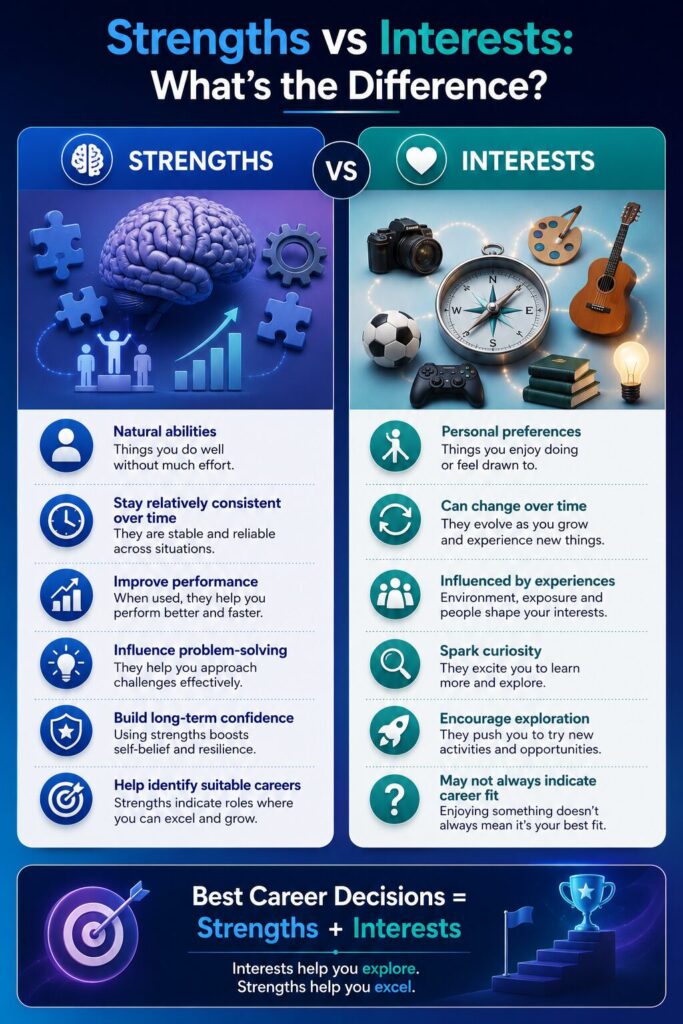
Many people use the words strengths and interests interchangeably, but they represent two very different aspects of a student’s personality.
An interest is something that captures your attention or curiosity. You may enjoy photography, coding, psychology, sports, gaming, or music. Interests often develop through exposure and can evolve significantly over time.
A strength, however, is a natural pattern of thinking or behaving that helps you perform consistently well. It represents the activities that feel energising rather than draining and the abilities that come naturally to you.
For example, two students may both be interested in medicine. One naturally enjoys analysing complex problems, communicating with people, and making thoughtful decisions under pressure. Another simply finds the profession prestigious because of family influence. Although their interests appear similar, their strengths are very different, which may lead to very different career outcomes.
Understanding this distinction is the first step toward making better career decisions.
Why Interests Alone Can Be Misleading
Interests are valuable because they encourage students to explore new possibilities. However, relying only on interests can sometimes lead to poor career decisions.
Think about how often interests change during school years. A student may become interested in animation after watching a movie, then shift to psychology after reading a book, and later dream of becoming an entrepreneur after watching motivational videos online.
This doesn’t mean those interests are meaningless. It simply shows that interests are influenced by experiences, people, trends, and exposure.
Many students also confuse hobbies with careers. Enjoying photography doesn’t necessarily mean becoming a professional photographer is the best career choice. Likewise, enjoying cricket doesn’t automatically mean becoming a professional athlete is the right path.
Social media has amplified this challenge. Students constantly see influencers, entrepreneurs, creators, and professionals showcasing exciting aspects of their careers without revealing the years of effort, discipline, and skills required behind the scenes.
Choosing a career based solely on temporary excitement can lead to disappointment when the reality of the profession doesn’t match expectations.
Why Strengths Are a Better Foundation for Career Decisions
Strengths provide a more reliable foundation because they remain relatively consistent throughout life.
Rather than focusing on what students like, strengths reveal how they naturally perform when solving problems, learning new concepts, collaborating with others, or making decisions.
Research from Gallup’s CliftonStrengths consistently shows that individuals who regularly use their strengths are more engaged and perform better at work than those who do not. This highlights the importance of understanding natural talents before making significant educational and career decisions.
For example, a student with strong analytical thinking may naturally enjoy solving complex problems across multiple fields, from engineering and finance to research and data science. Another student with exceptional communication strengths may thrive in teaching, psychology, marketing, or leadership roles regardless of their initial interests.
Strengths provide a stable foundation because they focus on how students naturally operate rather than what temporarily captures their attention.
This is why strengths-based career planning is becoming increasingly important for students navigating today’s rapidly changing career landscape.
The Best Career Decisions Combine Strengths and Interests
The debate shouldn’t be about choosing strengths versus interests. Instead, students should learn how they both complement each other.
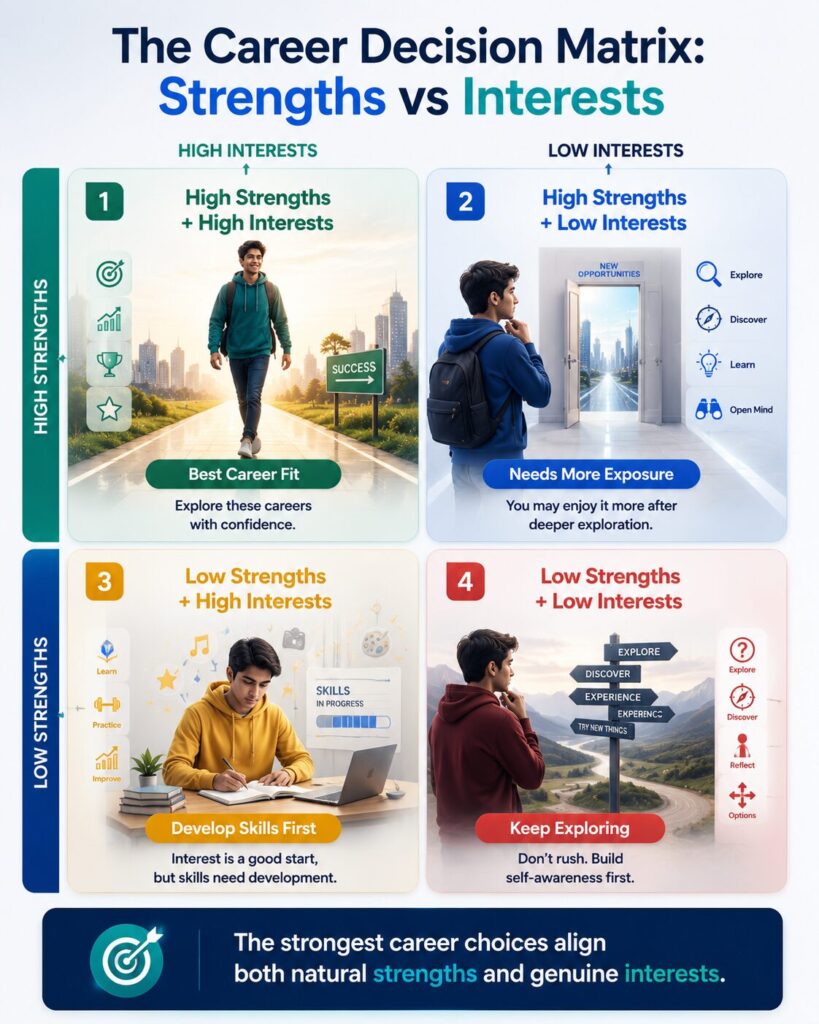
A practical way to think about career planning is through four possible combinations.
When students have high strengths and high interests, they have found an excellent career direction worth exploring in depth.
If they have strong strengths but low interest, they may simply need more exposure to understand the opportunities available in that field.
When students have a high interest but weaker strengths, they shouldn’t immediately abandon their dream. Instead, they should assess whether those skills can realistically be developed through practice and education.
If both strengths and interests are currently low, the priority should be exploration rather than making immediate career decisions.
Career planning becomes much easier when students stop asking, “What do I like?” and start asking, “Where can my natural strengths create long-term success?”
A Real-Life Example
Consider two students who both say they want to become doctors.
The first student has always enjoyed understanding scientific concepts, remains calm under pressure, communicates well with people, and genuinely enjoys solving complex health-related problems. Their strengths naturally align with the demands of the profession.
The second student also wants to become a doctor, but primarily because everyone in the family expects it or because society views medicine as prestigious. Their natural strengths, however, lie in creativity, visual thinking, storytelling, and innovation.
Although both students share the same interest, their long-term career satisfaction could be very different.
The first student is choosing a profession aligned with both strengths and interests. The second may eventually discover greater fulfilment in fields such as design, communication, digital media, or entrepreneurship.
This illustrates why career decisions should never rely on interests alone.
How Students Can Identify Their Natural Strengths
Many students assume strengths are difficult to identify, but they often reveal themselves through everyday experiences.
Students should pay attention to activities that feel effortless yet produce excellent results. They should notice the kinds of problems they enjoy solving, the compliments they consistently receive, and the situations where they feel energised instead of exhausted.
Teachers, parents, mentors, and classmates can also provide valuable feedback because they often recognise patterns that students overlook themselves.
Another effective approach is using structured strengths assessments and professional career guidance. These tools help students move beyond assumptions and identify strengths through evidence-based frameworks.
Developing self-awareness early enables students to make more informed academic choices and explore careers with greater confidence.
How Strengths Masters Helps Students Make Better Career Decisions
At Strengths Masters, we believe that career planning should begin with self-awareness rather than assumptions.
Many students spend months researching careers before understanding themselves. As a result, they compare options without knowing which ones genuinely align with their natural abilities.
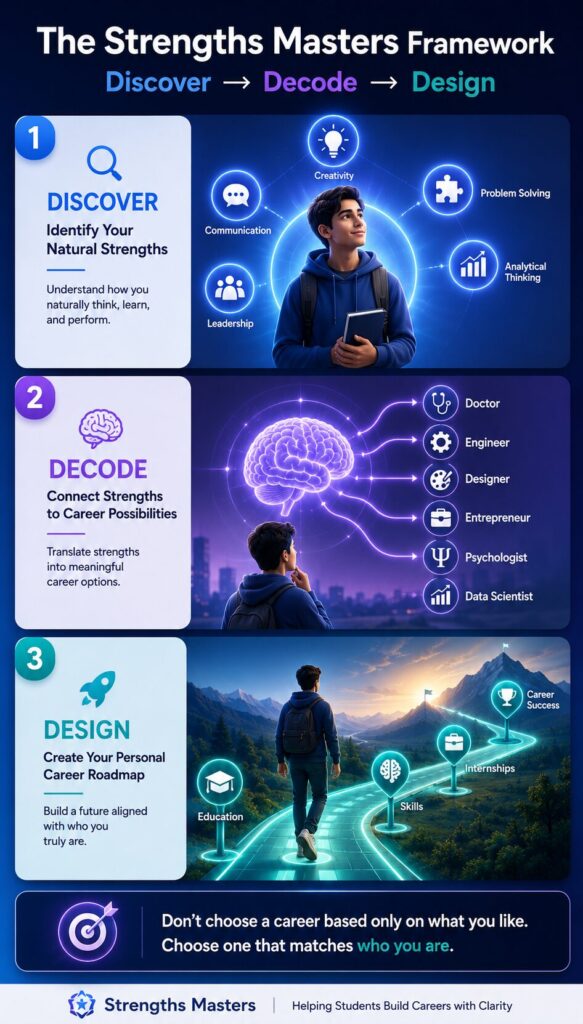
Our Strengths-Based Career Planning approach follows a simple three-step framework:
- Discover – Identify each student’s natural strengths and behavioural patterns.
- Decode – Translate those strengths into suitable career paths aligned with real-world opportunities.
- Design – Create a personalised roadmap that aligns education, career choices, and long-term growth.
Instead of asking students to fit into predefined career paths, we help them discover careers that fit who they naturally are.
This approach not only improves career clarity but also builds confidence, reduces confusion, and supports more informed decision-making for both students and parents.
Final Thoughts
Students often believe they must choose between following their interests and trusting their strengths. In reality, successful career planning requires understanding the relationship between both.
Interests open the door to exploration, but strengths determine where students are most likely to excel and sustain long-term success.
The future belongs to students who understand themselves before choosing a profession. Rather than chasing trends or comparing themselves with others, they focus on discovering how they naturally think, learn, and contribute.
When career decisions are rooted in self-awareness instead of uncertainty, students gain more than career clarity; they gain the confidence to build a future that truly reflects their potential.
Frequently Asked Questions:
1. Should students choose careers based on strengths or interests?
The best career decisions are based on both, but strengths should be the foundation. Interests help students explore possibilities, while strengths indicate where they are naturally capable of performing well. A career that aligns both strengths and interests is more likely to lead to long-term success, confidence, and satisfaction.
2. What is the difference between strengths and interests?
Strengths are your natural patterns of thinking, learning, and performing that help you excel consistently. Interests are activities or subjects you enjoy and are curious about. While strengths are relatively stable over time, interests can evolve as students gain new experiences. Understanding this difference helps students make smarter career decisions.
3. Can interests change over time?
Yes. Interests often change as students grow, learn new skills, meet different people, and gain exposure to new opportunities. A teenager who enjoys gaming today may later develop an interest in entrepreneurship or psychology. That’s why career planning should not rely only on current interests but also consider long-term strengths.
4. Why are strengths more reliable than interests?
Strengths are generally more reliable because they represent natural abilities that remain consistent across different situations. While interests may shift with age or exposure, strengths continue to influence how students solve problems, communicate, learn, and perform. This makes strengths a more dependable guide for long-term career planning.
5. How do strengths help in career planning?
Strengths help students identify careers where they are more likely to perform well, stay motivated, and achieve sustainable success. Instead of choosing a career based only on what seems exciting today, strengths-based career planning focuses on matching natural abilities with suitable career paths, leading to greater confidence and career clarity.
6. Should I follow my passion or my strengths?
Rather than choosing one over the other, students should understand how passion and strengths work together. Passion often grows as people become competent and successful in an area. A practical approach is to identify your strengths first, explore careers that match them, and then discover where your interests naturally deepen over time.
7. How can students identify their natural strengths?
Students can identify their natural strengths by observing activities they learn quickly, tasks they consistently perform well, problems they enjoy solving, and positive feedback they receive from teachers, parents, and mentors. Strengths assessments, reflective exercises, and guided career counselling can also provide deeper insights and help students make informed career choices.