


Key Takeaways
- Good marks measure academic performance but not complete career potential.
- Career success depends on a combination of strengths, skills, mindset, and adaptability.
- Examinations rarely measure communication, creativity, leadership, or emotional intelligence.
- Students who understand their natural strengths often make more confident career decisions.
- Parents should encourage career exploration alongside academic achievement.
- Strengths-based career planning helps students choose careers that fit who they are, not just what they scored.
Every Parent Wants Good Marks, but Are They Enough?
Imagine this.
Your child comes home with a report card showing 95% marks. As a parent, you’re naturally proud. Friends and relatives congratulate you, teachers praise your child, and it feels like their future is secure.
Now imagine another student who scores around 70%. While everyone worries about their future, that student eventually builds a successful career, enjoys their work, and grows into a confident professional.
This isn’t an unusual story. In fact, it’s becoming increasingly common.
Every year, thousands of students achieve excellent academic results, yet many struggle to answer one simple question:
“What career is right for me?”
At the same time, many students with average grades go on to become successful entrepreneurs, designers, consultants, business leaders, researchers, creators, and innovators.
So what creates this difference?
The answer lies in understanding one important truth:
Good marks measure academic performance, but they do not measure a student’s complete career potential.
Marks certainly matter. They can open opportunities, help students qualify for universities, and reflect dedication during examinations. However, long-term career success depends on much more than examination scores alone.
Today’s workplaces value qualities such as problem-solving, adaptability, communication, creativity, emotional intelligence, collaboration, and continuous learning abilities that traditional examinations rarely measure.
For parents, this shift can feel confusing. For decades, academic excellence was considered the safest path to success. But today’s career landscape is changing rapidly, making it essential to look beyond report cards when helping students make career decisions.
In this article, you’ll learn:
- What good marks actually measure.
- Why academic scores alone cannot predict career success.
- What research says about long-term career growth.
- A real-life case study that illustrates this challenge.
- What parents and students should focus on instead.
- How strengths-based career planning leads to better career clarity.
Why Parents Often Believe Good Marks Guarantee Career Success
Most parents don’t focus on marks because they want to pressure their children. They do it because they genuinely want to secure their child’s future.
For many families, good marks have traditionally represented discipline, intelligence, and the promise of a stable career. Earlier, career options were relatively limited, and academic performance often determined access to prestigious professions like engineering, medicine, or government services.
This belief has been passed down through generations.
Parents often think:
- “If my child scores well, they’ll get into a good college.”
- “A good college guarantees a good job.”
- “A good job guarantees a successful life.”
While this logic made sense in the past, today’s world is far more dynamic.
Technology is transforming industries, entirely new careers are emerging, and employers increasingly value practical skills, adaptability, and real-world problem-solving alongside academic qualifications.
This means that marks are one piece of the puzzle, not the complete picture.
Understanding this distinction doesn’t reduce the importance of education. Instead, it helps parents support their children more effectively by focusing on both academic excellence and career readiness.
What Good Marks Actually Measure
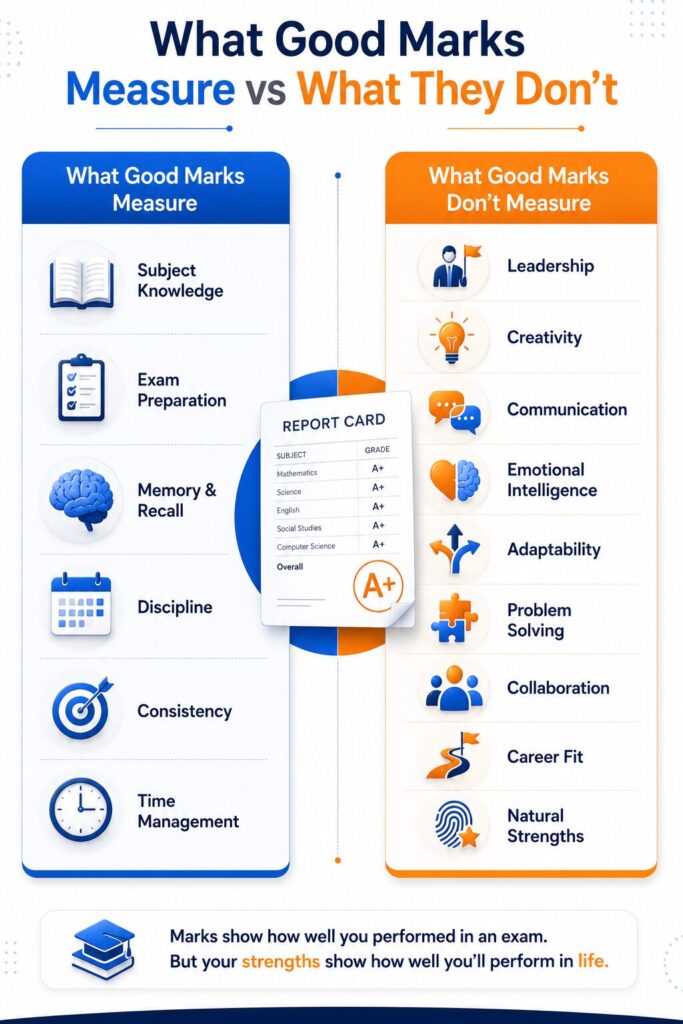
Before discussing what marks don’t measure, it’s important to appreciate what they do represent.
Good academic performance usually reflects several valuable qualities:
- Strong subject knowledge
- Consistent effort
- Discipline and study habits
- Ability to prepare for examinations
- Time management
- Commitment towards academic goals
These qualities are undoubtedly important and often contribute to future success.
However, examinations are designed to evaluate performance within a structured academic environment. They cannot fully assess many abilities that determine how well someone performs in real workplaces.
For example, marks generally do not measure:
- Leadership ability
- Creativity and innovation
- Communication skills
- Emotional intelligence
- Decision-making under uncertainty
- Curiosity
- Adaptability
- Collaboration
- Entrepreneurial thinking
- Natural behavioural strengths
A student may excel at memorising concepts and performing well in examinations, yet struggle when faced with open-ended challenges that require independent thinking or collaboration.
Similarly, another student with average marks may possess exceptional creativity, interpersonal skills, or strategic thinking qualities that become invaluable throughout their career.
This is why academic performance should be viewed as one indicator of potential rather than the only indicator of future success.
Why Good Marks Alone Don’t Predict Career Success
One of the biggest misconceptions in education is that academic excellence automatically leads to professional success.
Research suggests otherwise.
As workplaces evolve, employers increasingly seek individuals who can solve problems, work collaboratively, adapt to change, and continuously learn new skills.
The World Economic Forum’s Future of Jobs Report highlights that analytical thinking, resilience, flexibility, leadership, curiosity, and lifelong learning are among the most valuable skills for the future workforce.
Similarly, Gallup’s strengths-based research shows that individuals who understand and use their natural strengths are more engaged, productive, and likely to perform better in their roles.
This doesn’t mean marks are unimportant.
Rather, it means that marks alone cannot answer important career questions such as:
- Is this career aligned with my natural strengths?
- Will I enjoy this work over the next 20 years?
- Can I continue growing in this profession?
- Does this career match the way I naturally think and solve problems?
These questions require much deeper self-awareness than an examination score can provide.
Parents often witness this firsthand.
Some students consistently score above 90% but remain confused about choosing a career because they have never explored their strengths, interests, or working style.
Others may perform moderately in school yet thrive once they discover careers that align with how they naturally learn, communicate, and contribute.
This is why career planning should begin with understanding the student, not just understanding their report card.
Detailed Case Study: When High Marks Didn’t Lead to Career Clarity
To understand why marks alone cannot guarantee career success, let’s look at a realistic example based on common career counselling scenarios.
Case Study: Aarav’s Journey from Academic Excellence to Career Clarity
Aarav was a Class 12 student who had consistently scored above 93% throughout school. His teachers admired his discipline, relatives often called him “the future engineer,” and his parents believed he had a secure future because of his excellent academic record.
When it came time to choose a career, everyone assumed engineering was the obvious choice.
But there was one problem.
Whenever someone asked Aarav why he wanted to become an engineer, he struggled to answer. His response was usually:
“I’m good at studies, so engineering seems like the best option.”
During a career discovery process, a different picture emerged.
Although Aarav performed well academically, his natural strengths were:
- Strategic thinking
- Communication
- Relationship building
- Curiosity about business
- Creative problem-solving
He enjoyed leading school events, discussing ideas, and presenting projects far more than spending hours solving technical problems.
His marks reflected discipline and academic ability, but they did not reveal what kind of work would energise him every day.
After exploring different career paths aligned with his strengths, Aarav discovered that careers in management, consulting, and entrepreneurship matched his natural way of thinking much better.
Today, instead of chasing a career simply because of his marks, he has a clear roadmap based on his strengths, interests, and long-term goals.
Key Learning
Aarav’s success wasn’t limited by his marks; it was unlocked when he understood who he was beyond his report card.
This is a challenge many families face. Marks help students enter opportunities, but strengths help them thrive within those opportunities.
What Predicts Career Success Better Than Marks?
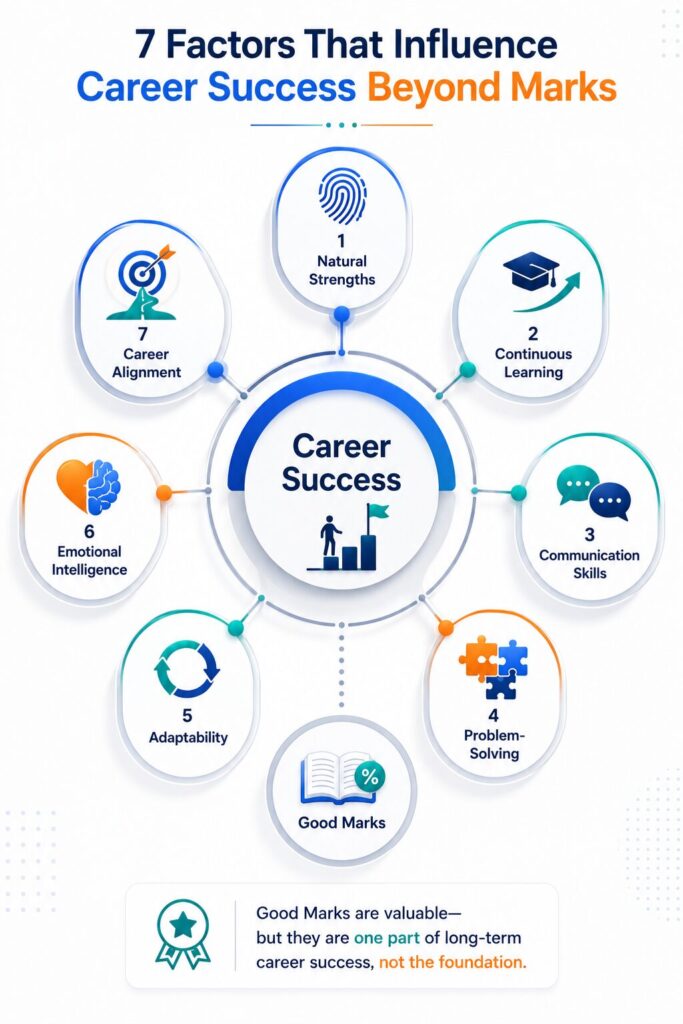
If marks aren’t the complete answer, what actually contributes to long-term career success?
Research consistently shows that a combination of personal strengths, skills, mindset, and adaptability influences career success.
Here are seven factors that matter significantly.
1. Natural Strengths
Natural strengths are the activities and ways of thinking that come naturally to an individual.
Unlike temporary interests, strengths tend to remain relatively stable over time and influence how people perform in different environments.
When students build careers around their strengths, they often experience:
- Higher confidence
- Better performance
- Greater engagement
- Increased satisfaction
Rather than asking, “Which subject scores highest?”, students should also ask:
“What am I naturally good at?”
2. Continuous Learning
Today’s careers evolve rapidly.
The skills required five years ago may no longer be enough tomorrow.
Successful professionals continuously:
- Learn new technologies
- Upgrade their knowledge
- Develop new skills
- Stay curious
Learning doesn’t stop after school or college; it becomes a lifelong habit.
3. Problem-Solving Ability
Employers don’t simply hire people because they scored well on examinations.
They hire people who can solve meaningful problems.
Whether someone works in healthcare, engineering, design, marketing, finance, or education, their ability to analyse situations and find effective solutions often matters more than their exam scores.
4. Communication Skills
Many talented students struggle professionally because they cannot communicate their ideas clearly.
Communication includes:
- Listening
- Presenting ideas
- Writing effectively
- Collaborating with teams
- Building relationships
These skills are rarely reflected in a report card but have a significant impact on career growth.
5. Adaptability
Industries change.
Technology changes.
Job roles change.
People who adapt quickly remain valuable regardless of market changes.
Adaptability helps professionals:
- Learn faster
- Handle uncertainty
- Explore new opportunities
- Remain employable
6. Emotional Intelligence
Career success isn’t only about intelligence.
It’s also about understanding people.
Emotional intelligence helps individuals:
- Manage stress
- Handle conflicts
- Work in teams
- Build trust
- Lead effectively
These abilities become increasingly important as careers progress.
7. Career Alignment
Even highly capable students may struggle if they choose careers that don’t align with their natural strengths.
A student who naturally enjoys analysing data may feel frustrated in a highly social sales role.
Similarly, someone with strong communication and relationship-building skills may struggle in work that requires long hours of isolated technical tasks.
Career success improves significantly when students choose roles that align with who they naturally are.
What Should Students Focus On Instead?
Instead of measuring success only through examination scores, students should adopt a broader approach to career development.
The first step is developing self-awareness. Understanding natural strengths, personality, preferred learning style, and working preferences provides a much stronger foundation for career decisions than marks alone.
The second step is building relevant skills. Communication, digital literacy, teamwork, leadership, and critical thinking have become essential across almost every profession.
Students should also actively explore careers rather than choosing paths based only on popularity or societal expectations. Speaking with professionals, attending career workshops, participating in internships, and gaining practical exposure can provide valuable insights that textbooks cannot.
Finally, students should embrace continuous learning. Career success today is less about knowing everything and more about being willing to learn throughout life.
What Can Parents Do?
Parents continue to play one of the most influential roles in a student’s career journey.
Instead of focusing only on report cards, parents can help children develop confidence, self-awareness, and informed decision-making.
Here are a few practical ways to support them:
- Celebrate effort and learning, not just marks.
- Encourage curiosity and exploration.
- Ask reflective questions instead of giving immediate career advice.
- Avoid comparing children with others.
- Help identify natural strengths through observation and meaningful conversations.
- Support career decisions based on long-term fit rather than short-term prestige.
When parents shift the conversation from “How many marks did you score?” to “What kind of work helps you perform at your best?”, they create an environment where children can make better career decisions.
How Strengths Masters Helps Students Build Careers Beyond Marks
At Strengths Masters, we believe that marks are an important milestone, but they should never become the only basis for a student’s career decisions.
Our approach is built around one simple idea:
The best career decisions are made when students first understand themselves, and then explore opportunities that align with their natural strengths.
Instead of asking,
“Which career has the highest salary?”
We encourage students to ask,
- What am I naturally good at?
- Which activities energise me?
- Where can I create the greatest impact?
- Which career matches both my strengths and future opportunities?
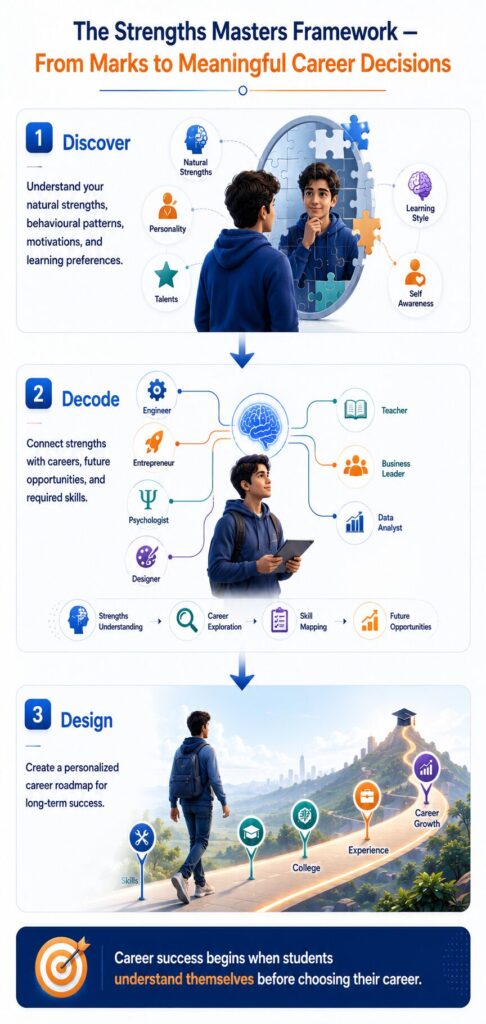
To make this process simple, we follow our proprietary framework:
The Strengths Masters Framework
1. Discover
Students identify their natural strengths, behavioural patterns, motivations, and learning preferences.
Rather than focusing only on academic scores, we help them understand how they naturally think, learn, and perform best.
2. Decode
The identified strengths are interpreted and connected to suitable career pathways.
Students gain clarity on:
- Careers aligned with their strengths
- Skills they need to develop
- Potential challenges
- Future opportunities
3. Design
Finally, students create an actionable career roadmap.
This includes:
- Career exploration
- Skill development
- Subject selection
- College planning
- Long-term career strategy
Instead of choosing careers based on marks alone, students begin making informed decisions based on self-awareness, evidence, and future readiness.
Conclusion
Good marks deserve appreciation because they reflect dedication, discipline, and academic achievement. They can help students gain admission to colleges and create valuable opportunities.
However, marks alone cannot predict whether a student will enjoy their career, remain motivated, adapt to change, or achieve long-term professional success.
The world of work has evolved. Employers increasingly value problem-solving, communication, adaptability, emotional intelligence, creativity, and continuous learning alongside academic knowledge.
This is why parents should see report cards as one part of the story, not the entire story.
Instead of asking,
“How many marks did my child score?”
try asking,
“What are my child’s natural strengths, and how can those strengths shape a meaningful career?”
When students understand who they are before deciding what they want to become, they make career choices with greater confidence, clarity, and purpose.
Because in the end, good marks may open doors, but natural strengths help students build fulfilling and sustainable careers.
Strengths Masters Insight
One of the most common patterns we observe is that students with excellent marks are not always the students with the greatest career clarity. Academic success answers “How well did I perform in school?”, whereas career clarity answers “Where can I perform at my best for the next 30 years?” Helping students discover this difference early leads to more informed, confident, and sustainable career decisions.
Frequently Asked Questions:
1. Do good marks guarantee career success?
No. Good marks indicate strong academic performance, discipline, and subject knowledge, but they do not guarantee long-term career success. Today’s employers also value communication, problem-solving, adaptability, emotional intelligence, creativity, and leadership. Students who combine academic achievement with their natural strengths and real-world skills are more likely to build successful and fulfilling careers.
2. Why are marks not enough?
Marks measure how well a student performs in exams, but they do not assess many of the skills required in modern careers. Success today depends on critical thinking, collaboration, resilience, continuous learning, and the ability to solve real-world problems. Academic excellence creates opportunities, but long-term career growth requires much more than high grades.
3. Why do some toppers struggle later?
Many toppers excel in structured academic environments but may struggle when careers demand decision-making, communication, leadership, adaptability, and practical problem-solving. Without career clarity or an understanding of their natural strengths, even high-performing students can feel uncertain about career choices or workplace challenges.
4. Can average students become successful?
Absolutely. Academic scores do not define a student’s future potential. Many successful professionals were average students who discovered their strengths, developed valuable skills, stayed consistent, and chose careers aligned with their abilities. Career success is built through continuous learning, self-awareness, and perseverance, not marks alone.
5. What matters more than marks?
Marks are important, but they are only one part of career readiness. Long-term success depends on a combination of natural strengths, practical skills, communication, emotional intelligence, adaptability, curiosity, and career alignment. Students who understand how they naturally perform best are often better equipped to make confident career decisions.
6. What role do strengths play?
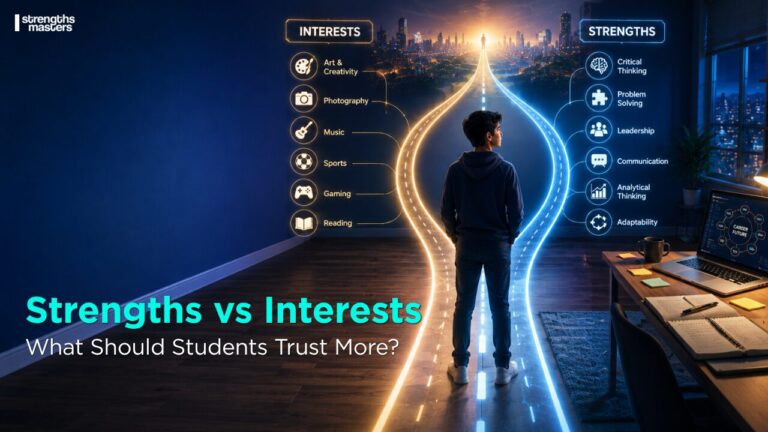
Natural strengths help students identify where they are most likely to perform well, stay motivated, and achieve long-term success. Unlike interests, which can change over time, strengths are more consistent patterns of thinking, learning, and performing. A strengths-based approach helps students choose careers that match who they are, not just what they score.
7. How should parents think about marks?
Parents should view marks as one indicator of academic progress rather than the sole measure of potential. Along with celebrating good grades, they should encourage self-awareness, career exploration, skill development, and confidence. Helping children discover their strengths prepares them for meaningful careers, not just successful exams.
8. What should students focus on besides academics?
In addition to academics, students should develop communication skills, critical thinking, leadership, emotional intelligence, adaptability, teamwork, digital skills, and problem-solving abilities. Exploring different career options and understanding their natural strengths can help them make informed decisions and stay future-ready.
9. How does Strengths Masters help?
Strengths Masters helps students move beyond marks by identifying their natural strengths and connecting them to suitable career paths. Through the Discover → Decode → Design framework, students gain greater self-awareness, career clarity, and a personalised roadmap for future success. Instead of choosing careers based only on grades or trends, they make evidence-based decisions aligned with their strengths, interests, and long-term goals.


Great content! Keep up the good work!