


- When Your Child Says, “I Don’t Know What I Want to Become”
- Is It Normal for Teenagers to Have No Career Interest?
- Why Students Often Have No Career Interest
- A Strengths Masters Observation
- Signs That Your Child Needs Exploration, Not Pressure
- A Real-Life Example
- Why Pressure Usually Makes Things Worse
- What Parents Should Do Instead
- The Strengths Masters Approach to Career Clarity
- A Strengths Masters Insight
- Final Thoughts
- Frequently Asked Questions:
When Your Child Says, “I Don’t Know What I Want to Become”
Few things worry parents more than hearing their child say:
“I don’t know what I want to do in life.”
For many families, this statement immediately raises concerns. Parents begin wondering whether their child lacks ambition, is wasting time, or is falling behind their peers.
In reality, this situation is far more common than most people realise.
At Strengths Masters, we frequently interact with students who seem completely uninterested in careers. However, after deeper conversations, we often discover something important: the issue is usually not motivation. It is a lack of clarity.
Many students are trying to answer one of the most complex questions of adolescence:
Who am I, and where do I fit?
Expecting immediate answers to this question can create unnecessary pressure. Career interest often develops gradually as students understand themselves better and gain exposure to different opportunities.
Is It Normal for Teenagers to Have No Career Interest?
Yes. In many cases, it is completely normal.
Teenagers today are growing up in a world with more career options than ever before. Traditional professions still exist, but entirely new careers continue to emerge across technology, media, healthcare, business, and the creator economy.
At the same time, students are dealing with academic pressure, social expectations, and uncertainty about the future.
Research from the Organisation for Economic Co-operation and Development (OECD) suggests that many young people struggle to connect education with future careers because they have limited career exposure and insufficient guidance.
Simply put, many students are not uninterested in careers. They are overwhelmed by choices and uncertain about where to begin.
Why Students Often Have No Career Interest
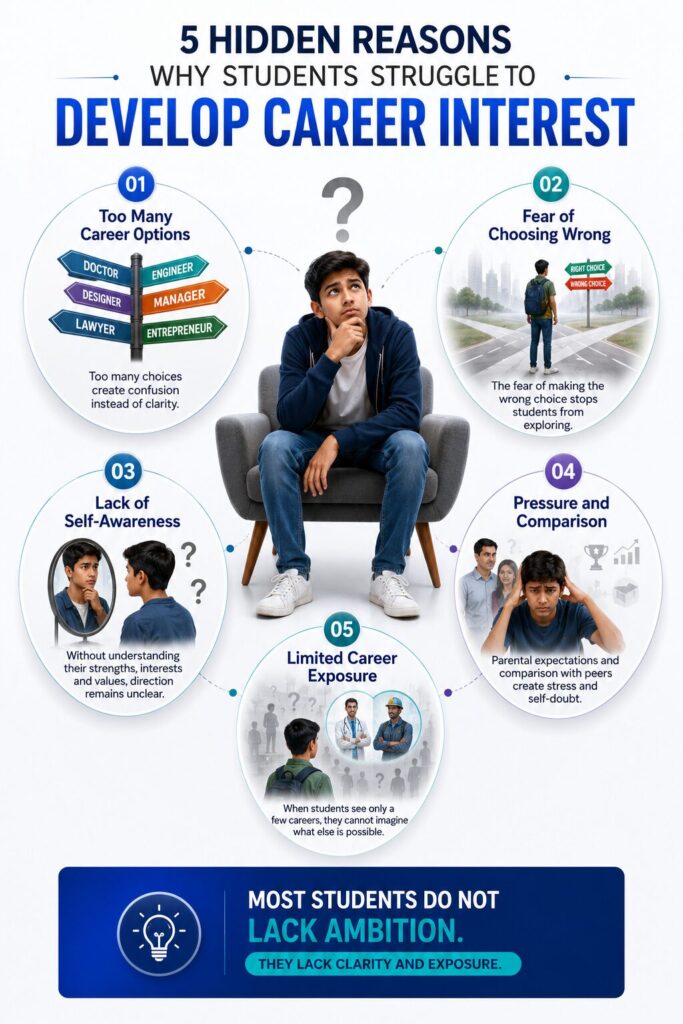
1. They Have Too Many Options
Students today are exposed to hundreds of career possibilities through social media, YouTube, and the internet.
While this access creates opportunities, it can also lead to confusion.
Instead of gaining clarity, many students experience decision paralysis.
2. They Fear Making the Wrong Decision
Students often believe that choosing one career means closing the door on every other possibility.
This pressure makes decision-making difficult.
As a result, many avoid thinking about careers altogether.
3. They Do Not Know Their Strengths
One of the biggest reasons students struggle with career interest is a lack of self-awareness.
They may know different professions exist, but they do not understand:
- How they naturally think
- What energises them
- How do they solve problems
- What environments help them perform best
Without this understanding, every career option feels equally confusing.
4. They Experience Pressure and Comparison
Many students hear statements like:
“Your friend already knows what he wants to become.”
“You should think seriously about your future.”
“At your age, I already had everything planned.”
Although these comments often come from good intentions, they can increase anxiety and reduce confidence.
5. They Have Limited Career Exposure
Students cannot develop an interest in opportunities they have never experienced.
Many only know a small number of professions, such as:
- Doctor
- Engineer
- Lawyer
- Government Officer
Limited exposure naturally limits curiosity.
A Strengths Masters Observation
At Strengths Masters, we often observe that students who say,
“I don’t know what I want to become,”
They are usually trying to choose careers before understanding themselves.
They are expected to make major decisions without first discovering their strengths, preferences, and natural ways of learning.
The issue is rarely a lack of ambition.
More often, it is a lack of self-understanding.
Signs That Your Child Needs Exploration, Not Pressure
Parents sometimes misinterpret career confusion as laziness.
However, some signs indicate students need exploration rather than pressure.
Your child may:
- Avoid career conversations
- Change career preferences frequently
- Show curiosity, but no clear direction
- Feel anxious when discussing the future
- Frequently say, “I don’t know”
These behaviours often indicate uncertainty, not a lack of interest.
A Real-Life Example
A Grade 11 student repeatedly told his parents:
“I don’t know what I want to become.”
His parents became increasingly worried because his friends already seemed to have clear plans.
During strengths exploration, we discovered that the student naturally demonstrated:
- Strong communication abilities
- Curiosity about human behaviour
- Strategic thinking
- Leadership tendencies
The student was not unmotivated.
He simply had never explored careers aligned with these strengths.
After gaining more self-awareness and exposure to different possibilities, he became significantly more engaged in career exploration.
This situation is more common than many parents realise.
Why Pressure Usually Makes Things Worse
Parents naturally want certainty.
However, pressure often produces the opposite result.
When students feel forced to make decisions before they are ready, they may experience:
- Fear of failure
- Reduced confidence
- Decision paralysis
- Increased avoidance
- Greater confusion
Career decisions made under pressure often focus on pleasing others rather than understanding personal fit.
In the long run, this can lead to dissatisfaction and disengagement.
What Parents Should Do Instead
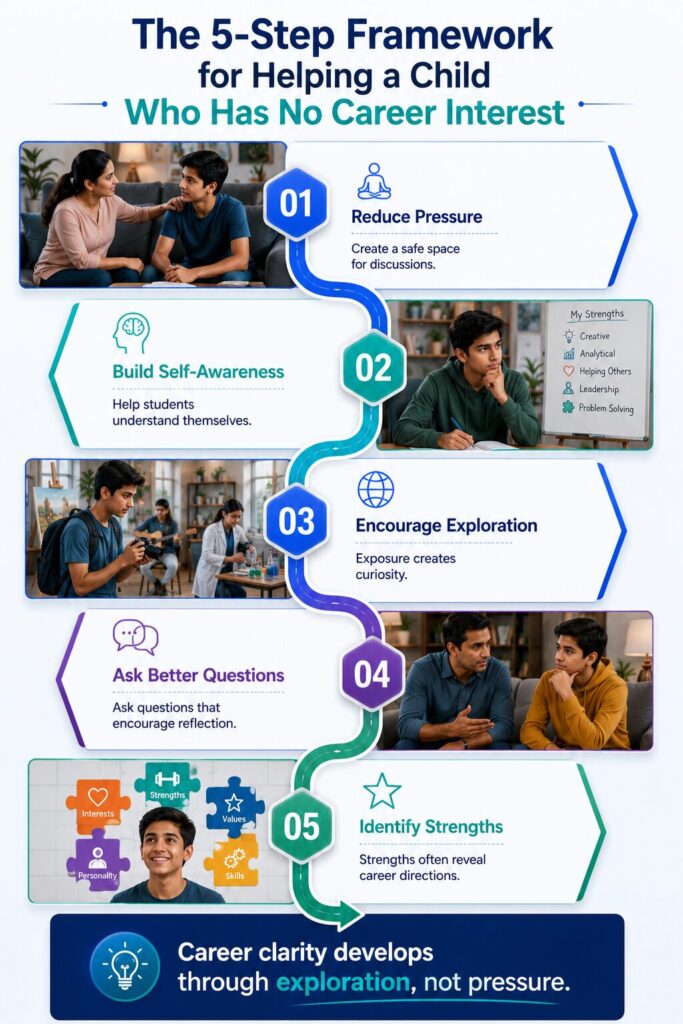
1. Reduce Immediate Pressure
Students do not need all the answers today.
Replace questions like:
“Have you decided on your career?”
with:
“What subjects or activities do you enjoy exploring?”
The goal is to create conversation, not urgency.
2. Focus on Self-Discovery
Career planning should begin with understanding the student.
Encourage your child to explore:
- Strengths
- Learning preferences
- Interests
- Values
- Problem-solving styles
Self-awareness often creates the foundation for future career clarity.
3. Encourage Exploration
Exploration builds curiosity.
Students can explore through:
- Projects
- Reading
- Internships
- Competitions
- Workshops
- Conversations with professionals
Career interest often develops after exposure.
4. Ask Better Questions
The quality of questions influences the quality of insights.
Try asking:
- What activities give you energy?
- What kind of problems do you enjoy solving?
- What do people appreciate about you?
- When do you feel most confident?
These conversations encourage reflection and self-discovery.
5. Help Them Identify Their Strengths
Strengths often provide clues about future possibilities.
According to the World Economic Forum’s Future of Jobs Report, skills such as analytical thinking, problem-solving, resilience, creativity, and leadership continue to increase in importance.
Many of these capabilities emerge from underlying strengths.
Understanding strengths does not automatically reveal one perfect career.
However, it often helps students identify directions where they are more likely to thrive.
The Strengths Masters Approach to Career Clarity
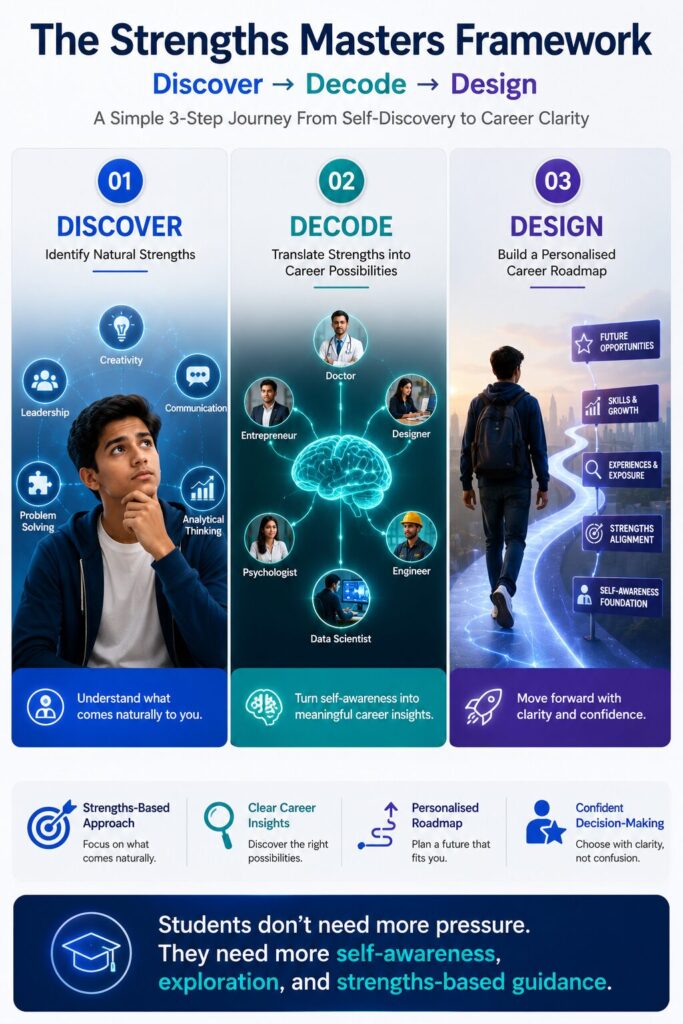
At Strengths Masters, we believe career planning should begin with self-awareness.
Our framework follows three stages:
Discover
Students identify their natural strengths, behavioural patterns, and ways of learning.
Decode
These strengths are translated into meaningful career insights and possibilities.
Design
Students create a personalised roadmap that helps them make informed and confident decisions.
This process shifts career planning from guesswork to clarity.
A Strengths Masters Insight
Career interests usually develop after students better understand themselves.
When students know:
- How they think
- What motivates them
- Where they perform naturally
- Which environments suit them
Career possibilities become easier to explore. Students often do not need more pressure. They need more self-awareness, more exploration, and more meaningful guidance.
Final Thoughts
A child with no career interest is not necessarily lazy, careless, or irresponsible. More often than not, they are standing at the beginning of a journey that requires patience and discovery. Career clarity rarely appears overnight. It develops through self-understanding, exploration, and strengths-based guidance.
As parents, perhaps the most helpful question is not:
“What do you want to become?”
Instead, ask:
“What helps you become your best self?”
Because when students understand themselves first, career direction often follows naturally.
Frequently Asked Questions:
1. Why does my child have no career interest?
A lack of career interest usually does not mean a child is lazy or unmotivated. Many students feel overwhelmed by the sheer number of career options, fear making the wrong choice, have limited exposure to different professions, or lack self-awareness about their strengths and preferences. In most cases, students need clarity and exploration rather than pressure.
2. What should parents do if their child has no career goals?
Parents should avoid rushing their child into making decisions. Instead, create a supportive environment where your child can explore interests, try new experiences, ask questions, and understand their natural strengths. Career clarity develops gradually through self-discovery and exposure.
3. Is it normal for teenagers to have no career interest?
Yes, it is completely normal. Adolescence is a period of self-discovery, and many teenagers are still learning about themselves and the world of work. Not having clear career interests at this stage is common and should be viewed as an opportunity for exploration rather than a problem.
4. How can parents motivate children to explore careers?
Parents can motivate children by exposing them to different career paths through conversations with professionals, workshops, projects, books, internships, and real-life experiences. The goal is to spark curiosity, not force decisions. Encouragement and open discussions are usually more effective than pressure.
5. How do I help my child discover career interests?
Start by helping your child understand which activities energise them, which problems they enjoy solving, and where their natural strengths consistently appear. Encourage them to experiment with different experiences and reflect on what they enjoy and do well. Interests often emerge through exploration and self-awareness.
6. Why are students confused about careers?
Students today are exposed to hundreds of career options, social media success stories, family expectations, and changing job markets. This abundance of information often leads to decision paralysis and confusion. Many students struggle because they are trying to choose careers before understanding themselves.
7. How can strengths help students gain career clarity?
Strengths provide valuable insights into how students naturally think, learn, communicate, and solve problems. When students understand their strengths, they can identify career directions that align with who they are. A strengths-based approach helps students make more informed and confident career decisions instead of choosing careers based solely on trends or external pressure.