


The decision that feels small, but isn’t
Class 10 results don’t just bring marks. They bring a question that almost every student and parent struggles with:
Which stream should I choose after 10th?
Science, Commerce, or Humanities.
On paper, it looks like a simple academic decision. But in reality, it shapes the next few years of a student’s life. Subjects change. Peer groups shift. Career paths start narrowing or opening. And yet, most students reach this point without any real clarity.
Not because they aren’t capable. But because they’re trying to decide without understanding themselves first.
Why career planning after 10th matters more than people think
Let’s clear a common misconception.
Choosing a stream after 10th is not choosing your entire career. But it does influence:
- What subjects will you study deeply
- Which entrance exams can you take
- What career options after 10th remain open or restricted
So while it’s not permanent, it’s definitely foundational. And here’s where it gets interesting. According to a large-scale OECD study covering over 80 countries, a significant portion of students show high uncertainty about their career plans, and this confusion is linked to poorer employment outcomes later in life
That’s not just theory. That’s long-term impact.
The real problem: students are choosing without clarity
If you observe closely, most stream selection after the 10th follows a predictable pattern.
Students rely on:
- Marks (“Science mein ache marks aaye, toh science le lete hain”)
- Peer decisions
- Parent advice
- Perceived “scope”
- Coaching institute influence
These are not wrong inputs. But they are incomplete. Because they don’t answer the most important question:
How to choose a career after 10th based on the student’s actual fit?
That’s why many students start doubting their decision in Class 11 itself.
The myth that drives most wrong decisions
Let’s address the biggest one.
“Science le lo, sab options open rahenge.”
It sounds practical. And to some extent, it is. But here’s the part that gets ignored. Options are only useful if you can sustain the path.
Science in Classes 11–12 demands:
- Strong conceptual clarity
- Consistent effort
- Comfort with abstract thinking
If a student doesn’t naturally connect with this way of learning, those “open options” quickly turn into pressure.
So the real question is not:
Science, Commerce, Arts, which is better?
The real question is:
Which stream fits this student’s way of thinking and learning?
What research actually says about career planning
Let’s step back from opinions and look at data.
Research from OECD shows that:
- Students who engage in career planning activities early are more likely to achieve better job outcomes later
- Yet, less than half of students have meaningful exposure, like workplace visits or career exploration, by age 15
- At the same time, student career choices are highly concentrated, with nearly 50% aiming for just a small set of jobs
What does this mean in simple terms?
– Students think they have many career options
– But they are actually choosing from a narrow, crowded set
– And most are doing it without enough real exposure
That’s exactly where confusion begins.
So, what should career planning after 10th actually look like?
Instead of starting with streams, start with the student.
Not in a vague “follow your passion” way. But in a structured way.
Good career planning after 10th involves understanding:
- How the student thinks (logical, creative, analytical)
- How they learn (conceptual vs practical)
- What kind of work can they sustain over time
- Their natural strengths and patterns
Because here’s the truth. Marks can change. Interests can evolve. But patterns stay more consistent. And that’s where clarity comes from.
A simple framework to choose the right stream
If you’re wondering how to decide a stream after 10th for students, this process works far better than guesswork.
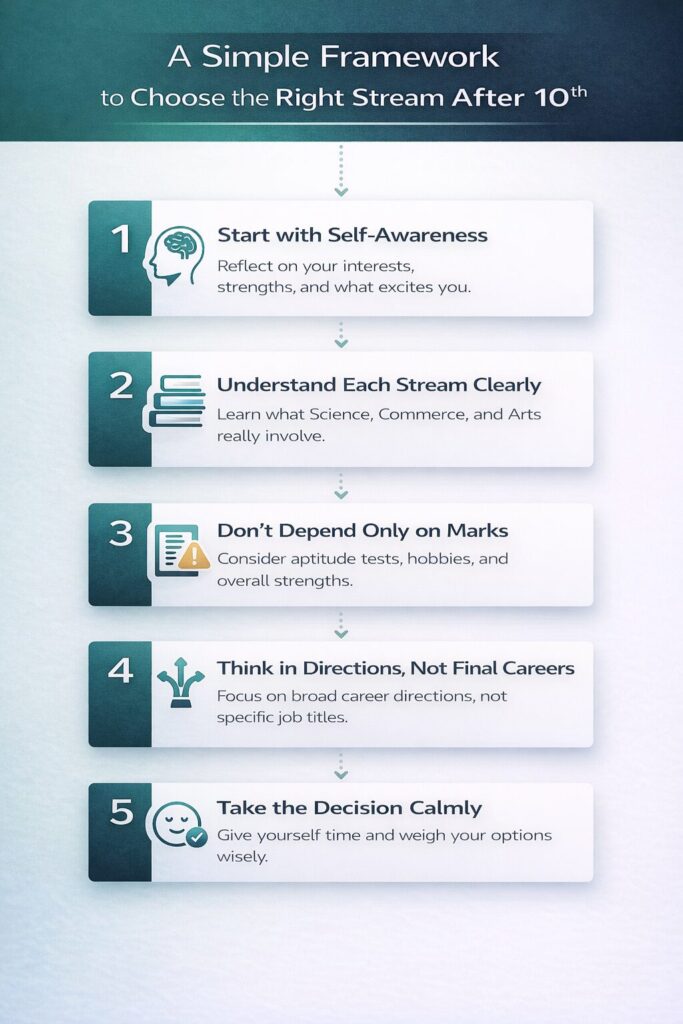
1. Start with self-awareness
Before looking at streams, understand the student.
Ask:
- Which subjects feel natural, not forced?
- What kind of thinking comes easily?
- Where does the student stay consistent?
For example:
- Logical + analytical → Science / Commerce
- Business + numbers → Commerce
- Communication + creativity → Humanities
This is the foundation of Strengths-Based Career Planning.
2. Understand each stream clearly
Many wrong decisions happen because students don’t fully understand streams.
Let’s simplify:
Science
- Subjects: Physics, Chemistry, Maths / Biology
- Requires analytical and conceptual thinking
- Career options after 10th: Engineering, medicine, tech, research
Commerce
- Subjects: Accounts, Economics, Business Studies
- Focus: Finance, business, numbers
- Careers: CA, finance, management, entrepreneurship
Humanities
- Subjects: Psychology, Sociology, Political Science, English
- Focus: People, society, ideas
- Careers: Law, psychology, design, media, civil services
There is no best stream after the 10th for students.
There is only the best-fit stream.
3. Don’t depend only on marks
Marks are important, but incomplete.
They show:
- Performance
- Effort
But they don’t show:
- Interest
- stamina
- long-term engagement
Two students can score 90 in science. One enjoys it, the other feels drained.
Same marks. Different outcomes.
So instead of asking:
“What did you score?”
Ask:
“Did you enjoy the process?”
4. Think in directions, not final careers
You don’t need to decide your entire career now.
You just need to choose a direction.
- Problem-solving → Science / Commerce
- Business mindset → Commerce
- Creativity/people → Humanities
This keeps flexibility intact while still being intentional.
5. Take the decision calmly
Most mistakes happen due to urgency.
“Forms close ho rahe hain”
“Sabne decide kar liya”
But clarity rarely comes from pressure.
Take time to:
- Discuss
- Explore
- Reflect
A thoughtful decision now saves years of confusion later.
Where do most students go wrong?
The typical path looks like this:
Choose stream → Adjust → Doubt → Switch
A better approach looks like this:
Understand student → Explore → Choose stream
That one shift changes everything.
The role of parents in this decision
Parents are deeply involved at this stage.
They want:
- Stability
- Good career growth
- Security
That’s valid.
But sometimes decisions become more about safety than fit.
A better approach:
- Observe patterns over time
- Ask questions instead of directing
- Encourage exploration
- Stay involved, but not controlling
When students feel understood, they make better decisions.
A smarter way to approach stream selection after the 10th
This is where structured guidance makes a real difference.
Instead of guessing, Strengths-Based Career Planning for students helps:
- Identify top strengths
- Understand thinking patterns
- Match strengths with career paths
- Guide stream selection clearly
At Strengths Masters, this is done through a structured process:
Discover – Decode – Design
- Discover: Identify natural strengths and patterns
- Decode: Analyse with a certified strengths psychologist
- Design: Create a clear stream and career direction
This removes confusion and replaces it with clarity.
Final thought
Career planning after 10th is not about getting it perfect. It’s about getting it clear enough. Students don’t need more options. They need a better understanding. Parents don’t need more pressure. They need better direction. And when both come together, the question:
Which stream should I choose after 10th?
stops feeling overwhelming. And starts feeling… clear.
Frequently Asked Questions:
1) How to decide a stream after 10th for students?
To decide the right stream after 10th, students should evaluate their strengths, interests, and learning style first. Instead of relying only on marks, compare personal fit with what each stream demands before making a decision.
2) What factors should be considered in career planning after 10th?
Key factors include the student’s natural strengths, subject interest, learning ability, career goals, and future opportunities. A balanced decision considers both personal fit and practical career scope.
3) Is science the best stream after 10th for students?
Science is not the best stream for everyone. It suits students who are comfortable with analytical thinking and conceptual subjects. The best stream depends on the student’s strengths, not popularity or marks alone.
4) How important is career guidance after 10th for students?
Career guidance after 10th is very important because it helps students make informed decisions. Proper guidance reduces confusion, improves clarity, and leads to better academic and career outcomes.
5) What are the most common mistakes in stream selection after the 10th?
Common mistakes include choosing based on marks, following peers, ignoring personal interests, and relying only on external advice. These often lead to confusion and dissatisfaction later.
6) Which stream should I choose after 10th for a successful career?
There is no single stream that guarantees success. A successful career depends on choosing a stream that matches the student’s strengths, interests, and ability to stay consistent over time.


[…] a student who is unsure about career planning after 12th or even after 10th, this can feel like a relief. But the problem starts when this “starting point” is treated as a […]