


Choosing a career should feel like a thoughtful decision. But for most students, it doesn’t. It feels rushed, confusing, and oddly dependent on what others are doing.
You’ll often see students doing everything right on paper. They study well, score decent marks, and even explore options online. Yet when it comes to making an actual decision, something feels off. There’s hesitation. Sometimes, even silent doubt.
And here’s the part that rarely gets discussed openly. The problem is not a lack of effort. It’s the way the decision is being made.
A report by NCERT has highlighted that a large number of Indian students reach key academic stages such as Class 10 and 12 without structured career awareness, leading to reactive rather than informed decisions.
So what we’re seeing isn’t random confusion. It’s patterned confusion. And once you understand the patterns, you can start fixing them.
Why Career Planning Goes Wrong in the First Place
Before getting into specific mistakes, it helps to understand the bigger picture.
Today’s students are exposed to more career options than ever before. Engineering, design, law, psychology, finance, content creation, and data science. The list keeps growing. On the surface, that sounds like a good thing. More options should mean better choices.
But in reality, it creates something else decision fatigue.
Add to that multiple opinions from parents, relatives, teachers, coaching institutes, and the internet, and suddenly the student is navigating noise, not clarity.
Most decisions then get shaped by three things: urgency, external influence, and incomplete understanding. That combination rarely leads to confident choices.
10 Career Planning Mistakes Students Make (And How to Avoid Them)
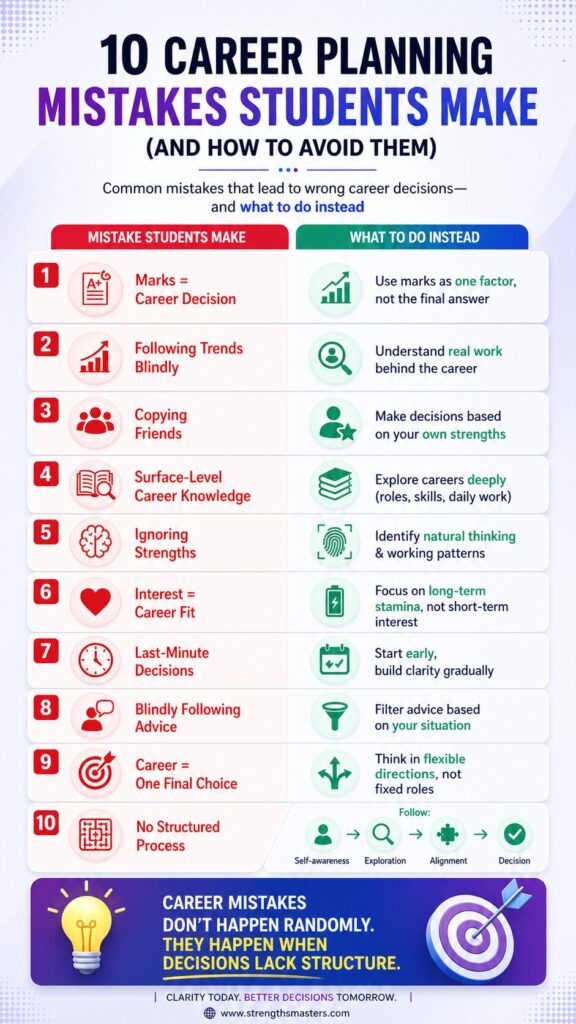
1. Treating Marks as the Final Decision Maker
Marks often become the default filter. A student scores high in science and immediately assumes that engineering or medicine is the natural next step. But marks only show performance in a structured system. They don’t reveal long-term fit.
A student may perform well in a subject because of discipline, good teaching, or exam familiarity. That doesn’t necessarily mean they will enjoy or sustain a career in that field.
A better approach is to treat marks as just one piece of information. Alongside it, students need to understand how they think, what kind of problems they enjoy solving, and where they naturally perform well without excessive effort.
2. Following Trends Without Understanding Them
Every few years, certain careers become “safe bets.” At one point, it was engineering, then MBA, now it’s coding, AI, or data science. The issue is not with these fields. The issue is entering them without understanding the reality behind them.
For instance, “tech” sounds exciting, but it involves long hours of problem-solving, debugging, and constant learning. Not everyone enjoys that process, even if the outcome looks attractive.
Students need to shift from trend-following to role-understanding. What does the work actually look like? What skills are required daily? Does the process feel engaging or exhausting?
3. Letting Peer Decisions Influence Personal Choices
It’s more common than most people admit. A student chooses a stream because their friends are choosing it. It feels easier. There’s comfort in familiarity.
But careers are long-term commitments. They cannot be based on short-term social comfort.
Two students sitting in the same classroom can have completely different thinking styles, strengths, and preferences. Expecting the same career path to suit both rarely works.
4. Understanding Careers Only at the Surface Level
Most students know career names, not career realities.
“Business” sounds attractive, but it includes sales, operations, finance, marketing, and strategy, each requiring very different skill sets. Similarly, “psychology” sounds interesting, but it involves years of study and emotional engagement that not everyone is prepared for.
Clarity improves when careers are explored deeply. Talking to professionals, observing real work, or even doing small projects can change how a student perceives a field.
5. Ignoring Natural Strengths Completely
This is where most career planning quietly breaks down.
Every student has natural patterns in how they think, learn, and respond to challenges. Some are analytical. Some are creative. Some are people-oriented. Others prefer structured systems.
Research by Gallup shows that individuals who use their strengths regularly are significantly more engaged and productive in their work.
Yet, most students make career decisions without ever understanding these patterns formally.
When decisions are made without this awareness, they often feel forced. And over time, that leads to disengagement.
6. Confusing Interest with Long-Term Fit
Students often say, “I’m interested in this.” But interest can be temporary. It can be influenced by exposure, trends, or even a good teacher.
The more important question is whether the student can stay consistent with that work over time.
This is where the idea of interest versus stamina becomes important. Interest attracts you. Stamina sustains you.
A student might enjoy watching videos about business, but may not enjoy the actual work involved in managing operations or handling financial decisions daily.
7. Leaving Decisions for the Last Moment
Many career decisions in India are made within a few weeks after board results are declared. Naturally, when time is limited, decisions become reactive.
Students then rely heavily on whatever information is most accessible at that moment, which is often incomplete or biased.
Career clarity is not something that appears suddenly. It develops gradually through reflection and exposure. Starting early, even in small ways, makes a significant difference.
8. Relying Too Much on Generic Advice
Advice is everywhere. Relatives suggest “safe” options. Coaching institutes recommend career paths aligned with their courses. Online content presents simplified answers.
While advice can be useful, most of it is not personalised. What worked for one person may not work for another.
Students need to learn how to filter advice through their own context rather than accepting it at face value.
9. Thinking Career Choice Is a One-Time Decision
There is a lot of pressure to “get it right” in one go. This creates unnecessary anxiety.
The reality is that careers today are not linear. People shift roles, industries, and even domains over time. What matters more is choosing a direction that allows growth.
Instead of asking, “Which exact job should I choose?” it is more useful to think in terms of direction. Analytical, creative, people-oriented, or strategic. This keeps options open while still providing clarity.
10. Not Following Any Structured Process
This is the underlying issue behind most mistakes.
Students often approach career planning in a scattered way. A bit of research here, some advice there, and then a quick decision when the deadline arrives.
Without a structured process, clarity becomes inconsistent.
A more reliable approach includes:
- Understanding oneself first
- Exploring careers in depth
- Matching strengths with real-world demands
- Making decisions based on clarity, not pressure
When the process improves, the outcome improves naturally.
What a Better Approach Looks Like
If you step back and look at all these mistakes, a pattern becomes obvious. Most students start from the outside. They ask, “Which career is best?” without first asking, “What suits me best?”
This reversal creates confusion.
A more grounded approach begins with the student. Understanding how they think, what energises them, and where they naturally perform well. From there, careers are explored and matched accordingly.
This is where strengths-based career planning by Strengths Masters becomes effective. Instead of forcing a student into a predefined path, the path is shaped around the student.
How Students Can Actually Avoid These Mistakes
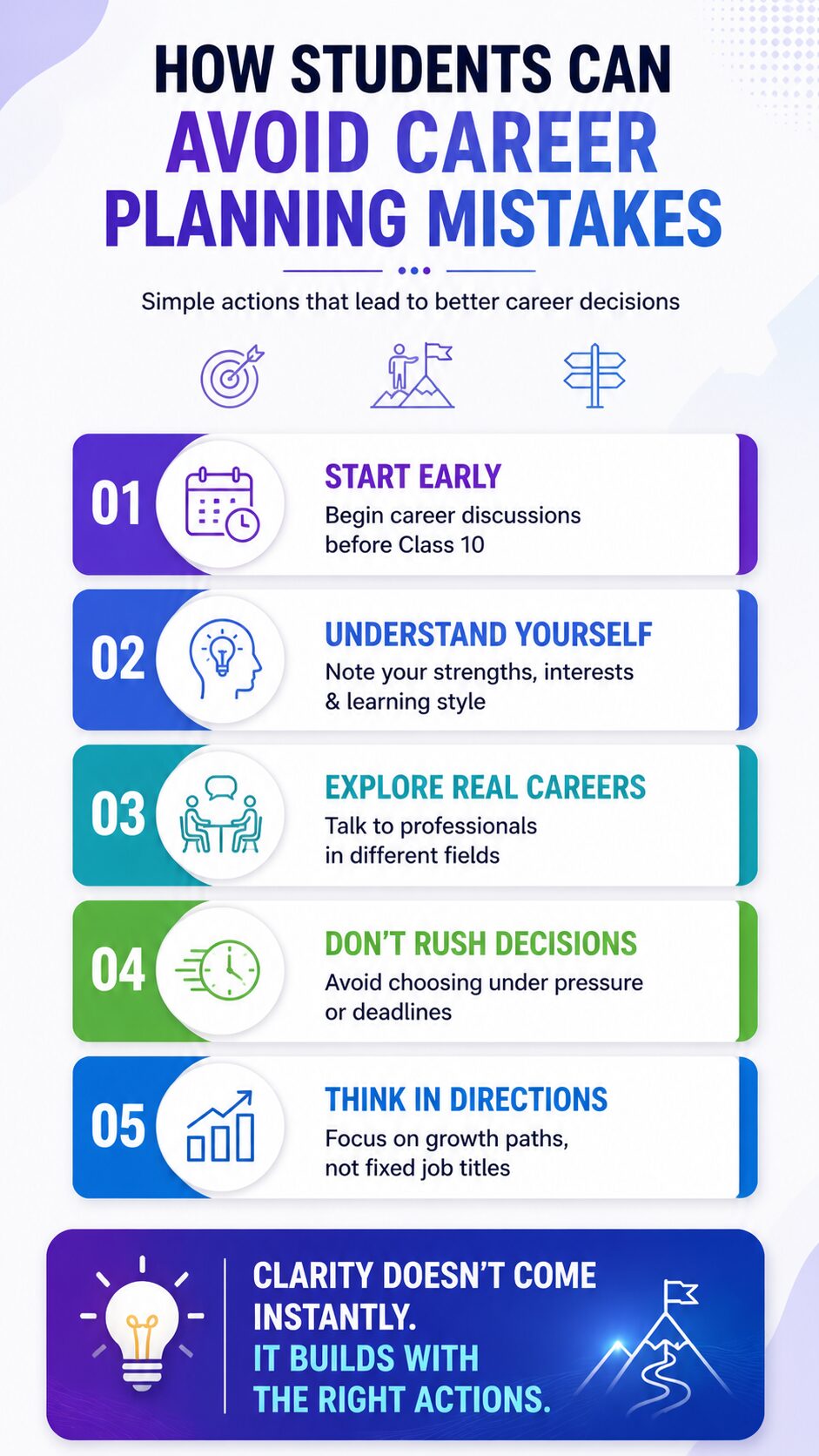
At a practical level, avoiding these mistakes doesn’t require drastic changes. It requires better thinking and slightly earlier action.
Students who make better career decisions usually do a few things differently. They start observing their own patterns early. They explore careers with curiosity rather than pressure. They take time to reflect before deciding.
Some simple actions that help:
- Start career discussions before Class 10, not after
- Write down patterns in strengths, interests, and learning styles
- Speak to people working in different fields
- Avoid rushing decisions just because deadlines are approaching
- Focus on direction rather than fixed outcomes
These may sound basic, but when done consistently, they create clarity.
Final Thought
Most students don’t struggle because they are confused by nature. They struggle because they are trying to make important decisions without a clear framework.
When the process is unclear, even smart students feel lost. But when the process becomes structured, things start making sense.
Career planning is not about finding a perfect answer instantly. It’s about reducing confusion step by step, until a direction feels right.
And that shift, from confusion to clarity, usually begins not with options, but with understanding the student first.
Frequently Asked Questions:
1) Why do most students get career planning wrong?
Most students get career planning wrong by relying on marks, trends, or external advice rather than understanding their strengths, interests, and long-term fit.
2) What are the biggest career planning mistakes students make?
Common mistakes include choosing based on marks, following trends blindly, copying peers, and not exploring careers deeply before deciding.
3) When should students start career planning?
Students should ideally start career planning before Class 10 so they have enough time to explore options and make informed decisions.
4) How can students choose the right career path early?
Students can choose the right career by understanding their strengths, exploring real career roles, and aligning their abilities with suitable fields.
5) Is career planning only about choosing a stream or course?
No, career planning is not just about choosing a stream or course; it’s about understanding long-term career direction, skills, and growth opportunities.
6) How important is self-awareness in career planning?
Self-awareness is crucial because it helps students identify what suits them naturally, leading to better career decisions and long-term satisfaction.
7) Can wrong career choices be corrected later?
Yes, career paths are flexible today, but early clarity reduces confusion, saves time, and helps students make more confident decisions from the start.



[…] biggest mistake students make is confusing guidance with […]