
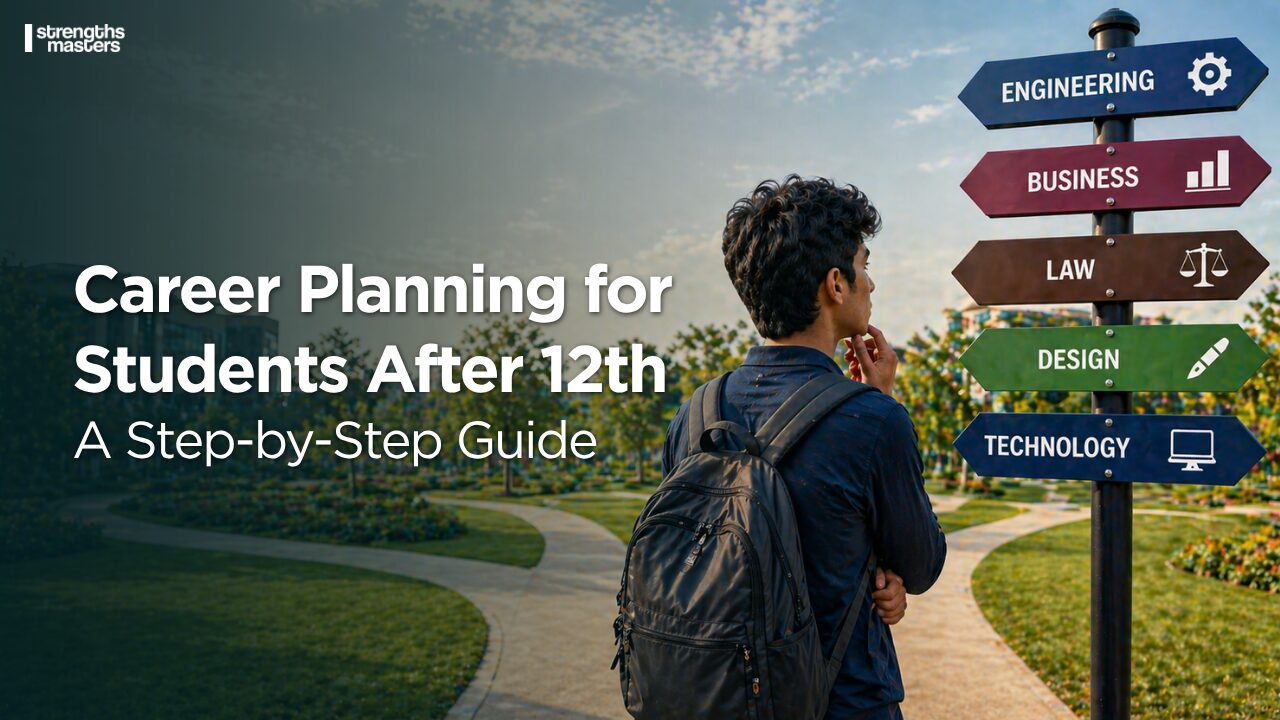
When Class 12 ends, confusion usually begins
Finishing Class 12 feels like a big achievement. For years, everything was structured. School, subjects, exams. There was always a next step already decided for you. Then suddenly, that structure disappears. And one question starts showing up everywhere:
What to do after 12th?
At first, it seems like a simple question. But the more you think about it, the heavier it feels. Because now, it’s not just about passing exams. It’s about choosing a direction that could shape the next 5 to 10 years. Students feel the pressure. Parents feel it too. Everyone wants to make the “right” decision.
But here’s something most people don’t say clearly:
The problem is not a lack of options. The problem is a lack of clarity.
Why career planning after 12th feels so overwhelming
If you look at the situation honestly, confusion makes sense.
There are hundreds of career options after 12th. Engineering, CA, law, design, psychology, data science, business, media… and new options keep emerging every year. But more options don’t automatically mean better decisions. In fact, it creates a different problem. Students don’t know how to filter.
So they rely on things like:
- Marks (“Science li thi, to engineering hi karna chahiye”)
- Trends (“AI ka scope hai”)
- Peer choices
- Family expectations
These inputs are not completely wrong. But they are incomplete. They don’t answer the most important question:
How to choose a career after 12th based on who you are?
That’s why many students:
- Lose interest in their course after 1–2 years
- Switch fields midway
- Feel disconnected from what they study
Not because they are incapable, but because the decision wasn’t aligned with them.
The biggest mistake students make after 12th
Most students focus on courses, not careers.
They ask:
“Which course should I take?”
But the better question is:
“Where does this course actually lead me?”
This difference is small, but it changes everything. A course is just a pathway. It does not guarantee a career outcome.
For example:
- BBA doesn’t guarantee a business career
- Engineering doesn’t guarantee interest in tech
- Psychology doesn’t automatically mean becoming a psychologist
When you choose a course without understanding the career behind it, you’re essentially guessing. And career planning after 12th should never be guesswork.
What career planning after 12th actually means
Let’s simplify this properly. Career planning after 12th is not about picking a job title or deciding your entire life at 17 or 18.
It is about:
- Understanding how you naturally think and work
- Identifying what kind of problems you enjoy solving
- Exploring careers that match those patterns
- Choosing a direction, not a final destination
Because careers today are flexible.
A commerce student can move into finance, consulting, or startups. A humanities student can go into law, design, or even business. A science student can shift into management or analytics later.
So the goal is not perfection.
The goal is clarity + direction.
A step-by-step approach to career planning after 12th
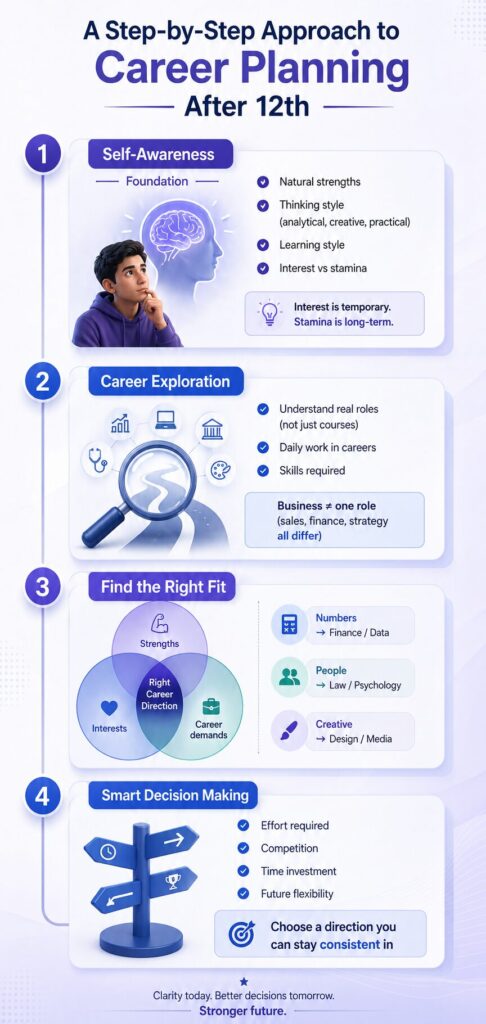
Instead of random advice, a structured process works far better. If you’re wondering how to decide on a career after 12th grade for students, this is a practical way to approach it.
1. Start with self-awareness
This is the foundation, but most students rush through it.
You need to understand:
- Your natural strengths (what comes easily to you)
- How do you think (analytical, creative, practical, strategic)
- How do you learn best
- What kind of work can you sustain long-term
There’s also an important distinction here.
Interest vs stamina.
You might find something interesting for a few days, but can you work on it consistently for years? That’s what matters.
For example:
- Someone who enjoys solving logical problems consistently may fit well in tech or finance
- Someone who naturally understands people may do better in psychology, HR, or management
- Someone creative may find energy in design, media, or storytelling
This is where strengths-based career planning becomes powerful. It focuses on patterns, not assumptions.
2. Explore careers deeply, not superficially
Most students search “career options after 12th” and scroll through lists. But that doesn’t create clarity.
Instead, explore like this:
- What does a typical day in this career look like?
- What skills are required?
- What kind of work is involved daily?
For example, “business” sounds attractive. But do you enjoy sales, operations, strategy, or finance? These are very different roles.
Similarly, “psychology” sounds interesting. But are you comfortable with long-term study and working closely with people’s problems?
This level of understanding makes decisions real.
3. Match yourself with the right direction
Now comes the most important step.
Take:
- Your strengths
- Your interests
- Career requirements
And find the overlap.
Some examples:
- Strong in numbers + analytical thinking → finance, data, engineering
- Good with communication + people → law, management, psychology
- Creative + visual thinking → design, media, branding
You don’t need a perfect match. But you need a strong enough fit.
This is how you answer:
“What career is right for me after 12th?”
4. Make a decision that is practical, not emotional
Once clarity improves, the decision becomes easier. But don’t decide based only on excitement.
Think about:
- Effort required (some careers need years of preparation)
- Competition level
- Time investment
- Future flexibility
Choose a direction where:
- You can stay consistent
- You are willing to put in effort
- You can grow over time
That’s a smart decision.
Career options after 12th
You don’t need a long list. You need a clear overview.
Science students
Career options after 12th science include engineering, medicine, research, data science, architecture, and technology fields. PCM and PCB open different pathways depending on your preference.
Commerce students
Career options after 12th commerce include CA, finance, business management, banking, and entrepreneurship. These fields require analytical thinking and consistency.
Humanities students
Humanities career options after 12th include law, psychology, design, media, civil services, and social sciences. These fields are diverse and growing rapidly.
The key is not the stream.
The key is fit.
Practical tips to choose the right career after 12th
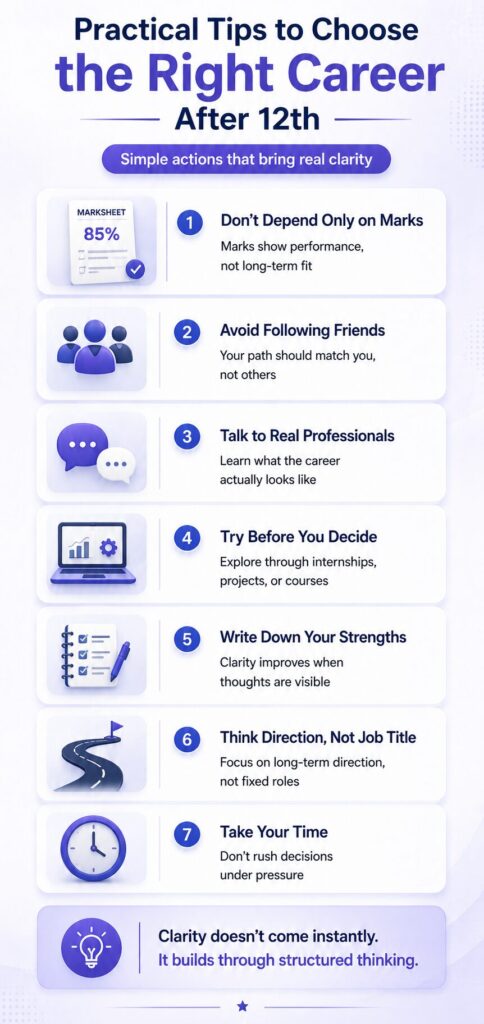
This is where most blogs stop at theory. Let’s make it actionable.
- Don’t decide based only on marks
- Avoid following friends blindly
- Talk to people actually working in that field
- Do short-term exposure (internships, projects, online courses)
- Write down your strengths and patterns clearly
- Think in terms of direction, not fixed job titles
- Give yourself time, don’t rush under pressure
One more important point.
Clarity doesn’t come instantly. It develops through structured thinking.
What if you are still confused after 12th?
Honestly, many students are. And that’s okay.
Confusion is not the problem.
Lack of structured guidance is.
Most students try:
- Google searches
- YouTube videos
- Asking relatives
But these methods give information, not clarity.
Clarity comes from understanding yourself deeply and connecting that with real-world careers.
How structured career guidance helps
This is where career counselling after 12th becomes useful, especially when it follows a structured approach.
A good career guidance program for students helps you:
- Identify your natural strengths
- Understand your thinking patterns
- Connect them with suitable careers
- Make decisions with confidence
At Strengths Masters, this is done through a simple but powerful framework:
Discover – Decode – Design
- Discover: Identify your top 5 natural strengths
- Decode: Analyse these strengths with a certified strengths psychologist
- Design: Create a clear career direction with student + parent
This approach removes guesswork and builds a strengths-based career planning for students that actually fits.
Final thought
Career planning after 12th is not about getting everything perfect. It is about getting enough clarity to move forward confidently.
Students don’t need more options.
They need a better understanding.
Parents don’t need to push harder.
They need to guide smarter.
When the process starts with the student and builds outward, decisions stop feeling overwhelming.
And the question:
“What to do after 12th?”
starts turning into:
“This is the direction I want to take.”