


Promoting a high performer into a managerial role often feels like the obvious decision. Someone who consistently delivers results, solves problems quickly, and demonstrates commitment naturally appears ready to lead others. On paper, the logic makes sense.
But the reality inside organisations often looks different.
Many new managers struggle not because they lack ability, but because leadership is a completely different responsibility. The moment someone moves into management, their success no longer depends only on personal performance. Instead, it depends on how effectively they guide, support, and influence a team.
And here’s where something subtle yet critical enters the picture: leadership credibility.
Before new managers can truly manage others, they must first build credibility with their teams. Without that foundation, authority alone rarely works. People may follow instructions temporarily, but trust, respect, and genuine engagement remain fragile.
For organisations that want to identify and nurture high-potential employees, the starting point must be broader than promotions alone. The environment matters.
Employee-friendly systems, fair policies, and a culture that encourages growth and learning create the conditions where leadership can actually develop. Without these foundations, even capable managers struggle to build trust and credibility with their teams.
So the real question becomes: how do new managers build leadership credibility in the first place?
Let’s explore 4 key ways that actually shape credibility inside teams.
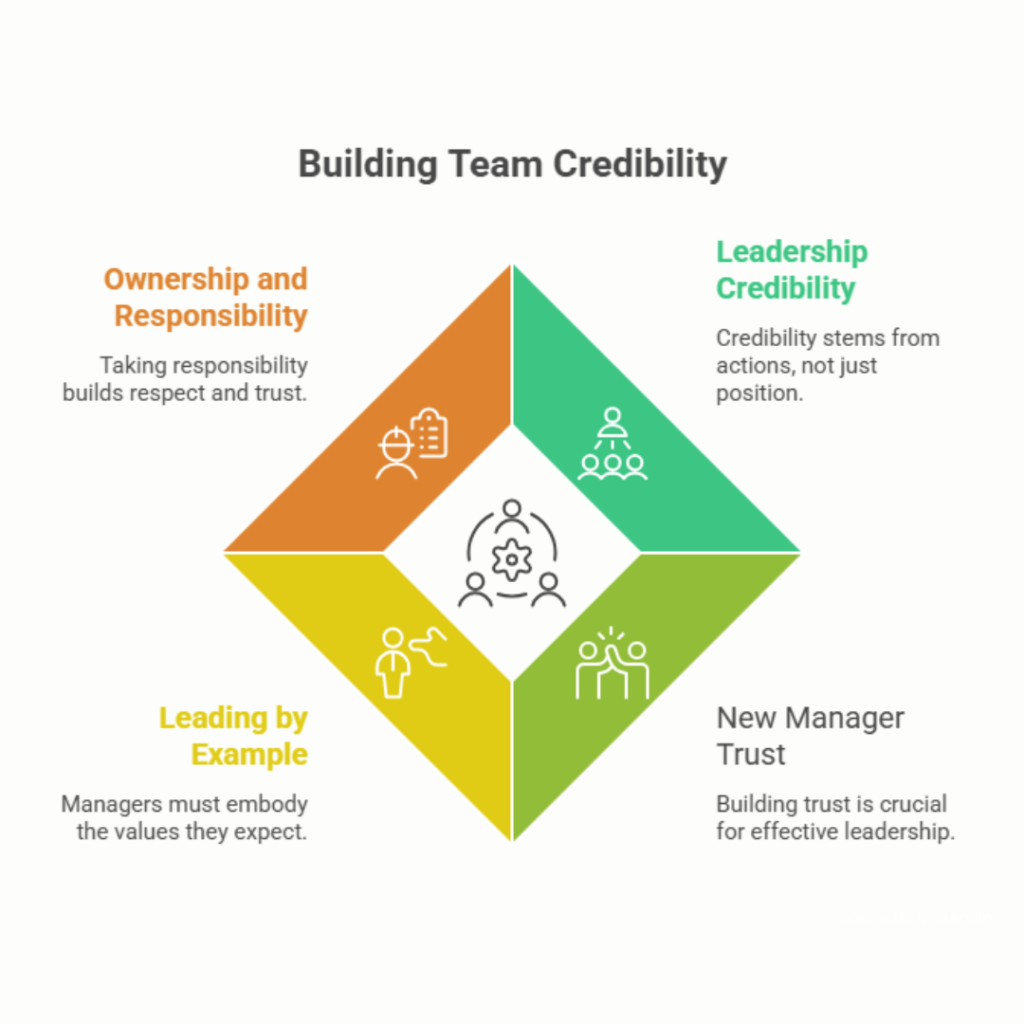
- Leadership Credibility Starts with Behaviour, Not Authority
When someone becomes a manager, the title changes instantly. Behaviour, however, takes time to adapt.
New managers sometimes assume that their formal role will automatically give them influence. But teams rarely operate that way. People watch closely. They observe how the manager behaves in meetings, how decisions are made, and how challenges are handled.
In other words, credibility grows from behaviour.
Managers who consistently demonstrate fairness, clarity, and accountability gradually build trust within their teams. Those who rely only on authority often face resistance, even if it remains unspoken.
Leadership researchers often describe this dynamic as “role modelling in leadership.” Teams learn what behaviour is acceptable by observing the manager’s actions.
A simple example illustrates this clearly.
If a manager speaks about accountability but avoids difficult decisions, the team notices the inconsistency. If a manager encourages open communication but reacts defensively to feedback, people become cautious.
But when managers demonstrate the behaviour they expect from others, ownership, transparency, reliability, and credibility begin to grow naturally.
- How New Managers Build Trust Within Their Teams
Trust rarely appears overnight. It grows through repeated experiences.
New managers who want to build trust with their teams often focus on three behavioural signals:
Consistency, fairness, and follow-through.
Consistency means that decisions and expectations remain stable over time. Teams feel confident when they know what to expect from their leader.
Fairness means treating team members with respect and equal consideration, especially when evaluating performance or distributing responsibilities.
Follow-through means doing what was promised, whether that involves resolving a problem, supporting an employee, or communicating an important decision.
When these three behaviours appear consistently, trust develops almost quietly. It isn’t announced; it simply becomes part of how the team experiences leadership.
And once trust exists, collaboration becomes far easier.
- Why Managers Must Lead by Example
You know what? Leadership influence often works in unexpected ways.
Managers may spend hours explaining policies, targets, or expectations. Yet the most powerful signal usually comes from something simpler: how they behave during everyday work.
This is why leading by example remains one of the strongest forms of leadership behaviour.
Consider a manager who consistently prepares for meetings, respects deadlines, and acknowledges mistakes openly. Without delivering long speeches, that behaviour quietly shapes the team’s culture.
Gradually, team members begin to mirror those habits.
The opposite can also happen. When managers appear disengaged, inconsistent, or dismissive, those behaviours also spread within the team.
Leadership culture, in many ways, is contagious.
That’s why behavioural leadership skills matter so much during the early months of a manager’s journey.
- Ownership and Responsibility: Signals That Build Respect
Among all leadership behaviours, ownership carries special weight.
When managers take responsibility for outcomes, both successes and setbacks, they send a powerful message to their teams.
Ownership communicates several things at once:
- The manager stands behind the team’s work
- Mistakes are treated as learning opportunities
- Accountability applies to everyone, including the leader
This approach creates psychological safety. Team members feel more comfortable raising concerns, sharing ideas, and asking for support.
In contrast, when managers shift blame or avoid responsibility, credibility erodes quickly.
Respect cannot grow in environments where accountability feels selective.
The Challenge Many First-Time Managers Experience
Something interesting happens when high performers become managers.
Most new managers step into leadership roles with very little preparation. One day, they are responsible only for their own work. The next day, they are expected to guide a team, handle expectations from senior leaders, and support the development of others.
Naturally, this transition brings pressure.
Some new managers adapt quickly. Others take longer to find their footing. And many quietly struggle while trying to balance their own responsibilities with the expectations of their team.
This becomes even more visible during busy periods, tight deadlines, or when teams are dealing with change. In those moments, people look toward their manager for direction, clarity, and reassurance.
But if a new manager is still figuring out their role, building credibility with the team becomes more difficult.
That’s why the early stage of a manager’s journey is so important. Before they can guide others effectively, they need to establish trust, consistency, and behavioural leadership within the team.
Structured Development Helps Managers Grow Faster
Even the most capable new managers benefit from guidance and structured learning.
Leadership behaviours such as role modelling, goal setting, reviewing work, giving feedback, and coaching employees are not always intuitive. They develop through practice and reflection.
Programs designed for emerging managers can help them build these capabilities faster and with greater confidence.
For example, leadership development workshops offered by Strengths Masters focus on helping new managers understand how their behaviour influences team dynamics. These programs emphasise practical leadership habits rather than abstract theories.
As managers learn to apply these behaviours consistently, their leadership credibility grows naturally.
Final Thoughts
Becoming a manager is one of the most significant transitions in a professional career.
The shift from individual contributor to team leader requires more than technical expertise. It requires trust, consistency, and behavioural leadership.
For first-time managers, building leadership credibility becomes the foundation for everything else. Without it, authority struggles to create influence. With it, teams begin to trust, collaborate, and perform more effectively.
When managers lead by example, take ownership of challenges, and remain consistent in their actions, something powerful happens.
Trust grows.
And when trust exists, leadership becomes far more effective.
Frequently Asked Questions
Why is leadership credibility important for new managers?
Leadership credibility is important because teams trust and respect managers who demonstrate consistency, fairness, and accountability. When managers lead by example and follow through on commitments, employees feel more confident in their leadership and are more willing to collaborate, communicate openly, and take ownership of their work.
How can new managers build trust with their teams?
New managers build trust by communicating clearly, keeping promises, treating team members fairly, and taking responsibility for outcomes. Consistent behaviour over time demonstrates reliability and integrity, helping employees feel secure working with their manager and strengthening collaboration within the team.
What does it mean for a manager to lead by example?
Leading by example means demonstrating the behaviours and work standards a manager expects from the team. When managers show accountability, professionalism, and respect in their actions, employees are more likely to follow those behaviours and contribute positively to the team environment.
What behaviours help managers gain credibility with their teams?
Managers gain credibility by maintaining consistency, taking ownership of results, listening to team members, and making fair decisions. When leaders behave transparently and support their teams during challenges, employees develop trust and confidence in their manager’s leadership.
Why do some new managers struggle to gain team trust?
New managers often struggle because they rely on authority instead of building relationships and demonstrating leadership behaviour. Trust develops gradually through consistent actions, communication, and fairness, not simply through a managerial title or position.