

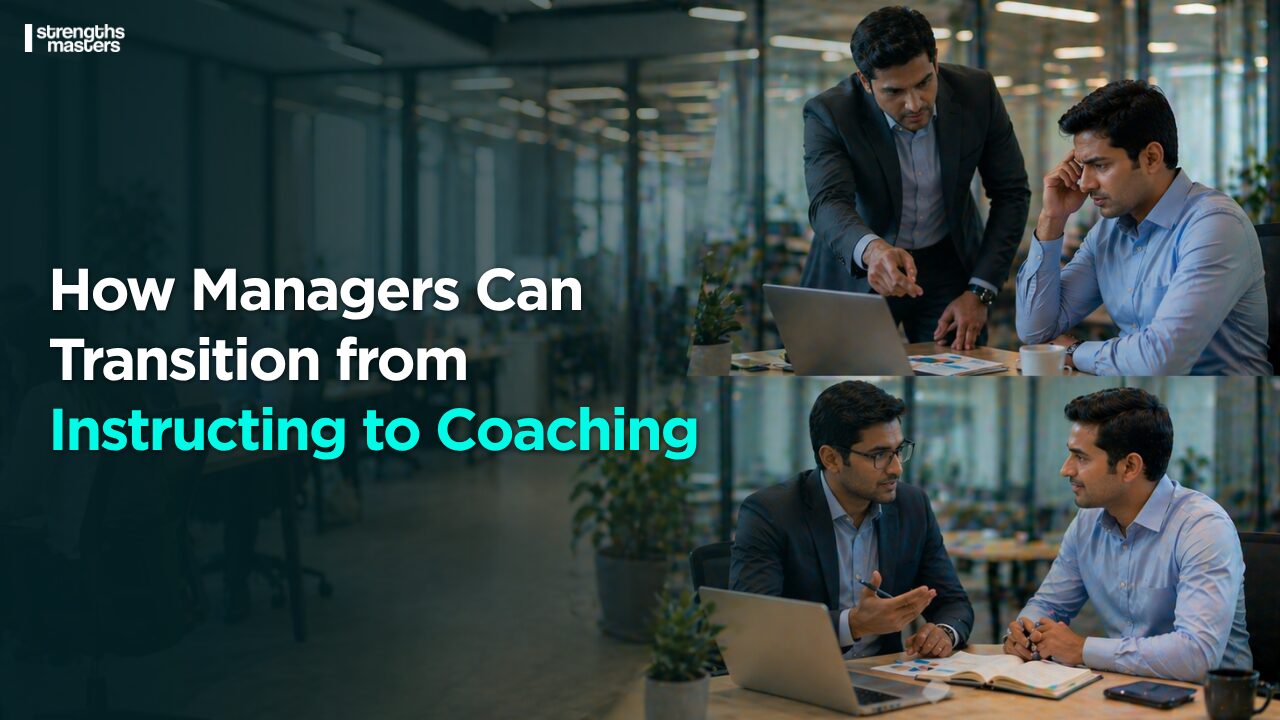
Two Managers. Same Team. Completely Different Outcomes.
In almost every organisation, you’ll find two kinds of managers working side by side. One believes in giving clear instructions, solving problems quickly, and ensuring that work moves without delay. The other takes a different route, asking questions, encouraging discussion, and allowing team members to think through problems before stepping in.
At first glance, the instruction-driven manager often appears more efficient. Decisions are faster, execution is smoother, and there is very little ambiguity in the short term. Deadlines are met, and things seem under control.
But as time passes, a deeper pattern starts to emerge. Teams led purely through instructions begin to slow down in unexpected ways. They hesitate before making decisions, rely heavily on approvals, and struggle when faced with unfamiliar challenges. On the other hand, teams led through coaching begin to show a different kind of behaviour; they think independently, take ownership, and adapt faster to change.
This contrast is not accidental. It reflects a fundamental difference in leadership approach. And in today’s corporate environment, where agility, ownership, and continuous learning are critical, this difference directly influences team performance and long-term business outcomes.
The Hidden Cost of Instruction-Driven Leadership
Most managers do not consciously choose to become instruction-heavy leaders. The shift usually happens gradually, often driven by pressure. When targets are tight and expectations are high, giving direct answers feels like the fastest way to move forward. It reduces ambiguity, speeds up execution, and ensures control over outcomes.
However, what feels efficient in the short term often creates long-term challenges. Over time, instruction-driven leadership begins to create subtle but significant issues within teams. Employees start depending on managers for even routine decisions. The initiative is reduced because people are conditioned to wait for direction. Problem-solving ability weakens because thinking is replaced by following instructions.
Research supports this pattern. According to Gallup’s State of the Global Workplace report, only about one in five employees strongly feel motivated by how their performance is managed. One of the key reasons identified is the lack of meaningful development conversations between managers and employees. When managers focus only on telling what to do, they miss the opportunity to build capability.
This also impacts scalability. A manager who constantly instructs becomes the central decision-maker for everything. As the team grows, this model breaks down. Decisions slow, bottlenecks increase, and the manager becomes overwhelmed, not because the team lacks talent, but because it lacks autonomy.
The Shift That Changes Everything: From Answers to Awareness
Coaching introduces a fundamentally different way of leading. Instead of focusing on providing solutions, coaching focuses on building awareness and capability within the team. It is less about control and more about development.
A coaching-oriented manager approaches situations with curiosity rather than certainty. Instead of immediately offering solutions, they explore the problem with the team member. Questions like “What do you think is the right approach here?” or “What options have you considered?” shift the responsibility of thinking back to the individual.
This shift may appear small, but its impact is significant. When employees are encouraged to think, they engage more deeply with their work. They begin to understand not just what needs to be done, but why it matters and how different approaches can lead to different outcomes. Over time, this builds confidence, improves decision-making, and strengthens accountability.
In essence, coaching transforms employees from task executors into problem-solvers. And that transformation is critical for organisations that want to remain competitive in complex, fast-changing environments.
Coaching vs Instructing: A Practical Comparison
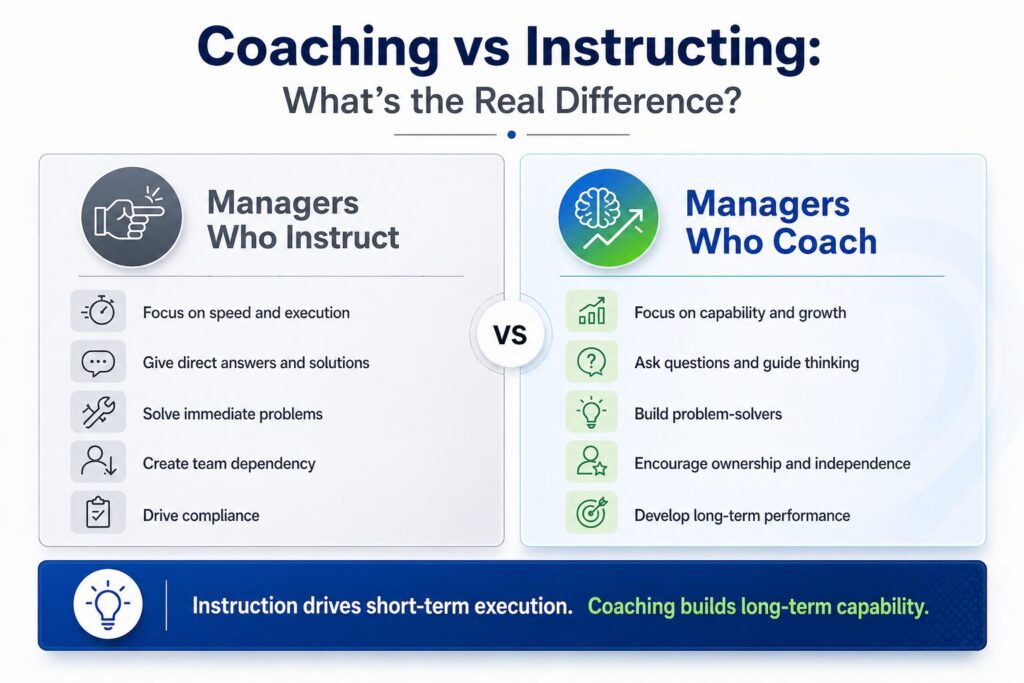
To understand the difference more clearly, it helps to look at how these two approaches play out in everyday management situations.
Managers who rely heavily on instruction tend to focus on immediate execution. They define tasks clearly, assign responsibilities, and ensure that work gets completed as expected. While this approach brings clarity, it often limits exploration and independent thinking.
In contrast, managers who coach focus on the process behind the task. They still ensure that outcomes are achieved, but they also invest time in helping team members understand how to approach challenges. Instead of directing every step, they guide thinking and encourage ownership.
The distinction becomes clearer when observed across behaviours:
- Instruction-driven managers prioritise speed, while coaching managers prioritise capability
- Instruction creates dependency, while coaching builds independence
- Instruction solves immediate problems, while coaching prevents future ones
- Instruction ensures compliance, while coaching develops commitment
Both approaches have their place. In high-pressure or crises, clear instructions are necessary. However, when instruction becomes the default mode, it restricts growth. Coaching, when applied consistently, creates a more resilient and self-sufficient team.
A Real Workplace Scenario That Highlights the Difference
Consider a situation where a team member is preparing for an important client presentation and feels uncertain about the approach.
An instruction-driven manager might step in quickly and say, “Follow last quarter’s format, focus on these key slides, and keep it concise.” The task gets completed efficiently, and the immediate need is addressed. However, the employee remains dependent on similar guidance in the future.
A coaching-oriented manager, on the other hand, approaches the same situation differently. They might ask, “What is the objective of this presentation?” or “What message do you want the client to take away?” These questions encourage the employee to think about the purpose and structure of their work. The manager then builds on the employee’s response, guiding them toward a stronger solution.
The outcomes in both cases may be similar in the short term, as the presentation is completed. But the long-term impact is very different. In the coaching scenario, the employee gains clarity, confidence, and the ability to handle similar challenges independently in the future.
Why Coaching Managers Drive Stronger Business Outcomes
The impact of coaching goes beyond individual development; it directly influences organisational performance.
According to Harvard Business Review, organisations that promote coaching-based leadership see higher levels of employee engagement and improved performance, particularly in roles that require problem-solving and collaboration. Coaching encourages dialogue, builds trust, and creates a culture where employees feel valued and heard.
Further data from PwC’s workforce research indicates that employees who receive continuous feedback and developmental support show significantly higher productivity and engagement levels. In some cases, performance improvements can reach up to 30–40% when employees feel actively supported in their growth.
Additionally, organisations with strong development cultures tend to retain talent more effectively. Employees are more likely to stay when they feel they are learning and progressing in their roles. In contrast, environments that rely heavily on instruction often struggle with engagement and retention, especially among younger employees who value growth and autonomy.
Even large organisations have recognised this shift. Leadership approaches that emphasise coaching, learning, and collaboration have been central to cultural transformations in several global companies, reinforcing the importance of moving beyond directive management styles.
Why Managers Find Coaching Difficult to Apply
Despite its benefits, coaching is not always easy to implement. Many managers struggle with it, not because they lack intent, but because it requires a change in mindset and behaviour.
One of the biggest challenges is the habit of solving problems quickly. Managers are often rewarded for efficiency, so taking time to ask questions and explore solutions can feel counterintuitive. There is also a perception that coaching takes more time, especially in fast-paced environments.
However, this perception overlooks a key reality. While coaching may take slightly longer in the moment, it reduces future dependency. Teams that are coached effectively require fewer interventions, make better decisions independently, and contribute more strategically over time.
Another challenge is patience. Coaching requires managers to resist the urge to jump in with answers. It involves listening actively, allowing space for thinking, and guiding without controlling. These behaviours take practice, but they are essential for building strong teams.
How Managers Can Transition from Instructing to Coaching
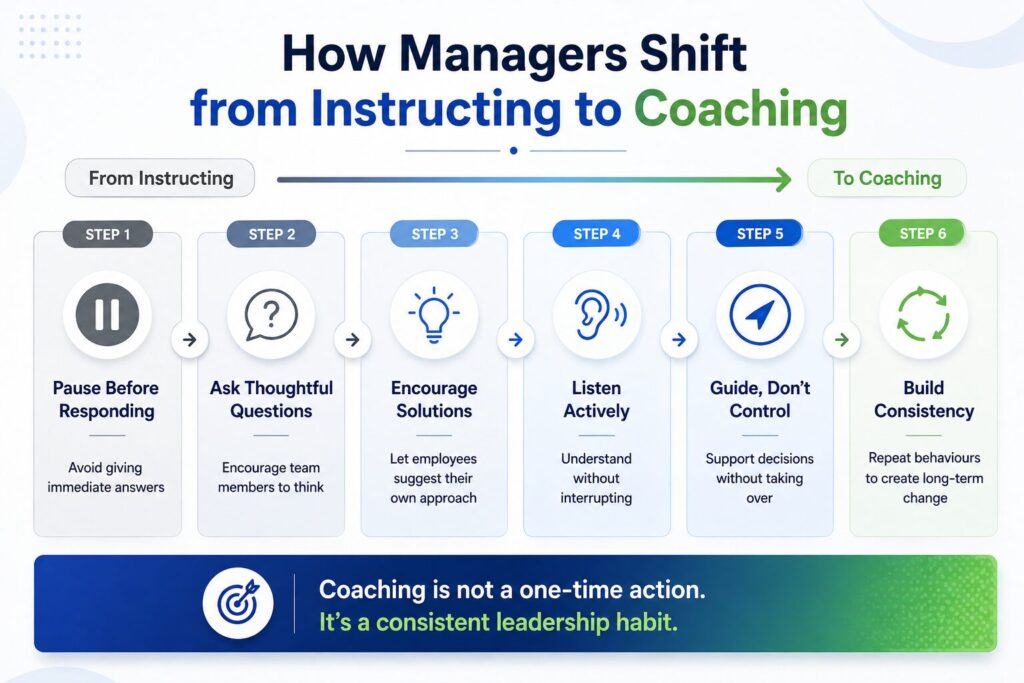
The transition from instructing to coaching does not require a complete overhaul of leadership style. It begins with small, intentional changes in everyday interactions.
Managers can start by pausing before responding to questions and asking one thoughtful question instead of giving an immediate answer. Encouraging team members to propose solutions, even if they are not perfect, helps build confidence and ownership.
Listening plays a critical role as well. When managers listen without interrupting, they gain deeper insight into how their team thinks, which allows them to guide more effectively. Over time, these small shifts create a culture where thinking, ownership, and accountability become the norm.
Consistency is key. Coaching is not a one-time intervention; it is a continuous process that shapes behaviour gradually.
Connecting Coaching with Broader Leadership Skills
Coaching becomes significantly more effective when integrated with other managerial capabilities. It does not operate in isolation.
For example, coaching works best when there is clarity in goals. Without clear direction, coaching conversations can become vague and unfocused. Similarly, regular reviews provide the data needed to identify where coaching is required. Feedback complements coaching by addressing performance gaps, while coaching focuses on long-term development.
Role modelling also plays a crucial role. Managers who demonstrate openness, accountability, and a willingness to learn create an environment where coaching conversations feel natural and productive.
When these elements come together, they create a comprehensive leadership approach that balances execution with development.
Where Structured Development Makes a Difference
The reality in most organisations is that managers are expected to develop these skills on their own. Some succeed through experience, while others struggle without clear guidance.
This is where structured development initiatives can add value. Programs like the 5 Skills for First-Time Managers by Strengths Masters focus on building essential managerial capabilities in a practical and structured way. By covering areas such as role modelling, goal setting, review, feedback, and coaching, these programs help managers develop a balanced and effective leadership approach.
The emphasis is not on theory, but on applying these skills in real workplace situations, making the learning both relevant and actionable.
Final Thoughts
Instruction ensures that work gets completed. Coaching ensures that people grow while completing that work.
And in the long run, growth is what sustains performance.
Managers who rely only on instructions may achieve short-term efficiency, but they risk creating teams that cannot function independently. Managers who coach, on the other hand, build teams that think, adapt, and take ownership.
Ultimately, leadership is not defined by how many answers a manager has, but by how many people they develop to find their own answers.
Frequently Asked Questions:
1) What is the difference between coaching and instructing in management?
The difference between coaching and instructing in management lies in the approach. Instructing focuses on giving direct answers and controlling execution, while coaching focuses on asking questions, developing thinking, and building long-term capability in teams.
2) Why are coaching managers more effective than instructing managers?
Coaching managers are more effective than instructing because they build independent, confident team members. Instead of creating dependency, they develop problem-solving skills, which improve long-term performance and team ownership.
3) How do managers shift from instructing to coaching?
Managers shift from instructing to coaching by asking more questions instead of giving answers, listening actively, encouraging team input, and guiding decisions rather than controlling them. Small behaviour changes over time create this shift.
4) How does coaching improve team performance?
Coaching improves team performance by increasing ownership, clarity, and engagement. When employees think through problems themselves, they make better decisions, take responsibility, and perform more consistently.
5) How do managers build ownership through coaching?
Managers build ownership through coaching by involving team members in decision-making, encouraging them to suggest solutions, and holding them accountable for outcomes instead of just tasks.
6) What are some coaching vs directive leadership examples?
In directive leadership, a manager tells the team exactly what to do. In coaching leadership, a manager asks, “What approach do you think will work?” and guides the team to arrive at the solution themselves.
7) When should managers use coaching vs instructing?
Managers should use instruction in urgent or high-risk situations where quick decisions are needed. Coaching should be used in day-to-day work to build capability, improve thinking, and develop long-term team performance.

[…] skills. Over time, teams become more confident in handling challenges independently. This coaching-based leadership approach is one of the strongest drivers of long-term team […]