


Choosing a career is one of the most important decisions a student makes. Yet, most students don’t actually choose their career; they end up guessing.
Some follow marks.
Some follow trends.
Some follow what others are doing.
And later, many realise they were never clear in the first place.
The problem is not a lack of options.
The problem is using the wrong decision-making approach.
If you’ve ever felt confused about your career, this blog will give you something most students never get:
A clear, structured, strengths-based approach to choosing the right career.
Why Most Students End Up Guessing Their Career
Before we jump into the solution, it’s important to understand what’s going wrong.
Most students rely on three things:
- Marks
- Interest
- External advice
At first, this seems logical. But each of these has limitations.
Marks only reflect performance in exams, not real-world capability.
Interest can be temporary and influenced by exposure.
Advice is often generic and not personalised.
This leads to a situation where decisions are made without clarity. And when clarity is missing, students start guessing.
- The real issue is not confusion.
- The real issue is a lack of a structured decision system.
The Smarter Approach: Strengths-Based Career Planning
Instead of guessing, smart students follow a better method:
Strengths-based career planning
This approach focuses on understanding:
- What comes naturally to you
- How do you think and solve problems
- Where you consistently perform well
Unlike marks or interests, strengths are stable patterns. They don’t change easily. And that’s why they are powerful.
When your career aligns with your strengths:
- You perform better
- You stay consistent
- You experience less burnout
- You grow faster over time
This is not just theory.
Research by Gallup has shown that people who use their strengths regularly are significantly more engaged and productive in their work.
In simple words:
When you work on your strengths, success becomes more natural, not forced.
Strengths vs Interest vs Marks
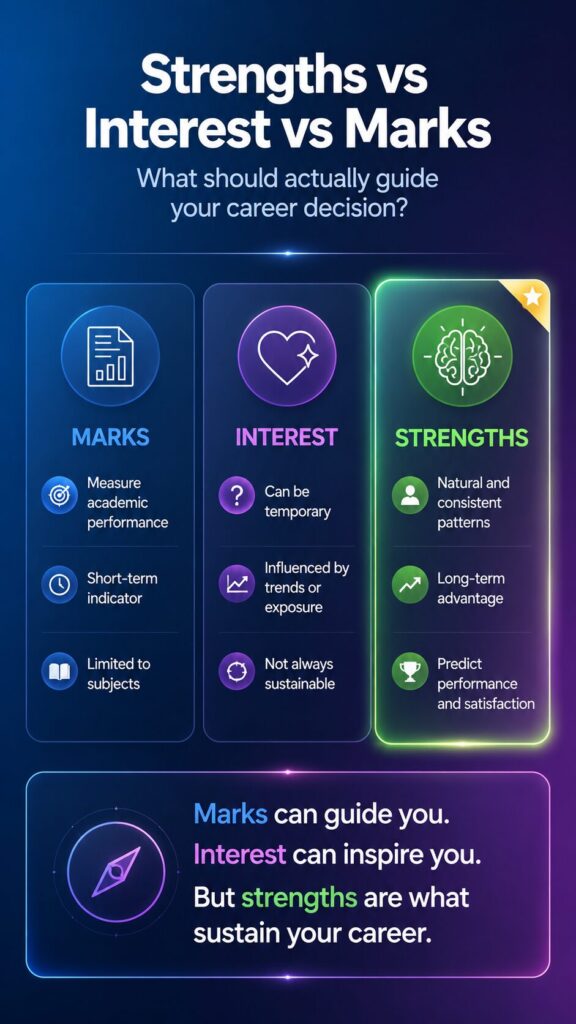
This is where most students get confused, so let’s simplify it.
- Marks
Measure academic performance
Short-term indicator
Limited to subjects - Interest
Can be temporary
Influenced by trends or exposure
Not always sustainable - Strengths
Natural and consistent patterns
Long-term advantage
Predict performance and satisfaction. - Marks can guide you.
- Interest can inspire you.
- But strengths are what sustain your career.
A Step-by-Step Process to Choose the Right Career
Now let’s move to the most important part, the actual system.
If you’re wondering how to choose the right career for students, follow this structured approach.
1. Start with Self-Awareness
This is the foundation, yet most students rush through it.
You need to understand:
- What comes naturally to you
- What kind of problems do you enjoy solving
- Where you perform well without excessive effort
For example:
- Some students naturally think in numbers and logic
- Some understand people and emotions easily
- Some are creative and visual thinkers
These are not random traits. These are patterns.
And patterns matter more than temporary interest.
2. Understand Your Thinking Style
Your thinking style determines the kind of work you will enjoy long-term.
Ask yourself:
- Are you analytical?
- Are you creative?
- Are you strategic?
- Are you people-oriented?
For example:
- Analytical thinkers often do well in tech, finance, and engineering
- People-oriented individuals fit better in psychology, management, and HR
- Creative thinkers thrive in design, media, and branding
The goal is not to label yourself.
The goal is to understand how your brain naturally works.
3. Map Your Strengths to Career Directions
This is where clarity starts forming.
Instead of asking:
“Which job should I choose?”
Ask:
“Which direction suits my strengths?”
Some examples:
- Strong in numbers + analytical thinking → finance, data, engineering
- Good with communication + people → law, management, psychology
- Creative + visual thinking → design, media, marketing
You don’t need a perfect match.
You need a strong enough alignment.
This is how you start answering:
“What career is right for me?”
4. Explore Careers Deeply (Not Superficially)
Most students search “career options after 10th” or “career options after 12th” and scroll through lists.
But lists don’t create clarity.
Instead, explore like this:
- What does a typical day in this career look like?
- What skills are required?
- What kind of work is involved daily?
For example:
- “Business” includes sales, operations, finance, and marketing, all very different
- “Psychology” involves long-term study and emotional engagement
The deeper you explore, the clearer your decision becomes.
5. Validate Your Choice Through Real Exposure
This step is often ignored, but it’s extremely powerful.
Try:
- Internships
- Short-term projects
- Online courses
- Talking to professionals
This converts your understanding from theoretical → practical.
For example:
You may feel interested in coding. But after trying it for a few weeks, you’ll know whether you actually enjoy the process.
This is where real clarity develops.
6. Choose Direction, Not a Final Destination
One of the biggest mistakes students make is thinking:
“I have to choose my entire career right now”
That’s not true.
Careers today are flexible and evolving.
Instead of choosing a fixed job, focus on:
- Direction
- Growth potential
- Skill alignment
For example:
Choosing “analytical direction” opens multiple paths:
- finance
- data science
- consulting
- analytics
This reduces pressure and improves decision quality.
Common Mistakes You Should Avoid
Even with the right approach, students often fall into these traps:
- Choosing based only on marks
- Following friends blindly
- Getting influenced by trends
- Not exploring careers deeply
- Ignoring their natural strengths
Awareness of these mistakes itself gives you an advantage.
Practical Tips to Make Better Career Decisions
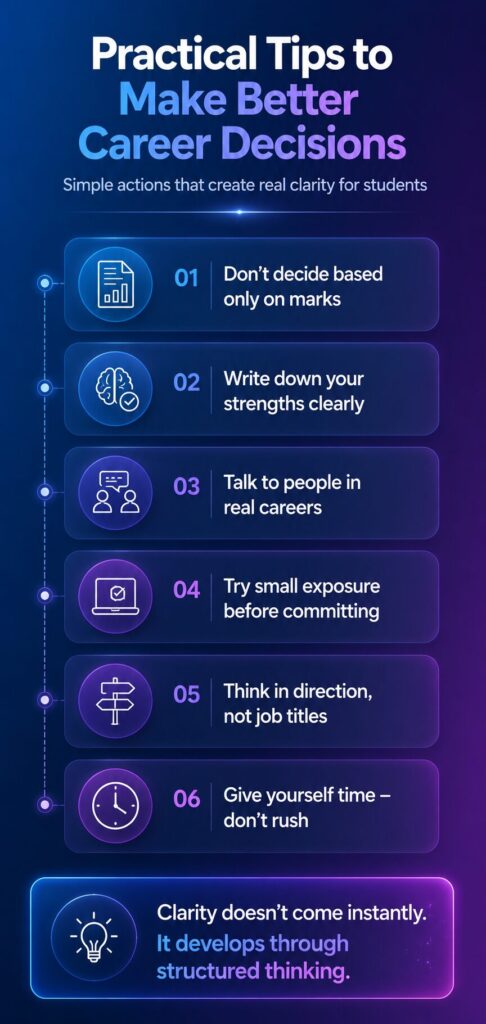
If you want quick, actionable clarity, follow these:
- Don’t decide based only on marks
- Write down your strengths clearly
- Talk to people working in different fields
- Try a small exposure before committing
- Think in terms of direction, not job titles
- Give yourself time, don’t rush under pressure
Remember:
Clarity doesn’t come instantly. It develops through structured thinking.
Why This Approach Works Better
Let’s simplify everything:
Most students:
- Guess → feel confused → doubt their decision
Smart students:
- Follow a process → gain clarity → make confident decisions
The difference is not intelligence.
The difference is in the approach.
Strengths-based career planning works because:
- It is personalised
- It is structured
- It focuses on long-term success
Final Thought: Stop Guessing, Start Understanding
Choosing a career is not about luck.
It’s not about following others.
And it’s definitely not about guessing.
It’s about understanding yourself deeply and making decisions based on that understanding.
The right career is not randomly chosen.
It is discovered through clarity.
So before you make your next career decision, pause and ask:
“Am I guessing… or am I following a system?”
Because that one shift can change everything.
Frequently Asked Questions:
1) How do students actually choose the right career for themselves?
Students can choose the right career by understanding their strengths and thinking styles, and by exploring real career options, rather than relying only on marks or trends.
2) How can I choose a career based on my strengths and not just marks?
To choose a career based on strengths, identify what comes naturally to you, map it to career options, and validate it through real-world exposure like internships or projects.
3) Why are marks not enough when deciding a career path?
Marks only reflect academic performance and don’t show your strengths, interests, or long-term career fit, which are critical for success and satisfaction.
4) What is strengths-based career planning, and how does it help students?
Strengths-based career planning helps students choose careers by focusing on their natural abilities, thinking patterns, and long-term potential instead of external pressure.
5) How should I choose my career after 10th in the right way?
After the 10th, students should focus on stream selection based on strengths, learning style, and future career direction rather than just marks or peer decisions.
6) I am confused after 12th – how do I decide the right career path?
If you are confused after 12th, follow a structured process: self-awareness, career exploration, strengths mapping, and practical exposure before making a decision.
7) What is the best way to choose a career for long-term success and clarity?
The best way is to align your strengths with career demands, think in directions instead of fixed jobs, and avoid decisions based on pressure or short-term trends.