


Career planning has changed dramatically over the last decade. Earlier, students usually chose between a handful of well-known career options such as engineering, medicine, law, or government services. Today, however, students are growing up in a world filled with hundreds of career possibilities across technology, business, design, psychology, artificial intelligence, entrepreneurship, content creation, healthcare, and many other emerging fields.
While having more options should theoretically make career planning easier, it often creates the opposite effect. Many students feel overwhelmed by the number of choices available to them. They worry about making the wrong decision, choosing a career with limited opportunities, or disappointing their families. In the middle of this uncertainty, parents naturally want to help.
The challenge is that career guidance and career pressure can sometimes look very similar.
Most parents genuinely want what is best for their children. They want stability, security, growth, and happiness. Yet, despite good intentions, many career conversations become stressful because parents and students approach the decision from different perspectives.
The smartest parents understand an important principle: their job is not to choose a career for their child. Their job is to help their child make a better career decision.
Why Parents Have a Bigger Impact Than They Realise
When people talk about career planning for students, they often focus on schools, counsellors, aptitude tests, or online resources. However, research consistently shows that parents remain one of the strongest influences on a student’s career decisions.
A student’s confidence, willingness to explore opportunities, attitude toward risk, and perception of success are often shaped at home long before career planning formally begins.
Think about it. When students are confused about choosing a stream after Class 10 or selecting a course after Class 12, whose opinion do they usually value most?
Their parents’.
This influence can be incredibly positive. Parents can provide emotional support, practical guidance, and a real-world perspective. But influence becomes problematic when it turns into control. Students who feel pressured into a particular career often struggle with motivation, engagement, and confidence because the decision no longer feels like their own.
The goal of parents should not be to direct every career choice. Instead, it should be to create an environment where informed and thoughtful decisions can happen.
Why Career Planning Often Creates Conflict Between Parents and Students
One of the biggest reasons career discussions become difficult is that parents and students are usually solving different problems.
Parents tend to think about long-term outcomes. They worry about financial stability, job security, career growth, and future opportunities. Their concerns are practical and understandable.
Students, on the other hand, are trying to understand themselves. They are asking questions like:
- What am I good at?
- What kind of work will I enjoy?
- What career fits my personality?
- What if I make the wrong decision?
Neither side is wrong.
The problem begins when one perspective completely dominates the conversation.
For example, a parent may recommend engineering because it offers strong career opportunities. Meanwhile, the student may feel drawn toward design, psychology, or another field that aligns more closely with their natural strengths. Without proper discussion, both sides can feel misunderstood.
The most productive career conversations happen when parents focus on understanding before advising.
Five Career Planning Mistakes Parents Often Make
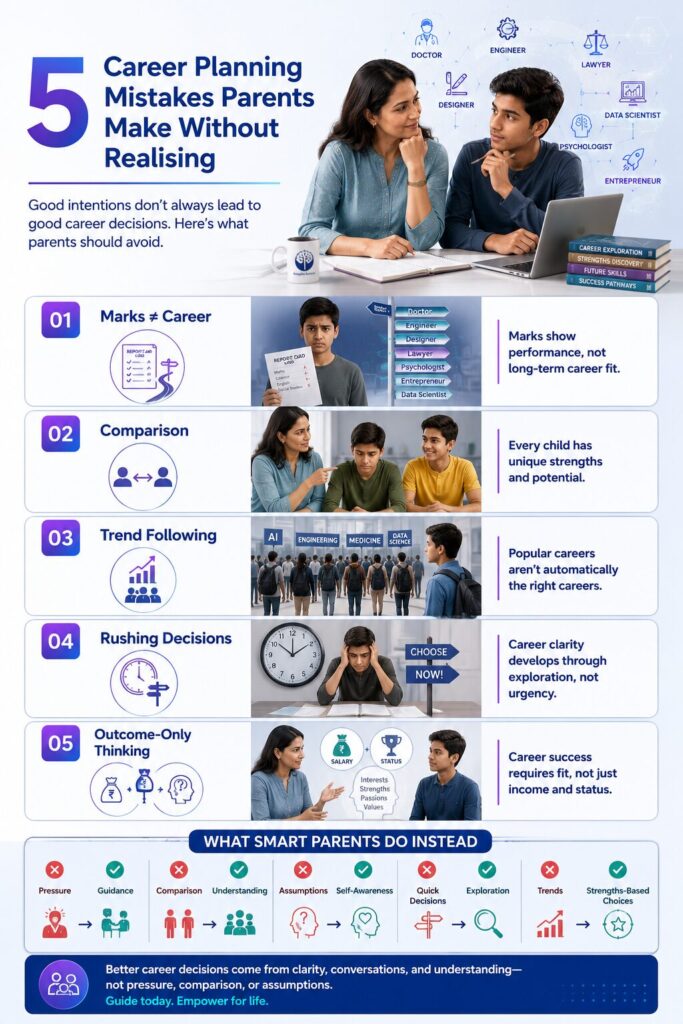
Many career-planning challenges can be traced to a few common mistakes. These mistakes usually come from concern rather than bad intentions, but they can still create confusion.
1. Treating Marks as the Ultimate Career Indicator
Academic performance matters, but marks tell only part of the story.
A student may score highly in science because they are disciplined and hardworking. That doesn’t automatically mean they will enjoy working as a doctor or engineer for the next 30 years.
Marks measure performance in an academic environment. They do not reveal natural strengths, thinking patterns, motivations, or long-term career fit.
Parents who rely solely on marks often overlook important factors that contribute to career satisfaction and success.
2. Comparing Children With Other Students
Comparison is one of the fastest ways to damage confidence.
Every student has different strengths, interests, learning styles, and ambitions. A career path that works exceptionally well for one student may be completely unsuitable for another.
The question should never be, “What are other students choosing?”
The better question is, “What is right for my child?”
3. Following Popular Career Trends
Every generation has its “safe” career options. Today, many students are encouraged to pursue fields such as AI, data science, software engineering, or government jobs simply because they appear promising.
These can be excellent careers. However, popularity should never replace suitability.
Successful careers are built on alignment between the individual and the work itself.
4. Expecting Immediate Clarity
Many parents expect students to know exactly what they want to do after Class 10 or Class 12.
The reality is that career clarity develops gradually through exploration, reflection, conversations, and experience. Most students need time to understand themselves before making major decisions.
5. Focusing Only on Outcomes
Questions about salary, stability, and growth are important. However, parents sometimes focus so heavily on outcomes that they forget to examine fit.
A career may offer excellent opportunities, but if it doesn’t align with a student’s natural strengths, sustaining motivation over the long term becomes difficult.
What Students Actually Need From Their Parents
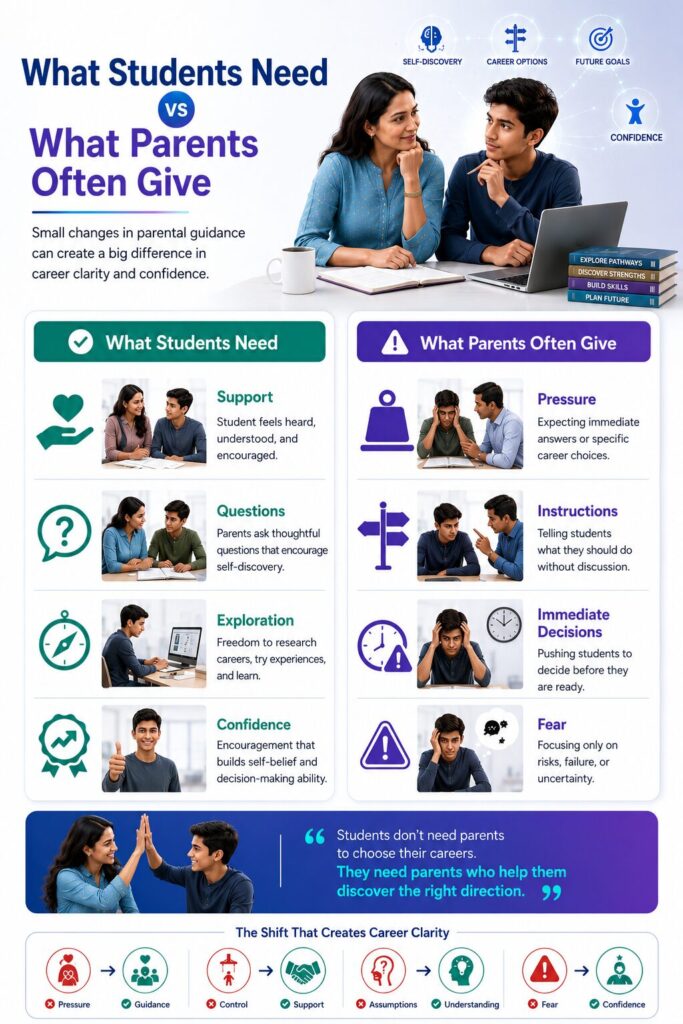
Many parents assume students need answers. In reality, most students need support.
Students need someone who listens before advising. They need a safe space to explore possibilities without fear of judgment. They need encouragement to ask questions and investigate different options.
The most effective parents do not constantly tell students what to do. Instead, they ask thoughtful questions that encourage self-discovery.
For example, rather than saying:
“You should become an engineer.”
A more helpful question might be:
“What kind of problems do you enjoy solving?”
That small shift changes the conversation from instruction to exploration.
Students also need permission to be uncertain. Career planning is a journey, not a one-time decision. When parents acknowledge this reality, students often feel less anxious and more open to meaningful exploration.
A Smarter Framework for Career Planning
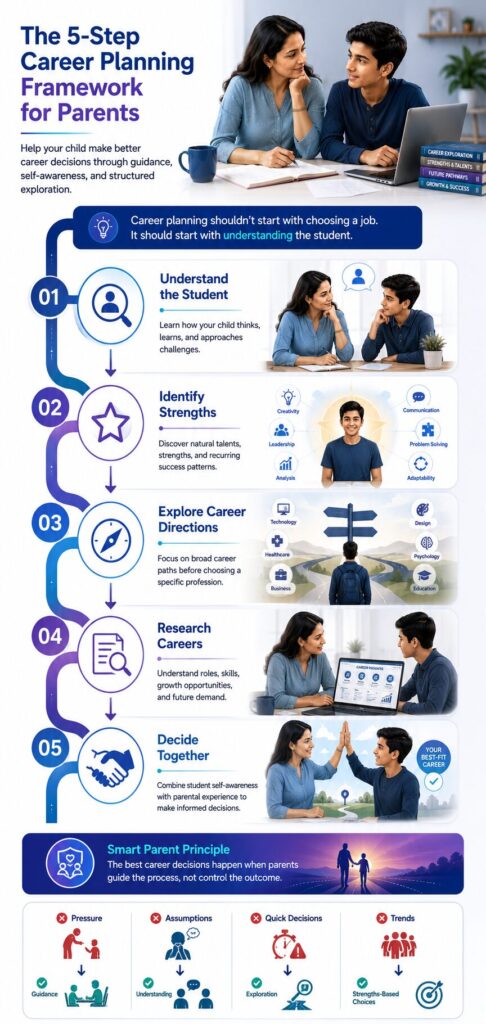
Instead of focusing immediately on career titles, smart parents help students follow a structured process.
Step 1: Understand the Student First
Before exploring careers, understand the individual.
Look at:
- Natural strengths
- Learning style
- Interests
- Personality traits
- Thinking patterns
Career planning becomes much easier when students understand themselves first.
Step 2: Identify Strengths
Every student has recurring patterns in how they think, learn, and solve problems.
Some are analytical.
Some are creative.
Some excel at building relationships.
Others thrive in structured environments.
These strengths often provide stronger career clues than marks alone.
Step 3: Explore Career Directions
Instead of selecting a specific job immediately, focus on broader directions.
For example:
- Analytical strengths → Technology, Finance, Engineering
- Creative strengths → Design, Media, Marketing
- People-focused strengths → Psychology, HR, Management
This approach reduces pressure while keeping options open.
Step 4: Research Real Career Opportunities
Students should understand:
- Day-to-day responsibilities
- Required skills
- Future demand
- Career growth opportunities
Career names alone rarely provide enough information for good decisions.
Step 5: Make Decisions Together
Parents bring experience.
Students bring self-awareness.
The best decisions happen when both perspectives are respected.
Why Strengths Matter More Than Pressure
One of the biggest mistakes in career planning is focusing only on marks or interests.
Marks show performance.
Interests show attraction.
Strengths reveal something much deeper.
Strengths are natural and recurring patterns in how people think, behave, learn, and perform. Unlike temporary interests, strengths tend to remain consistent over time.
Research by Gallup has shown that individuals who regularly use their strengths are significantly more engaged and productive in their work environments.
This is why strengths-based career planning is becoming increasingly important.
When students choose careers aligned with their strengths, they are more likely to experience confidence, motivation, performance, and long-term satisfaction.
How Strengths Masters Helps Parents and Students Make Better Career Decisions
At Strengths Masters, we believe that career planning should begin with self-awareness rather than assumptions.
Our vision is simple: every student deserves career clarity based on strengths, not pressure, trends, or guesswork.
Through our Strengths for Students program, we help students understand how they naturally think, learn, and perform. Instead of focusing solely on marks or career trends, we help students identify their unique strengths and connect them to suitable career directions.
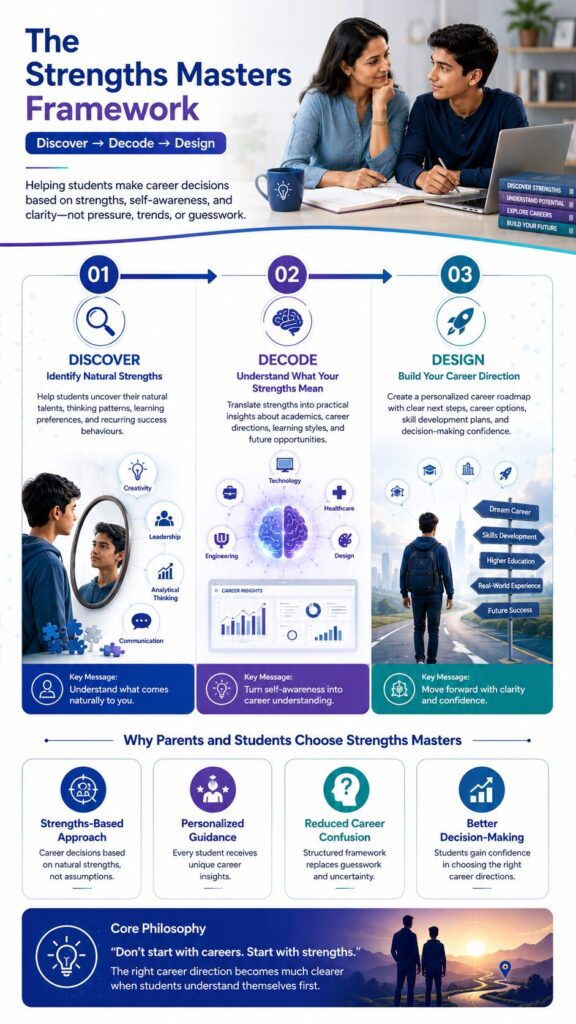
Our framework follows three stages:
Discover
Identify natural talents, strengths, and recurring success patterns.
Decode
Understand what those strengths mean for academics, career options, and future opportunities.
Design
Create a clear action plan that helps students move toward careers aligned with their strengths.
For parents, this creates more meaningful career conversations.
For students, it creates greater confidence and clarity.
The result is a career decision based on understanding rather than pressure.
Final Thoughts
The best career decisions are rarely made under pressure.
They are made through understanding.
Smart parents recognise that career planning is not about controlling outcomes. It is about helping students understand themselves, explore opportunities, and make informed decisions with confidence.
When parents replace comparison with curiosity, pressure with support, and assumptions with self-awareness, career planning becomes far more effective.
And in a world filled with endless career options, that may be one of the most valuable gifts a parent can provide.
Frequently Asked Questions:
1. What is the role of parents in career planning for students?
Parents play a critical role in career planning by providing guidance, emotional support, and opportunities for exploration. Instead of choosing a career for their child, parents should help students understand their strengths, interests, and future career options so they can make informed decisions.
2. How can parents help students choose the right career?
Parents can help students choose the right career by encouraging self-awareness, discussing different career paths, supporting career exploration, and focusing on strengths rather than marks alone. The most effective career decisions happen when parents guide the process instead of controlling the outcome.
3. Should parents choose a career for their child?
No. Parents should not choose a career on behalf of their child. While parental experience is valuable, long-term career success depends on the student’s strengths, personality, motivation, and career fit. Parents should act as mentors rather than decision-makers.
4. What mistakes do parents make during career planning?
Common career planning mistakes include comparing children with others, focusing only on marks, following popular career trends, expecting immediate clarity, and prioritising salary over career fit. These mistakes can increase confusion and pressure for students.
5. Why are strengths important in career planning?
Strengths are important because they represent natural and consistent patterns of thinking, learning, and problem-solving. Unlike temporary interests or exam scores, strengths often predict long-term performance, engagement, and career satisfaction.
6. At what age should parents start career planning with their child?
Career planning should begin gradually during the middle and high school years. The goal is not to force a career decision early but to help students develop self-awareness, explore career options, and understand how their strengths relate to future opportunities.
7. How does Strengths Masters help parents and students make better career decisions?
Strengths Masters helps parents and students through a strengths-based career planning approach. Using the Discover → Decode → Design Framework, students gain clarity about their natural strengths, explore suitable career directions, and make confident career decisions based on self-awareness rather than guesswork.
8. What is the best way for parents to support career decision-making without creating pressure?
The best approach is to create open conversations, ask thoughtful questions, encourage exploration, and focus on strengths instead of expectations. Students are more likely to make confident and informed career decisions when they feel supported rather than pressured.