

Introduction
Trust is one of the most talked-about concepts in leadership and one of the least understood. Almost every organisation says it wants employees to take ownership, communicate openly, collaborate effectively, and make better decisions. Yet many managers struggle to create the environment where these behaviours naturally happen.
The reason is simple.
Trust and accountability are often treated as opposing forces. Some managers believe that increasing trust means reducing oversight and lowering expectations. Others focus so heavily on accountability that employees begin feeling monitored rather than supported. Neither approach produces high-performing teams. The most effective managers understand that trust and accountability are not competing priorities. They strengthen each other. When trust is low, employees avoid risks, hesitate to speak openly, and become dependent on managers for decisions. When accountability is weak, performance suffers because expectations and ownership become unclear.
According to Gallup, employees who trust leadership are significantly more engaged and are more likely to feel connected to their work and organisation. Similarly, research from Deloitte suggests that organisations with high-trust cultures tend to experience better collaboration, higher innovation, and stronger business performance. The workplace has become increasingly complex. Teams work across locations, priorities shift rapidly, and decisions need to be made faster than ever before. In this environment, managers cannot create performance through control alone. They need teams that feel trusted enough to act independently and accountable enough to deliver results consistently.
That balance is where leadership effectiveness truly begins.
Why Teams Struggle With Trust
Trust problems rarely appear overnight. They usually develop through everyday management behaviours. Employees begin losing trust when communication becomes inconsistent, priorities keep changing without explanation, decisions are made behind closed doors, or mistakes are punished rather than discussed.
Micromanagement also weakens trust.
When managers continuously monitor small details, employees often interpret it as a lack of confidence in their abilities. Over time, initiative decreases because people stop believing that independent thinking is valued. At the same time, completely removing accountability creates a different problem. Employees become uncertain about expectations, ownership weakens, and performance standards become inconsistent. Strong leadership requires balancing both trust and accountability simultaneously.
Signs Your Team Lacks Trust
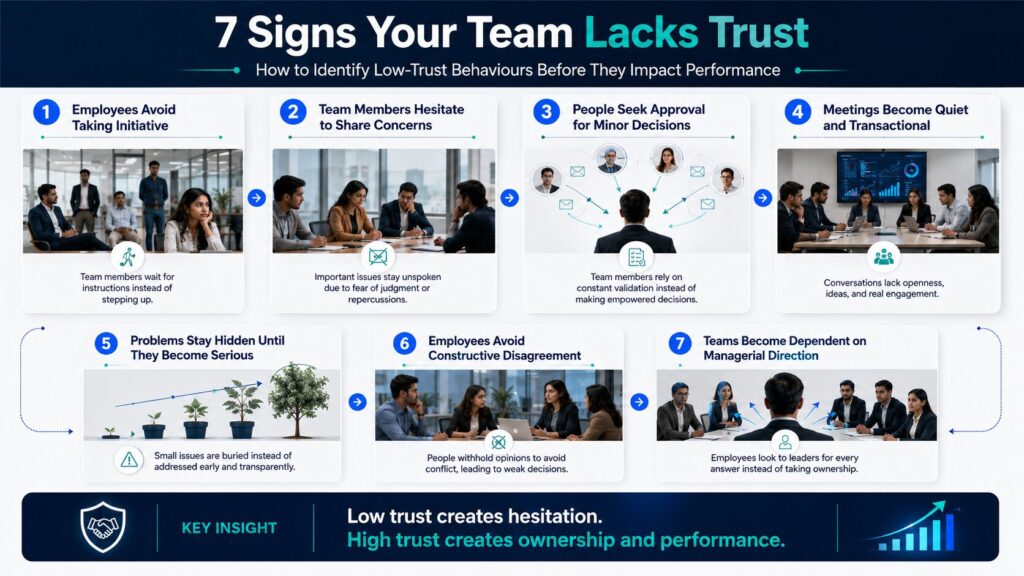
Most trust issues appear in subtle ways before they become performance problems.
Some common warning signs include:
- Employees avoid taking initiative.
- Team members hesitate to share concerns.
- People seek approval for minor decisions.
- Meetings become quiet and transactional.
- Problems remain hidden until they become serious.
- Employees avoid constructive disagreement.
- Teams become dependent on managerial direction.
These behaviours often indicate that employees do not feel sufficiently safe, supported, or empowered to contribute fully.
How Effective Managers Build Trust Without Lowering Accountability
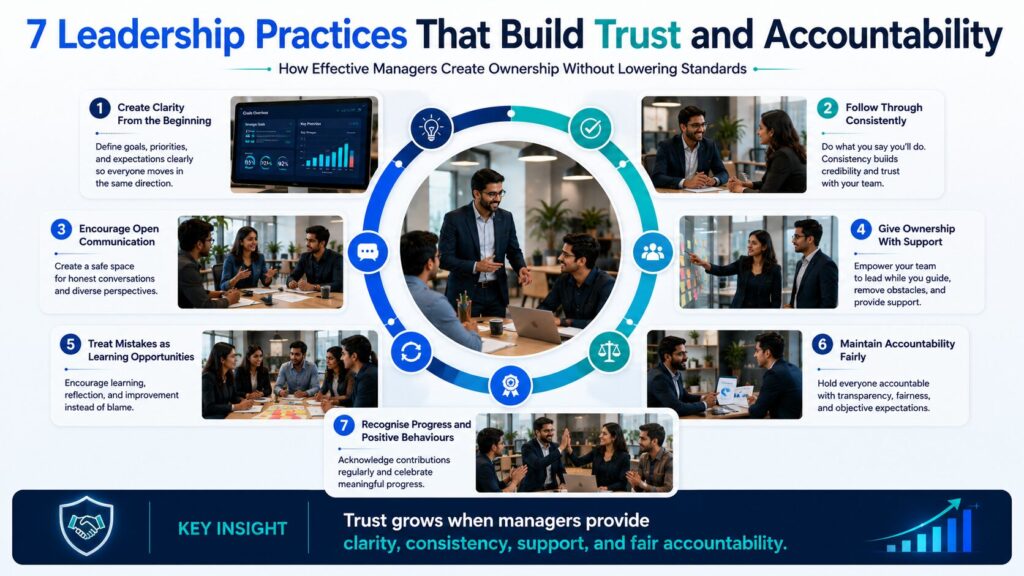
1. They Create Clarity From the Beginning
Trust grows when employees understand what is expected of them. One of the fastest ways to damage trust is through confusion. When priorities constantly change, responsibilities remain unclear, or expectations are not communicated properly, employees become uncertain about how to succeed.
Effective managers create trust by providing clarity around:
- Goals
- Priorities
- Responsibilities
- Success measures
- Decision boundaries
Clarity reduces anxiety and allows people to focus their energy on meaningful work. This directly connects to creating clarity in everyday work because employees trust leaders who provide direction and consistency.
2. They Follow Through Consistently
Trust is built through repeated experiences.
Employees observe whether managers:
- Keep commitments
- Honour deadlines
- Provide promised support
- Follow through on decisions
- Apply expectations fairly
Even small inconsistencies can weaken credibility.
For example, a manager who encourages feedback but reacts defensively when employees share concerns sends conflicting signals.
Over time, employees stop speaking openly. Strong managers understand that trust depends heavily on behavioural consistency. People trust leaders whose actions align with their words.
3. They Encourage Open Communication
Employees are more likely to contribute ideas and raise concerns when they feel heard. Effective managers intentionally create opportunities for open dialogue.
They ask questions such as:
“What challenges are you facing?”
“What concerns should we discuss?”
“What can we improve as a team?”
“What support would help you perform better?”
These conversations are not simply communication exercises. They are trust-building moments.
According to research from Harvard Business Review, teams perform better when employees feel psychologically safe enough to share concerns, challenge assumptions, and contribute ideas without fear of negative consequences. Open communication creates stronger relationships and better decisions.
4. They Give Ownership With Support
Many managers unintentionally weaken trust by either controlling everything or withdrawing completely. Effective managers choose a different approach. They provide ownership alongside support.
For example, a manager might ask an employee to lead a client presentation while remaining available for guidance if required.
The employee owns the outcome. The manager remains supportive without taking over.
This sends an important message:
“I trust your capability, and I will support your success.”
That balance significantly improves confidence and accountability.
5. They Treat Mistakes as Learning Opportunities
Trust decreases when employees fear making mistakes.
People become risk-averse and avoid taking initiative because they worry about criticism or blame. Strong managers understand that mistakes often provide valuable learning opportunities.
Instead of immediately focusing on fault, they ask:
What happened?
What can we learn?
How do we improve next time?
This approach encourages problem-solving and continuous improvement. Employees become more willing to take ownership because they know mistakes will lead to learning conversations rather than punishment. This does not mean lowering accountability.
Performance standards still matter.
However, accountability shifts focus to growth and improvement rather than blame.
6. They Maintain Accountability Fairly
Trust and accountability cannot exist separately. Employees trust managers when accountability standards are fair and consistent.
Problems arise when:
- Some employees avoid consequences.
- Expectations change unexpectedly.
- Performance conversations become inconsistent.
- Feedback depends on personal preferences.
Effective managers establish accountability systems that are transparent and predictable.
Everyone understands:
- What success looks like
- How performance is measured
- How progress is reviewed
- How challenges are addressed
Fair accountability strengthens trust because employees perceive leadership decisions as objective rather than arbitrary.
7. They Recognise Progress and Positive Behaviours
Trust also grows through recognition. Employees want to know that their effort and contributions matter.
Strong managers recognise behaviours such as:
- Taking ownership
- Solving problems independently
- Supporting colleagues
- Learning new skills
- Demonstrating accountability
Recognition reinforces desired behaviours and strengthens relationships. According to Gallup research, employees who receive meaningful recognition are more likely to remain engaged and committed to their work. Recognition communicates appreciation. Appreciation builds trust.
The Difference Between Trust and Comfort
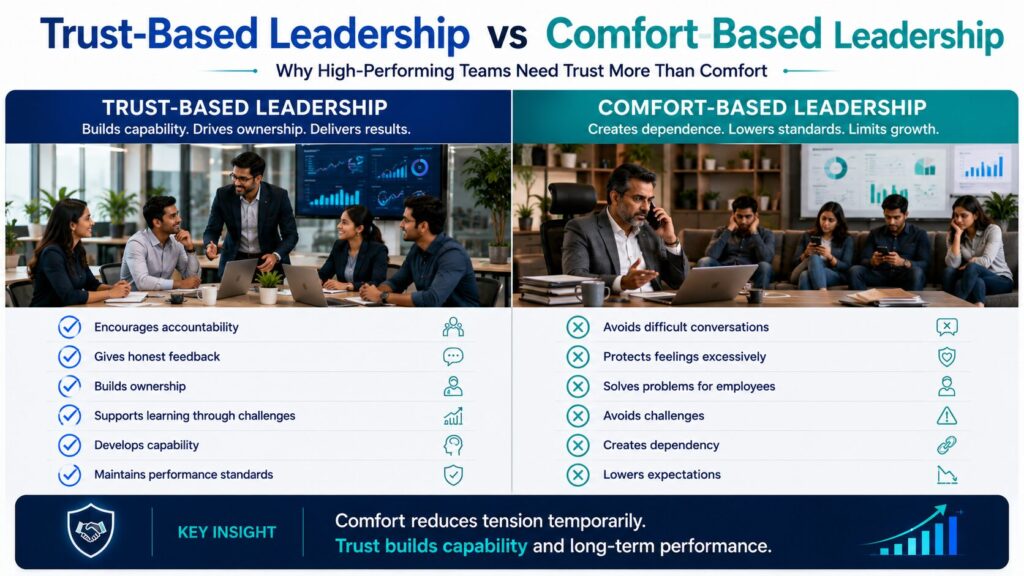
Many leaders unintentionally create comfort instead of trust.
The two are very different.
| Trust-Based Leadership | Comfort-Based Leadership |
| Encourages accountability | Avoids difficult conversations |
| Provides honest feedback | Protects feelings excessively |
| Builds ownership | Solves problems for employees |
| Supports learning | Avoids challenges |
| Develops capability | Creates dependency |
| Maintains standards | Lowers expectations |
Comfort may reduce short-term tension. Trust creates long-term performance. Effective managers build environments where employees feel respected, supported, and challenged to grow.
How Strengths Masters Helps Managers Build High-Trust Teams
At Strengths Masters, leadership development focuses on practical workplace challenges managers experience every day. Building trust is rarely about personality. It is about leadership capability.
Programs such as the 5 Skills for First-Time Managers help leaders improve:
- Communication clarity
- Coaching conversations
- Delegation capability
- Accountability systems
- Feedback delivery
- Performance reviews
- Team development practices
The objective is not simply to improve relationships. The objective is to help managers create environments where people can communicate openly, take ownership, make decisions confidently, and perform consistently. High-performing teams require both trust and accountability. Neither works effectively without the other.
Conclusion
The strongest teams are not built through control. They are built through trust.
However, trust does not mean lowering standards, avoiding difficult conversations, or removing accountability.
Research from Deloitte and Gallup consistently shows that employees perform better when they trust leadership, understand expectations, and feel empowered to contribute meaningfully.
High-trust environments encourage collaboration, innovation, and ownership because people feel safe enough to think independently and accountable enough to deliver results.
For managers, the lesson is clear. Leadership effectiveness is not about choosing between trust and accountability. It is about intentionally building both.
When employees trust leadership and understand their responsibilities, teams become more confident, more resilient, and significantly more capable of performing without constant supervision.
Frequently Asked Questions:
1. How do managers build trust without reducing accountability?
Learn how effective managers create trust by setting clear expectations, empowering employees, and maintaining consistent accountability.
2. Why is trust important for leadership effectiveness?
Discover why trust is the foundation of employee engagement, collaboration, decision-making, and long-term team performance.
3. What are the best ways leaders can improve trust within their teams?
Explore practical leadership strategies such as transparent communication, active listening, and fair accountability practices.
4. What is the connection between trust and accountability in the workplace?
Understand how trust and accountability work together to build ownership, improve performance, and strengthen team relationships.
5. How do managers create psychological safety without compromising performance standards?
Learn how leaders encourage open communication and honest feedback while maintaining high expectations and accountability.
6. Why do employees lose trust in their managers?
Discover common reasons employees lose trust, including inconsistent behaviour, poor communication, micromanagement, and lack of transparency.
7. How can trust-based leadership help build high-performing teams?
Find out how trust-based leadership increases ownership, innovation, collaboration, and sustainable business performance.