

Introduction
Most managers give feedback.
Yet many employees continue making the same mistakes, missing the same expectations, and repeating the same performance challenges.
This creates a frustrating cycle. Managers invest time in performance discussions, employees acknowledge the feedback, and everyone leaves the conversation believing progress will happen. A few weeks later, little has changed.
The problem is not that feedback is unimportant.
The problem is that feedback is often delivered in a way that creates awareness but not action.
In today’s workplace, where organisations expect employees to adapt quickly, collaborate effectively, and take greater ownership, feedback has become one of the most important leadership capabilities. Managers are no longer expected to simply evaluate performance. They are expected to develop it.
According to Gallup workplace research, employees who receive meaningful feedback are significantly more engaged than those who rarely receive feedback. Similarly, research from Deloitte and Gartner continues to highlight the importance of ongoing performance conversations over traditional annual reviews.
The goal of feedback is not to tell employees what they did wrong.
The goal is to help employees improve future performance.
Great managers understand this difference. They use feedback as a development tool rather than a correction tool. As a result, they create stronger accountability, better performance, and more capable teams.
Why Most Feedback Fails
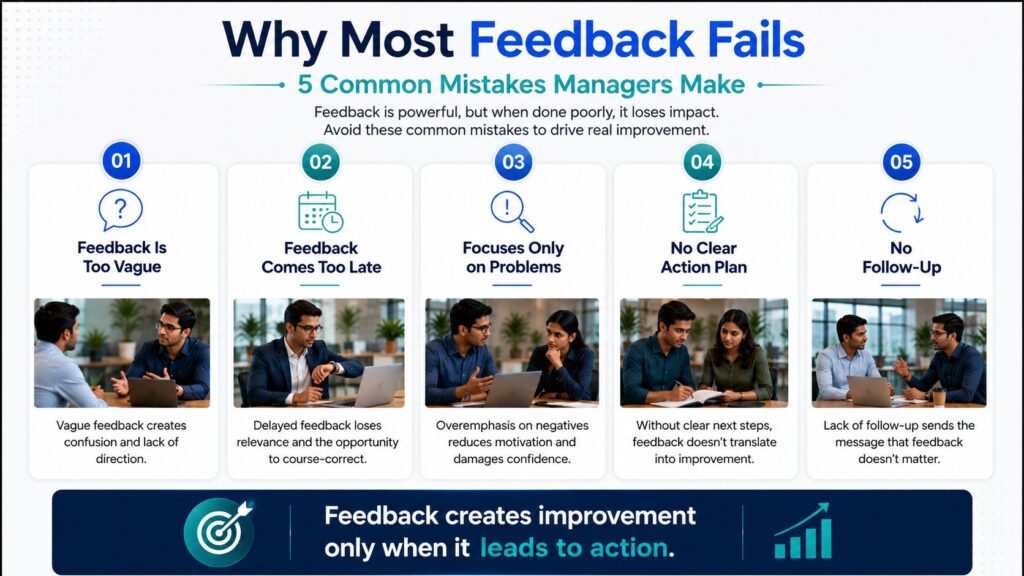
Many feedback conversations fail long before the discussion even begins.
The issue is rarely employee resistance. More often, the issue is how feedback is delivered.
Common mistakes include:
- Feedback is too vague.
- Feedback is delayed.
- Feedback focuses only on problems.
- Managers speak more than they listen.
- No clear action plan follows the conversation.
- There is no follow-up.
Consider this example:
A manager tells an employee:
“You need to communicate better.”
The employee may agree, but what exactly should change?
Should they provide more updates?
Should they improve stakeholder management?
Should they respond faster to emails?
The feedback lacks clarity.
Without clarity, improvement becomes difficult.
This is why many feedback conversations feel productive in the moment but fail to create lasting behavioural change.
What Feedback That Drives Performance Actually Looks Like
Effective feedback creates more than awareness.
It creates action.
The purpose of feedback is to help employees understand what needs to change, why it matters, and how improvement can happen.
Strong feedback creates five outcomes:
- Clarity
- Awareness
- Accountability
- Action
- Improvement
Many managers unknowingly follow this process:
Feedback → Conversation → Agreement → No Change
Great managers follow a different process:
Feedback → Understanding → Action → Behaviour Change → Performance Improvement
The difference is significant.
One creates discussion.
The other creates results.
The 5-Part Feedback Framework Great Managers Use
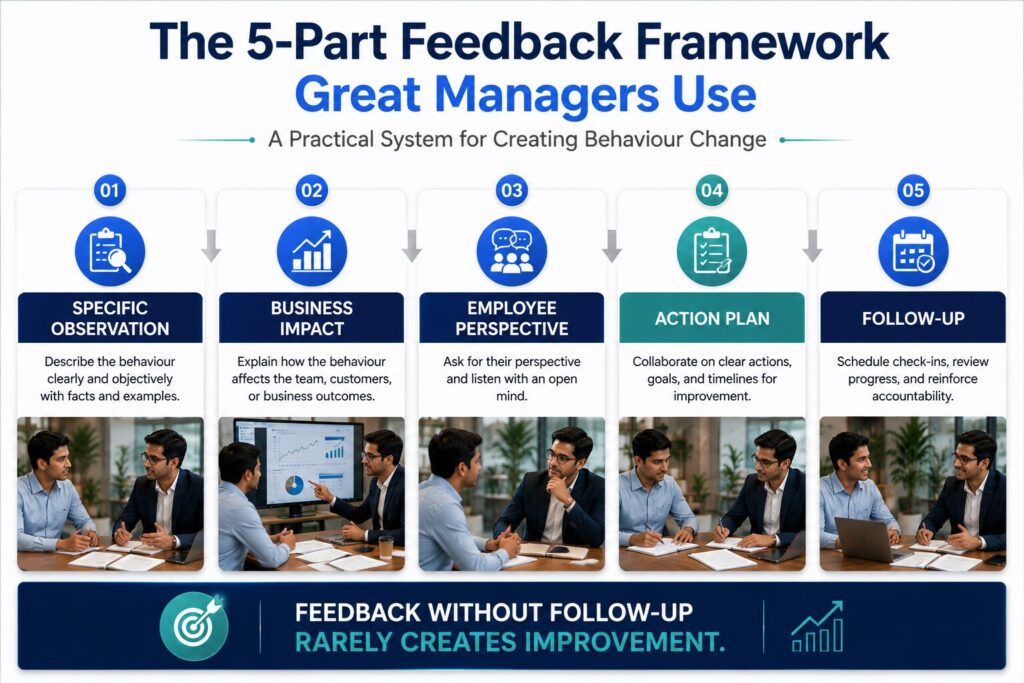
1. Start With Specific Observations
The best feedback starts with facts.
Not assumptions.
Not personal opinions.
Not labels.
Employees respond more positively when managers focus on observable behaviour.
For example:
Instead of saying:
“You are not proactive.”
A manager might say:
“Over the past month, three client updates were submitted after the agreed deadline.”
The second statement is specific and measurable.
It creates clarity instead of defensiveness.
When employees understand exactly what behaviour is being discussed, they are more likely to engage constructively.
2. Explain the Business Impact
Many managers describe behaviour but fail to explain why it matters.
This is a missed opportunity.
Employees are more likely to change their behaviour when they understand the consequences of their actions.
For example:
“Those delayed client updates affected project visibility and created uncertainty for both the client and the internal team.”
Now the employee understands the broader impact.
Feedback becomes connected to business outcomes rather than personal criticism.
This approach strengthens accountability because employees understand how their work affects team performance.
3. Ask for Their Perspective
One of the biggest mistakes managers make is turning feedback into a one-way conversation.
Effective feedback is collaborative.
Great managers ask questions such as:
- What challenges contributed to this situation?
- What obstacles are you experiencing?
- How do you see the issue?
- What support would help?
These questions often reveal important context.
Perhaps priorities changed unexpectedly.
Perhaps workloads became unrealistic.
Perhaps expectations were unclear.
Understanding the employee’s perspective creates better solutions and strengthens trust.
4. Agree on Clear Actions
Feedback without action is simply a discussion.
Every performance conversation should end with clarity around next steps.
Managers and employees should agree on:
- What needs to change
- What success looks like
- When improvement should occur
- How progress will be measured
For example:
“Over the next four weeks, client updates will be delivered by 4 PM every Friday.”
This creates accountability because expectations become measurable.
Employees leave the conversation knowing exactly what success looks like.
5. Follow Up Consistently
This is where many managers fail.
They provide feedback once and assume improvement will happen automatically.
Behavioural change requires reinforcement.
Regular follow-up conversations help managers:
- Monitor progress
- Remove obstacles
- Reinforce positive behaviours
- Maintain accountability
Improvement rarely happens from a single conversation.
It happens because managers continue supporting progress after the conversation ends.
A Real Workplace Example
Imagine a team leader managing a project coordinator who consistently misses deadlines.
A traditional feedback conversation might sound like this:
“You need to improve your time management.”
The employee agrees.
Nothing changes.
A performance-focused feedback conversation looks different.
The manager explains:
Three project reports were submitted after the agreed deadline this month. This delayed client communication and affected project planning.
The manager then asks:
“What challenges are making it difficult to meet deadlines consistently?”
The employee explains that multiple urgent requests often interrupt planned work.
Together, they agree on new prioritisation processes and weekly review meetings.
Over the next month, project delivery will improve significantly.
The difference was not the feedback itself.
The difference was in how the feedback was delivered and followed up on.
Feedback vs Criticism
Many employees fear feedback because they associate it with criticism.
The two are not the same.
Feedback focuses on helping people improve.
Criticism often focuses on judging people.
| Feedback | Criticism |
| Focuses on behaviour | Focuses on the person |
| Future-oriented | Past-oriented |
| Encourages improvement | Creates defensiveness |
| Specific and actionable | General and vague |
| Collaborative | One-way |
Employees may resist criticism.
They are far more likely to accept feedback that helps them succeed.
This distinction is essential for managers who want feedback conversations to drive improvement rather than frustration.
How Often Should Managers Give Feedback?
Many organisations still rely heavily on annual performance reviews.
The challenge is timing.
If an issue occurs in January but is discussed in December, the opportunity for improvement has largely been lost.
High-performing managers create continuous feedback systems.
A practical approach includes:
Daily:
Recognition and appreciation.
Weekly:
Coaching conversations and progress discussions.
Monthly:
Development-focused feedback.
Quarterly:
Formal performance reviews and career discussions.
Ongoing feedback helps employees adjust their behaviours faster and maintain stronger performance throughout the year.
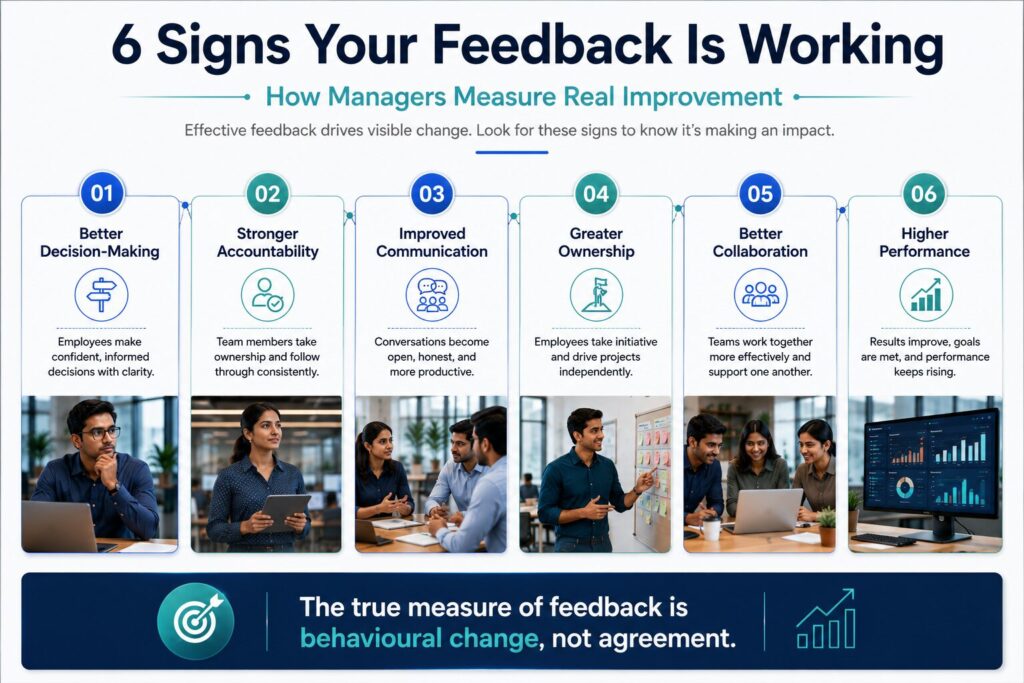
Signs Your Feedback Is Working
Many managers evaluate feedback success incorrectly.
They assume success occurs when an employee agrees during the conversation.
Agreement is not the goal.
Improvement is the goal.
Effective feedback produces visible changes such as:
- Better decision-making
- Stronger accountability
- Improved communication
- Greater ownership
- Better collaboration
- Higher performance
The true measure of feedback effectiveness is behavioural change.
If behaviour improves, feedback is working.
If behaviour remains unchanged, managers should revisit how feedback is being delivered.
How Strengths Masters Helps Managers Build Feedback Skills
Providing effective feedback is not a natural skill for most managers.
Many leaders are promoted because of technical expertise, operational knowledge, or individual performance. Few receive formal training on how to conduct feedback conversations that create improvement.
At Strengths Masters, leadership development focuses on helping managers build practical workplace capabilities.
Programs support leaders in developing:
- Coaching conversations
- Performance review skills
- Accountability discussions
- Communication effectiveness
- Team development practices
- Difficult performance conversations
The goal is not simply to help managers deliver feedback.
The goal is to help managers create environments where feedback drives learning, ownership, and performance improvement.
Because stronger feedback conversations ultimately lead to stronger teams.
Conclusion
Great managers do not measure feedback success by how well a conversation goes.
They measure it by what happens afterwards.
Feedback becomes valuable when it creates clarity, accountability, action, and measurable improvement.
The most effective leaders understand that performance conversations are not about pointing out mistakes. They are about helping people perform at a higher level.
When managers provide specific observations, explain business impact, invite employee perspectives, create action plans, and follow up consistently, feedback becomes one of the most powerful tools for improving workplace performance.
In modern organisations, feedback is no longer a management activity.
It is a leadership capability.
And the managers who master it build stronger teams, better accountability, and better business outcomes.
Frequently Asked Questions:
1. How do managers give feedback that improves performance?
Managers improve performance by giving feedback that is timely, specific, objective, and focused on future improvement rather than personal criticism. Effective feedback explains what happened, why it matters, and what actions should be taken next. Great managers also invite employees to share their perspective and agree on measurable follow-up actions. Regular coaching conversations create continuous improvement instead of relying only on annual performance reviews. When feedback is clear and actionable, employees understand expectations, build confidence, and improve accountability.
2. Why does employee feedback often fail?
Employee feedback usually fails because it is too vague, delayed, overly critical, or lacks clear next steps. Many managers point out problems without explaining the business impact or agreeing on an improvement plan. Feedback also loses effectiveness when there is no follow-up to reinforce progress. High-performing organisations treat feedback as an ongoing coaching process rather than a one-time conversation. Consistent, constructive feedback builds trust, ownership, and long-term performance improvement.
3. What is the best feedback framework for managers?
One of the most practical feedback models is a five-step framework:
• Describe the specific behaviour or situation.
• Explain the business or team impact.
• Ask for the employee’s perspective.
• Agree on clear actions for improvement.
• Schedule follow-up to review progress.
This structured approach keeps conversations objective, encourages two-way communication, and helps employees understand expectations. Managers who use consistent feedback frameworks create stronger accountability, better communication, and higher team performance.
4. How often should managers give feedback to employees?
Effective managers provide feedback continuously instead of waiting for formal performance reviews. Small coaching conversations after projects, weekly one-to-one meetings, and regular check-ins help employees adjust quickly and improve performance. Positive feedback should reinforce successful behaviours, while developmental feedback should be delivered as close as possible to the observed situation. Frequent feedback creates clarity, reduces misunderstandings, and supports continuous learning without overwhelming employees.
5. What is the difference between feedback and criticism?
Feedback is designed to help employees improve, while criticism often focuses only on mistakes without offering solutions. Constructive feedback is specific, objective, respectful, and action-oriented. It explains how behaviour affects business outcomes and identifies practical next steps. Criticism, on the other hand, can feel personal, judgmental, and discouraging. Managers who coach rather than criticise build stronger trust, psychological safety, and employee engagement while maintaining high performance expectations.
6. How can feedback improve accountability in teams?
Feedback strengthens accountability by making expectations, responsibilities, and performance standards clear. When managers discuss both achievements and improvement opportunities regularly, employees understand what success looks like and take greater ownership of their work. Follow-up conversations reinforce commitments and measure progress over time. Teams with a strong feedback culture are more likely to solve problems proactively, communicate openly, and consistently deliver better business results.
7. How do leaders create a strong feedback culture?
Leaders create a strong feedback culture by making feedback frequent, balanced, and part of everyday work. They encourage two-way conversations, recognise good performance, address issues early, and model openness to receiving feedback themselves. Clear expectations, psychological safety, and consistent follow-up help employees view feedback as an opportunity to learn rather than a threat. Organisations with healthy feedback cultures develop stronger managers, more engaged employees, better collaboration, and higher-performing teams.