


1. They Delegate Outcomes, Not Just Tasks
One of the biggest delegation mistakes managers make is assigning activities rather than outcomes.
For example:
Task Delegation:
“Prepare the monthly report.”
Outcome Delegation:
“Ensure leadership receives a clear monthly performance summary that supports decision-making.”
The difference is significant.
Task delegation focuses on activity.
Outcome delegation focuses on results.
When employees understand the desired outcome, they gain flexibility to make decisions, solve problems, and take ownership of the process. This improves accountability and strengthens decision-making capability across the team.
2. They Clarify Expectations From the Beginning
Many delegation failures occur because expectations were never clearly communicated.
Employees need clarity around:
- Objectives
- Success criteria
- Deadlines
- Quality standards
- Available resources
- Escalation points
This directly connects to the leadership principle discussed in our blog on creating clarity in everyday work. Strong managers understand that delegation without clarity creates confusion. Delegation with clarity creates confidence. When expectations are clearly defined, managers spend less time correcting misunderstandings, and employees perform with greater independence.
3. They Match Responsibility to Capability
Effective delegation is not about assigning work randomly. It is about assigning the right responsibility to the right person at the right stage of development.
For example:
A new employee may require:
- Structured guidance
- Frequent checkpoints
- Additional coaching
An experienced employee may require:
- Broader ownership
- Greater decision authority
- Fewer reviews
Strong managers adjust delegation based on capability rather than applying the same approach to everyone. This accelerates development while reducing unnecessary risk.
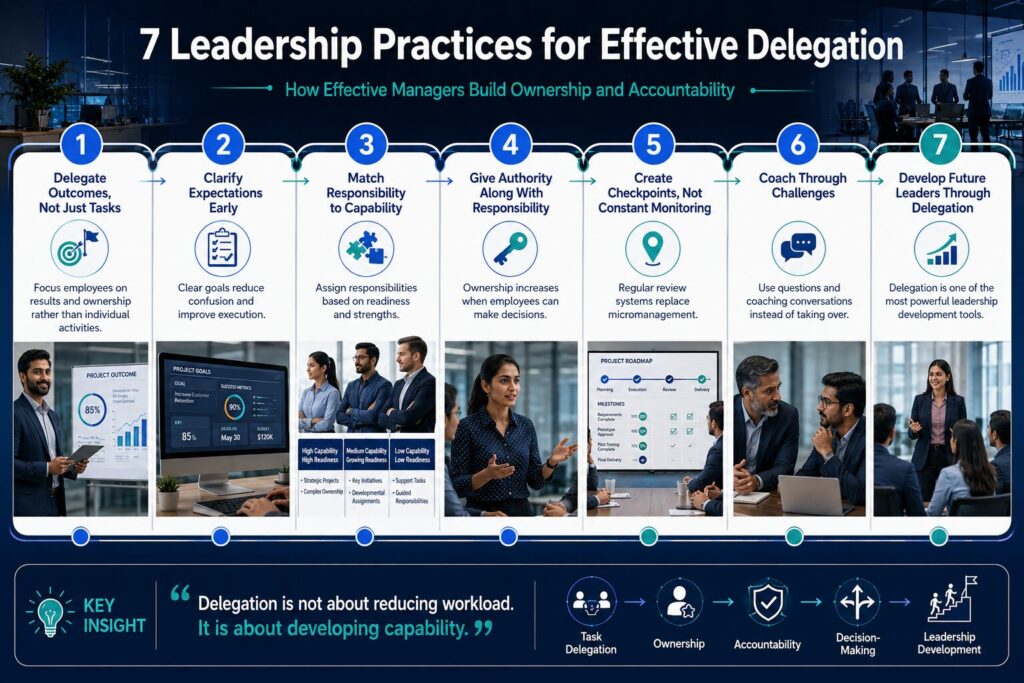
4. They Give Authority Along With Responsibility
One of the most frustrating experiences for employees is being held responsible for outcomes while lacking authority to make decisions. This creates confusion, delays, and disengagement. For delegation to succeed, responsibility and authority must work together. Consider a project lead responsible for client delivery. If every decision requires managerial approval, ownership becomes impossible.
However, if decision boundaries are clearly established, employees can move work forward confidently while still escalating major risks when necessary. This approach strengthens both accountability and employee ownership.
5. They Create Checkpoints Instead of Constant Monitoring
Many managers confuse visibility with control. As a result, they continuously monitor work. Employees interpret this behaviour as a lack of trust. Strong managers take a different approach. Instead of checking progress constantly, they create structured review points.
Examples include:
- Weekly progress reviews
- Milestone discussions
- Project status updates
- Performance check-ins
This provides visibility without creating micromanagement. Employees maintain ownership while managers remain informed. This balance is essential for effective delegation.
6. They Coach Through Challenges Instead of Taking Work Back
A common delegation mistake occurs when employees encounter difficulties. The manager immediately steps in and takes control. While this may solve the immediate problem, it damages long-term capability development. Effective managers use challenges as coaching opportunities.
Instead of saying:
“I’ll handle it.”
They ask:
- What options have you considered?
- What is causing the issue?
- What solution would you recommend?
- What support do you need?
This coaching approach develops confidence, problem-solving skills, and decision-making capability. Over time, employees become increasingly self-sufficient. This principle aligns closely with our previous discussion about building problem-solving independent teams.
7. They Use Delegation to Develop Future Leaders
The most effective managers view delegation as a leadership development tool. Delegation is not simply about reducing workload. It is about preparing employees for greater responsibility.
When managers intentionally delegate:
- Strategic projects
- Stakeholder interactions
- Decision-making responsibilities
- Leadership opportunities
Employees gain valuable experience that strengthens future leadership capability. Organisations that consistently develop leaders internally often create stronger succession pipelines and improve long-term performance. Delegation becomes a growth strategy rather than a workload strategy.
The Difference Between Delegation and Abdication
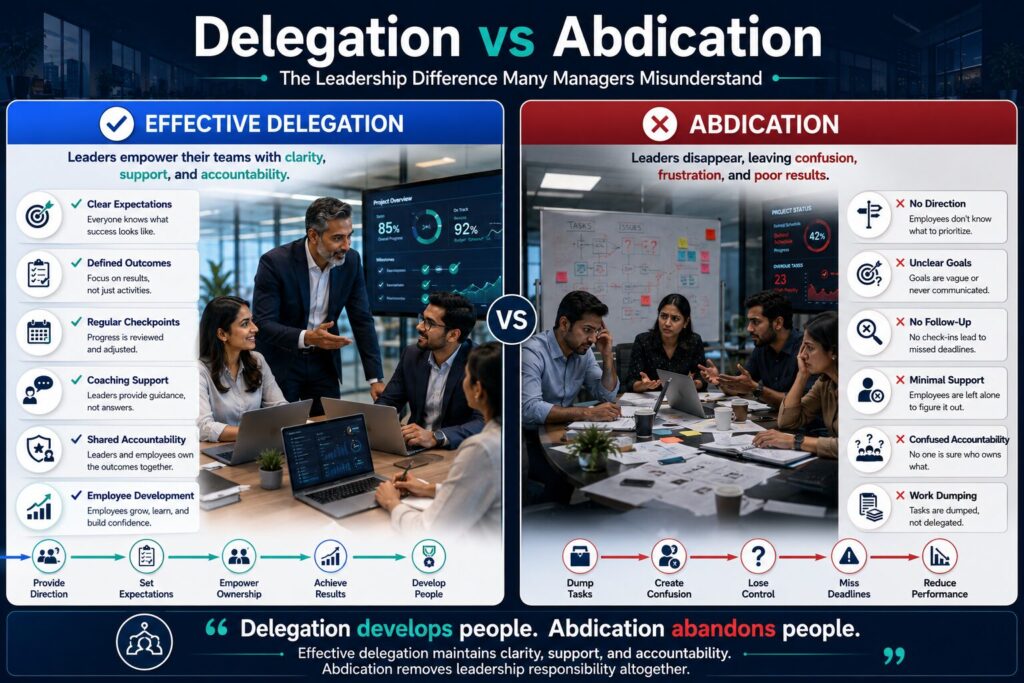
Many managers worry that delegating means losing control. In reality, delegation and abdication are very different.
| Effective Delegation | Abdication |
| Clear expectations | Unclear expectations |
| Defined outcomes | No direction |
| Regular checkpoints | No follow-up |
| Coaching support | Minimal support |
| Shared accountability | Confused accountability |
| Employee development | Work dumping |
Delegation strengthens performance. Abdication creates confusion. Effective managers remain engaged in outcomes while allowing employees to own execution.
How Strengths Masters Helps Managers Build Delegation Capability
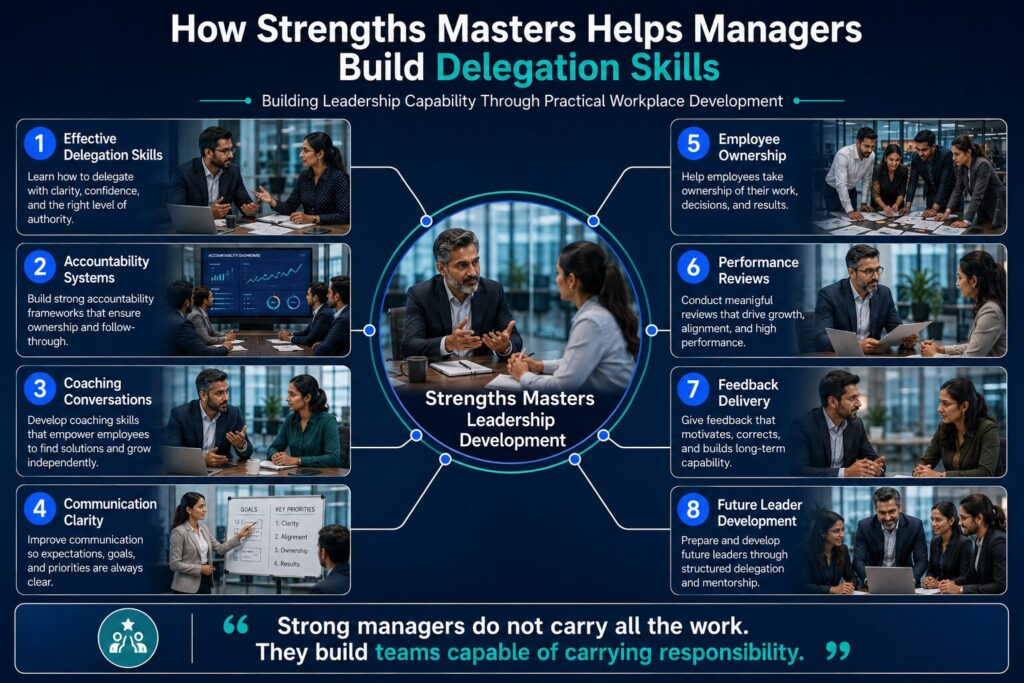
At Strengths Masters, leadership development focuses on helping managers build practical workplace capabilities that improve team performance. One of the most common challenges managers face is balancing accountability with empowerment. Many leaders understand the importance of delegation but struggle to implement it effectively.
Programs such as the 5 Skills for First-Time Managers help leaders strengthen:
- Delegation skills
- Coaching conversations
- Accountability systems
- Communication clarity
- Performance reviews
- Employee development
- Team ownership
The objective is not to teach managers how to monitor work more closely. The objective is to help leaders build teams that can perform confidently, make decisions independently, and take ownership of outcomes. This creates stronger managers and stronger organisations.
Conclusion
As organisations become more complex, leadership effectiveness increasingly depends on a manager’s ability to develop capability within teams. Managers who attempt to control every detail often become bottlenecks. Managers who delegate effectively create capacity, improve engagement, and accelerate employee growth.
Research from Gallup consistently shows that employees perform better when expectations are clear, and they are empowered to contribute meaningfully. Likewise, McKinsey & Company has highlighted that organisations with empowered teams are better positioned to adapt, innovate, and execute effectively in changing environments.
The lesson is clear.
Delegation is not about giving work away. It is about building ownership, confidence, accountability, and future leadership capability. The strongest managers are not those who do the most work themselves. They are the ones who develop teams capable of delivering exceptional results without constant supervision.
Frequently Asked Questions:
1) How can managers delegate work without losing control?
Managers can delegate without losing control by focusing on outcomes rather than activities. Effective delegation starts with clearly defining expectations, success criteria, timelines, and decision-making boundaries. Instead of monitoring every step, leaders create accountability through structured checkpoints and regular progress reviews. This approach gives employees the autonomy to execute while ensuring alignment with organisational goals. The result is greater ownership, faster execution, and stronger team capability without the need for micromanagement.
2) What is the difference between delegation and micromanagement?
Delegation empowers employees to take responsibility for achieving outcomes, while micromanagement focuses on controlling how work is completed. Effective delegation provides clarity, authority, and support, allowing employees to apply their judgment and problem-solving skills. Micromanagement, on the other hand, creates dependency, slows decision-making, and reduces accountability. Strong leaders guide performance through coaching and accountability systems rather than constant oversight.
3) Why do managers struggle to delegate effectively?
Many managers struggle with delegation because they fear mistakes, loss of control, or reduced quality. Others believe it is faster to complete tasks themselves rather than invest time in developing employees. However, avoiding delegation often creates bottlenecks, limits team growth, and increases managerial workload. Successful leaders view delegation as a leadership development strategy that builds capability, confidence, and long-term organisational performance.
4) How does delegation improve employee ownership and accountability?
Delegation increases ownership by giving employees responsibility for both decisions and outcomes. When individuals have clear expectations, appropriate authority, and accountability for results, they become more engaged and proactive. Effective delegation encourages problem-solving, independent thinking, and commitment to achieving goals. Over time, employees develop stronger decision-making skills and take greater responsibility for their performance and contributions.
5) What are the signs of poor delegation in leadership?
Common signs of poor delegation include employees constantly seeking approval, managers becoming decision-making bottlenecks, repeated follow-ups on routine tasks, lack of accountability, and reduced team productivity when the manager is absent. Organisations may also experience slower execution, employee disengagement, and leadership burnout. These indicators often suggest that work has been assigned without providing sufficient ownership, authority, or clarity.
6) How can managers develop future leaders through delegation?
Delegation is one of the most effective tools for leadership development. Managers can develop future leaders by assigning meaningful responsibilities, expanding decision-making authority, and providing coaching throughout the process. Stretch assignments help employees build confidence, judgment, and accountability in real business situations. Over time, this creates a stronger leadership pipeline and prepares employees to take on larger roles and responsibilities.
7) What delegation skills are most important for first-time managers?
First-time managers should focus on developing skills such as setting clear expectations, defining outcomes, communicating priorities, matching responsibilities to employee capability, and conducting effective follow-up conversations. They must also learn to coach rather than solve every problem themselves. Strong delegation skills enable new managers to build trust, improve team performance, and create a culture of ownership and accountability from the beginning of their leadership journey.