
Introduction
Many managers believe strong leadership means always having answers, solving every issue quickly, and staying deeply involved in team decisions. Initially, this approach may appear effective because work moves faster and employees rely heavily on managerial guidance.
But over time, this creates a hidden problem inside teams.
Employees stop thinking independently. Instead of solving challenges, they wait for instructions. Managers become the centre of every decision, approval, and escalation. Team performance slows down because progress depends on one person’s availability.
This is one of the biggest leadership challenges modern organisations face today.
According to Gallup research, employees perform better when they clearly understand expectations and feel trusted to make decisions. Similarly, McKinsey & Company reports that organisations with empowered teams improve execution speed, adaptability, and collaboration significantly faster than highly controlled environments.
High-performing teams are not built by managers who control every detail.
They are built by managers who create clarity, confidence, ownership, and structured problem-solving habits inside teams.
This is where many organisations struggle.
Managers often unintentionally create dependency cultures by constantly stepping in to fix problems, answering every question immediately, or monitoring work too closely. While this may improve short-term control, it weakens long-term team capability.
Effective leadership today is not about becoming the smartest person in the room.
It is about building teams that can think, adapt, solve problems, and perform independently even when the manager is not involved in every conversation.
That shift is what separates reactive teams from high-performing teams.
In this blog, we will explore:
- Why teams become dependent on managers
- The signs of low team ownership
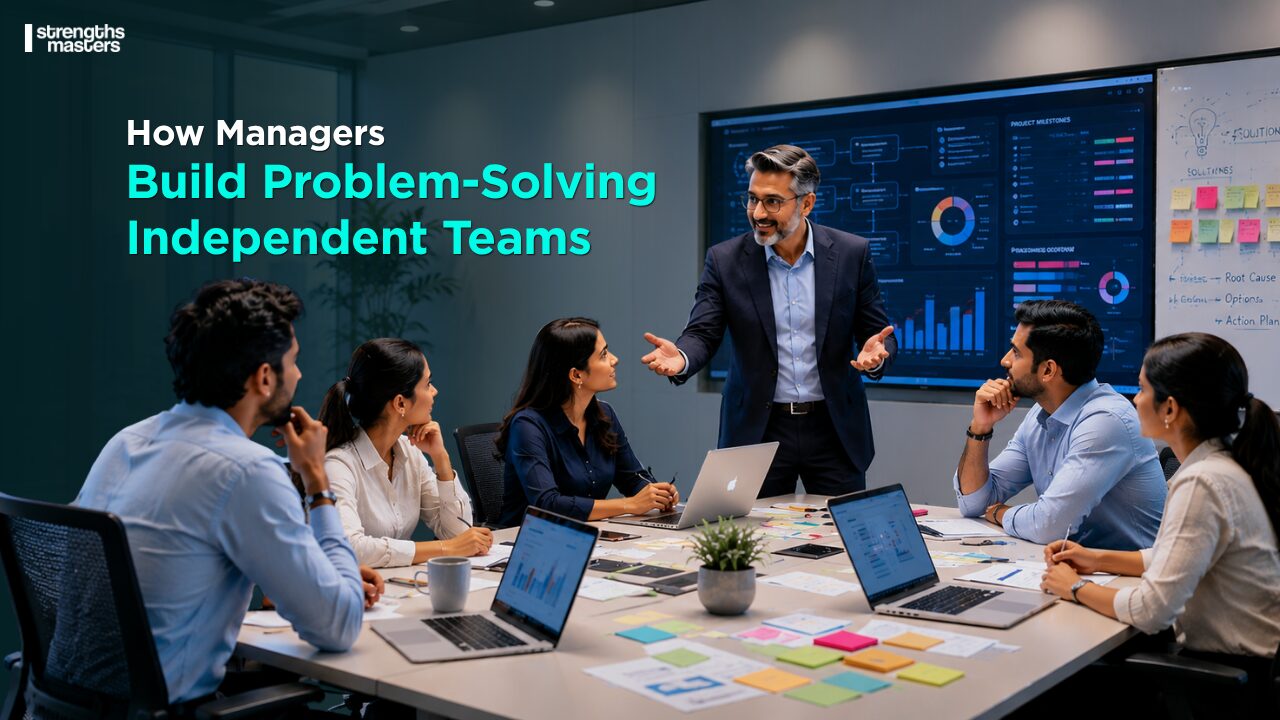
- How effective managers build problem-solving independent teams
- The difference between support and dependency
- How leadership development programs help managers create stronger team capability
Why Teams Become Dependent on Managers
In most workplaces, dependency does not happen suddenly. It develops through everyday leadership habits.
Managers often create dependency unintentionally by:
- Solving problems too quickly
- Giving answers before employees think independently
- Checking work excessively
- Avoiding delegation risks
- Controlling decisions closely
- Stepping into every conflict immediately
Over time, employees learn an important behavioural pattern:
“The manager will eventually solve it.”
As a result:
- Initiative decreases
- Problem-solving confidence drops
- Employees seek approval for small decisions
- Escalations increase unnecessarily
- Managers become overloaded
This creates a cycle where managers feel forced to stay involved constantly because the team no longer operates independently.
Signs Your Team Is Too Dependent
Some common signs include:
- Employees constantly ask for approval on small decisions
- Team members wait for instructions instead of taking initiative
- Problems escalate quickly without internal problem-solving
- Managers spend most of their day following up
- Decision-making slows down significantly
- Employees hesitate to handle uncertainty independently
- Team productivity drops when the manager is unavailable
- Ownership remains unclear across projects
These signs often indicate that the team lacks confidence, accountability systems, or structured decision-making support.
How Effective Managers Build Problem-Solving Teams
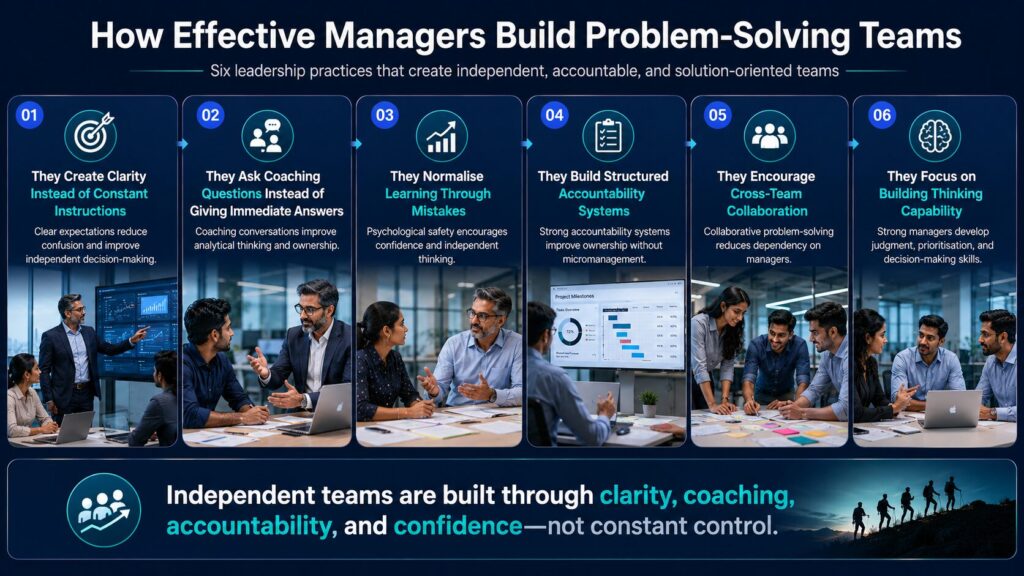
1. They Create Clarity Instead of Constant Instructions
Independent teams are built through clarity, not excessive supervision.
Strong managers define:
- Expected outcomes
- Priorities
- Success metrics
- Ownership areas
- Decision boundaries
When employees clearly understand goals and expectations, they require fewer instructions because they know how to make decisions independently.
For example:
A senior operations manager handling a client delivery team noticed employees frequently escalated routine issues for approval. Instead of answering every question individually, the manager introduced structured decision frameworks:
- Which decisions could employees make independently
- Which issues required escalation
- What outcomes mattered most
Within weeks, decision speed improved significantly because employees gained clarity and confidence. This is how effective managers reduce dependency while improving accountability.
2. They Ask Coaching Questions Instead of Giving Immediate Answers
One major difference between controlling managers and leadership-focused managers is how they respond to problems. Reactive managers immediately provide solutions.
Effective managers ask questions first.
Questions like:
- What options have you considered?
- What do you think is causing the issue?
- What solution would you recommend?
- What risks should we consider?
- What outcome are we trying to achieve?
These conversations help employees strengthen analytical thinking and decision-making skills. Over time, teams become more confident in handling challenges independently. This coaching-based leadership approach is one of the strongest drivers of long-term team capability.
3. They Normalise Learning Through Mistakes
Many teams become dependent because employees fear making mistakes. When managers react negatively to every error, employees stop taking ownership and avoid independent decisions. Strong managers understand that controlled mistakes are part of growth.
Instead of focusing only on blame, they focus on:
- What happened
- Why it happened
- What can improve next time
- What systems need adjustment
This creates psychological safety inside teams.
Employees become more willing to think independently because they know learning is supported, not punished. According to Google Project Aristotle Research, psychological safety is one of the strongest predictors of high-performing teams. Independent thinking grows where employees feel safe contributing ideas and solutions.
4. They Build Structured Accountability Systems
Independence does not mean lack of accountability. In fact, independent teams require stronger accountability systems.
Effective managers create:
- Clear review rhythms
- Ownership tracking
- Performance visibility
- Goal alignment systems
- Structured follow-ups
The difference is that accountability focuses on outcomes instead of constant monitoring.
For example:
Instead of checking employee activity every hour, managers review:
- Progress against goals
- Delivery quality
- Timelines
- Obstacles
- Problem-solving actions taken
This improves ownership without creating micromanagement pressure.
5. They Encourage Cross-Team Collaboration
Dependent teams often rely too heavily on managers because collaboration between employees remains weak.
Strong managers encourage employees to:
- Share knowledge
- Solve problems together
- Learn from peers
- Discuss solutions before escalation
This strengthens internal capability across the team.
For example:
A team lead managing software implementation projects introduced peer problem-solving sessions before manager escalations. Employees were encouraged to discuss challenges together first.
Over time:
- Escalations reduced
- Collaboration improved
- Team confidence increased
- Managers gained more strategic time
This shift helped employees become more solution-oriented instead of instruction-dependent.
6. They Focus on Building Thinking Capability
Many managers train employees only on tasks. Effective managers develop thinking capability.
They help employees understand:
- How to prioritise
- How to evaluate trade-offs
- How to communicate risks
- How to make decisions under uncertainty
- How to approach complex situations logically
This creates stronger professional maturity across teams. Because independent teams are not built simply by assigning work. They are built by strengthening judgment, ownership, and confidence over time.
The Difference Between Support and Dependency
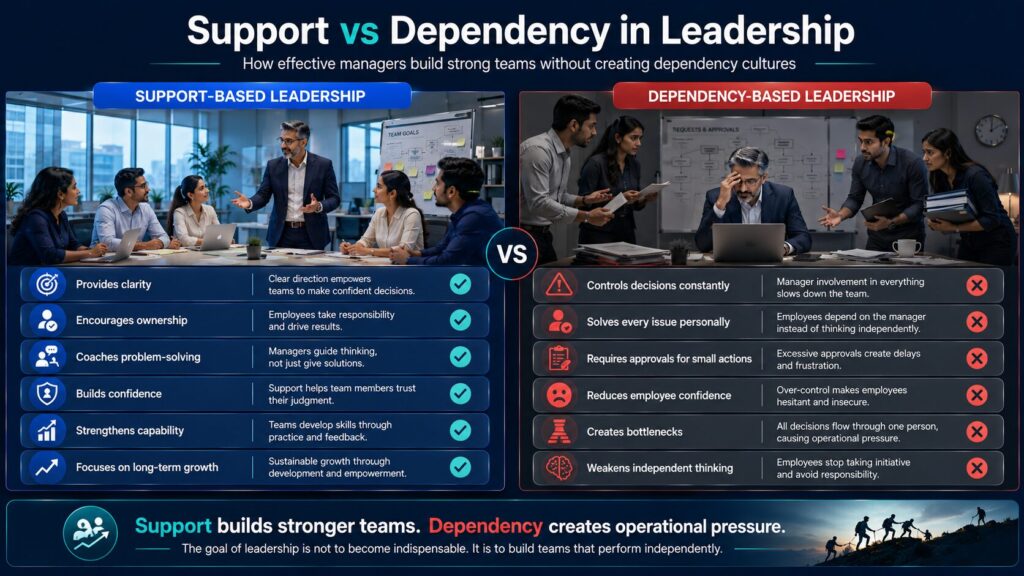
Many managers confuse support with involvement in every detail. But there is a major difference.
| Support-Based Leadership | Dependency-Based Leadership |
| Provides clarity | Controls decisions constantly |
| Encourages ownership | Solves every issue personally |
| Coaches problem-solving | Requires approvals for small actions |
| Builds confidence | Reduces employee confidence |
| Strengthens capability | Creates bottlenecks |
| Focuses on long-term growth | Weakens independent thinking |
Support creates stronger teams.
Dependency creates operational pressure.
The goal of effective leadership is not to become indispensable.
The goal is to build teams that perform strongly even without constant supervision.
How Strengths Masters Helps Managers Build Independent Teams
At Strengths Masters, leadership development focuses on practical workplace leadership challenges that managers experience daily.
Programs are designed to help managers improve:
- Coaching conversations
- Accountability systems
- Team communication clarity
- Goal setting
- Performance reviews
- Feedback delivery
- Team ownership
- Decision-making capability
The focus is not simply leadership theory. The focus is on helping managers build real-world leadership habits that improve team execution, accountability, and independent problem-solving.
Managers learn how to:
- Reduce micromanagement behaviours
- Improve employee ownership
- Create structured accountability
- Build coaching-led cultures
- Strengthen confidence inside teams
This approach helps organisations create high-performing teams that rely less on constant managerial control and more on clarity, capability, and ownership. Because sustainable performance comes from leadership systems that develop people, not dependency cultures that slow organisations down.
Conclusion
Modern workplaces are becoming faster, more complex, and increasingly collaborative. Managers who try to control every detail eventually become bottlenecks.
According to research from Deloitte Insights, empowered teams respond faster to change, improve innovation, and collaborate more effectively than highly hierarchical organisations. Similarly, studies published by Harvard Business Review show employees with greater autonomy demonstrate stronger engagement, accountability, and long-term performance outcomes.
The future of leadership is not built around constant supervision.
It is built around:
- clarity
- coaching
- accountability
- ownership
- independent thinking
Managers who successfully build problem-solving teams create stronger execution, higher trust, better decision-making, and healthier workplace cultures. Because the strongest teams are not the ones that depend entirely on managers. They are the ones capable of solving challenges confidently, collaboratively, and independently.
Frequently Asked Questions:
1) How can managers build problem-solving teams without micromanaging employees?
Effective managers build problem-solving teams by creating clarity, encouraging independent thinking, using coaching conversations, and improving accountability systems instead of controlling every decision.
2) Why do employees become too dependent on managers at work?
Employees often become dependent on managers when leaders solve every problem themselves, give constant instructions, require approvals for small tasks, and do not develop decision-making confidence within teams.
3) What are the best leadership strategies to build independent teams?
The best leadership strategies include setting clear expectations, coaching employees through questions, encouraging collaboration, building accountability systems, and improving team ownership culture.
4) How do managers improve employee problem-solving skills in the workplace?
Managers improve employee problem-solving skills by allowing teams to think through challenges independently, asking coaching questions, encouraging learning from mistakes, and providing guidance instead of immediate solutions.
5) What is the difference between supportive leadership and micromanagement?
Supportive leadership builds confidence, accountability, and independent thinking, while micromanagement creates dependency, delays decision-making, reduces ownership, and weakens team capability over time.
6) How can leadership development programs help managers build stronger teams?
Leadership development programs like Strengths Masters help managers improve coaching, communication clarity, accountability systems, feedback delivery, and team leadership skills needed to build high-performing independent teams.
7) How do high-performing companies create independent and accountable teams?
High-performing companies create independent teams by developing strong managers, improving communication clarity, encouraging ownership culture, building structured review systems, and focusing on long-term leadership capability development.