
One of the most common leadership challenges in modern workplaces is this:
Managers want better accountability from their teams, but in trying to stay informed and maintain control, they unintentionally micromanage.
It usually begins with good intentions.
A manager wants deadlines met, clients handled properly, and work delivered to a high standard. So they start checking updates more frequently, asking for constant progress reports, reviewing every small task, and staying involved in every decision.
Over time, however, something unexpected happens.
Employees stop taking ownership. Teams become dependent on approvals. Initiative decreases. Managers become exhausted from constant follow-ups, while employees feel controlled instead of trusted.
This is where the real leadership challenge begins.
Because accountability and micromanagement are not the same thing.
Strong managers know how to create visibility without creating pressure. They build ownership without controlling every action. And most importantly, they create systems where employees become responsible for outcomes instead of simply completing instructions.
That is the difference between managing work and leading people.
Why Accountability Breaks in Teams
Many managers believe accountability problems happen because employees are careless or unmotivated.
In reality, accountability usually breaks down because of leadership gaps, unclear systems, and inconsistent communication.
Employees struggle to take ownership when:
- Expectations are unclear
- Priorities constantly change
- Feedback is delayed
- Reviews happen inconsistently
- Managers solve every problem themselves
- Responsibilities are not clearly defined
In these environments, employees begin focusing more on avoiding mistakes than driving results.
According to Gallup workplace research, employees who clearly understand expectations at work are significantly more engaged and productive than those who do not. Clarity directly influences accountability because people perform better when they know exactly what success looks like.
This is why accountability is deeply connected to leadership clarity, reviews, coaching, and communication.
The Difference Between Accountability and Micromanagement
One of the biggest misconceptions in management is assuming that close control automatically improves performance.
It does not.
In fact, excessive control often weakens ownership over time.
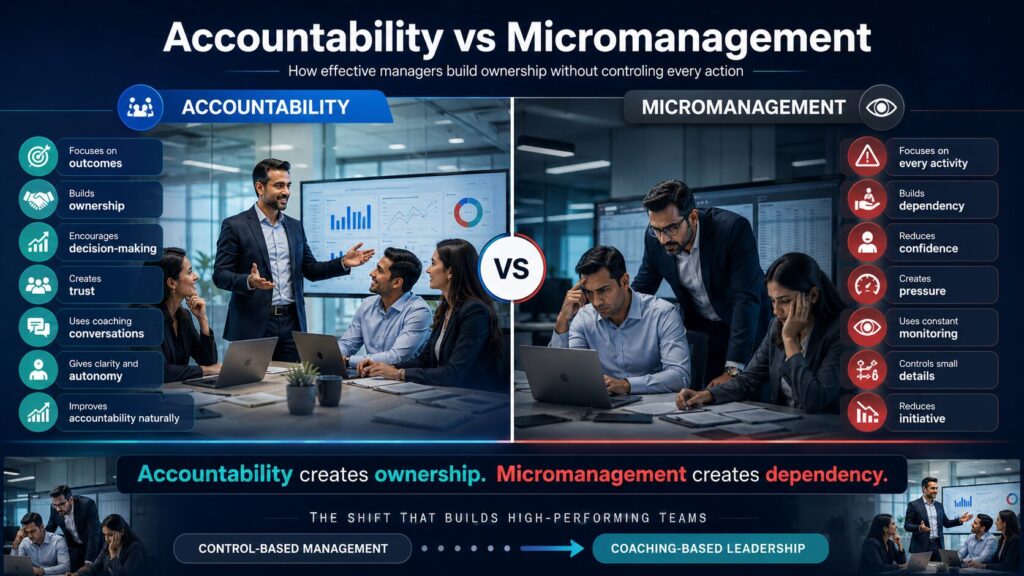
Here is the real difference:
| Accountability | Micromanagement |
| Focuses on outcomes | Focuses on every activity |
| Builds ownership | Builds dependency |
| Encourages decision-making | Reduces confidence |
| Creates trust | Creates pressure |
| Uses coaching conversations | Uses constant monitoring |
| Gives clarity and autonomy | Controls small details |
| Improves accountability naturally | Reduces initiative |
Micromanagement may create short-term compliance, but it rarely creates long-term ownership.
Employees begin waiting for instructions instead of thinking independently. Decision-making slows down because teams seek approval for everything. Managers become bottlenecks instead of leaders.
This is why high-performing organisations focus on accountability systems rather than control systems.
Signs a Manager Is Accidentally Micromanaging
Many managers do not realise they are micromanaging because their intentions are positive. They believe they are being responsible, involved, or supportive.
But certain patterns slowly reduce employee ownership.
Common signs include:
- Asking for updates multiple times a day
- Reviewing every small decision
- Struggling to delegate fully
- Constantly correcting employee methods
- Stepping into tasks too early
- Not allowing employees to solve problems independently
- Excessive meetings and follow-ups
- Low trust in employee judgment
Over time, this creates a dangerous cycle.
The more managers control, the less ownership employees have. And the less ownership employees take, the more managers feel they need to control. Breaking this cycle requires a different leadership approach.
How Effective Managers Build Accountability Without Control
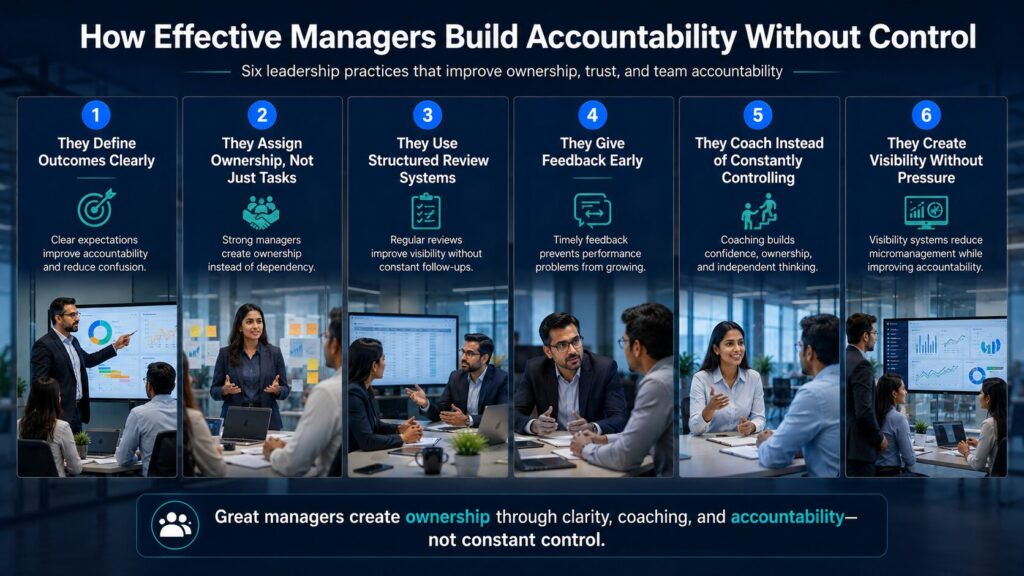
Strong managers do not remove visibility. They remove unnecessary control.
They create structures that encourage employees to take ownership while still maintaining alignment and performance standards.
Here are the key ways effective managers build accountability in teams.
1. They Define Outcomes Clearly
One of the biggest reasons accountability fails is unclear expectations.
Employees cannot take ownership of outcomes they do not fully understand.
Effective managers clearly define:
- What success looks like
- Expected timelines
- Quality standards
- Priorities
- Responsibilities
Instead of saying:
“Handle this project quickly.”
They say:
“The goal is to complete the client proposal by Friday with final approval from finance and zero data errors.”
Specific expectations improve confidence because employees know exactly what they are accountable for.
This directly connects to goal setting and team clarity. Accountability becomes much easier when expectations are visible and measurable.
2. They Assign Ownership, Not Just Tasks
Weak delegation sounds like:
“Please help with this.”
Strong delegation sounds like:
“You own this project from planning to final delivery.”
There is a major difference between assigning activities and assigning ownership.
Effective managers clearly define:
- Who owns the outcome
- Who supports execution
- Who approves decisions
- What decisions can employees make independently
This reduces confusion and prevents employees from constantly seeking approval for every small action.
Ownership increases when employees feel trusted to lead outcomes, not just complete instructions.
3. They Use Structured Review Systems
One reason managers start micromanaging is fear of losing visibility.
Strong managers solve this problem through structured reviews instead of constant interruptions.
Rather than checking progress randomly throughout the day, they create predictable review rhythms:
- Weekly reviews
- Milestone check-ins
- Project dashboards
- Progress updates
- One-on-one conversations
This allows managers to stay informed without creating pressure.
Reviews also help identify risks early before problems become serious.
This is why review systems are one of the most important leadership tools for accountability and execution.
4. They Give Feedback Early
Many accountability issues become larger simply because managers wait too long to address them.
Strong managers provide feedback early and specifically.
Instead of waiting for formal evaluations, they address issues when they are still manageable.
For example:
“I noticed the client updates were delayed this week. What obstacle slowed progress?”
This approach focuses on improvement instead of blame.
Timely feedback:
- Prevents repeated mistakes
- Improves clarity
- Strengthens accountability
- Builds trust through communication
Employees perform better when feedback becomes part of regular leadership conversations instead of occasional criticism.
5. They Coach Instead of Constantly Controlling
Micromanaging managers often solve every problem themselves.
Coaching managers do something different:
They help employees think through problems independently.
Instead of saying:
“Do it this exact way.”
They ask:
“What approach do you think will work best?”
“What risks should we prepare for?”
“What support do you need?”
These conversations improve:
- Ownership
- Confidence
- Critical thinking
- Accountability
Coaching creates capable teams. Control creates dependent teams.
This is one of the biggest mindset shifts modern managers need to develop.
6. They Create Visibility Without Pressure
Effective managers understand that accountability requires transparency, but transparency does not require surveillance.
Instead of repeatedly asking employees for updates, they create systems where progress is already visible.
Examples include:
- Shared dashboards
- Task management systems
- Milestone trackers
- Weekly summaries
- Accountability reviews
This reduces unnecessary follow-ups while keeping managers informed.
Employees feel trusted because managers are not constantly checking every activity.
Practical Questions Managers Should Ask Instead of Micromanaging
The quality of a manager’s questions often determines the quality of accountability within the team.
Strong managers ask questions that encourage ownership and problem-solving.
Examples include:
- What progress have you made so far?
- What obstacles are slowing execution?
- What support would help you move faster?
- What risks should we prepare for?
- What decisions can you handle independently?
- Where do you need more clarity?
- What is your plan for completing this on time?
These questions create accountability conversations instead of control conversations.
A Real Workplace Example
A sales manager in a growing company became frustrated because deadlines were repeatedly slipping. In response, he began checking employee updates several times a day and reviewing every customer email before it was sent.
Initially, visibility improved. But within weeks, team confidence dropped significantly. Employees stopped making decisions independently because they feared making mistakes.
The manager eventually shifted his approach.
Instead of constant follow-ups, he introduced:
- Weekly review meetings
- Clear ownership areas
- Milestone tracking
- Coaching-based one-on-ones
Within two months:
- Response times improved
- Employee confidence increased
- Managers spent less time chasing updates
- Accountability became stronger across the team
The difference was not stricter control.
It was a better leadership system.
Why Many Managers Struggle with Accountability
Most managers are promoted because of technical expertise, not because they were trained in leadership.
As a result, many managers never formally learn:
Without these skills, managers often rely on excessive involvement to stay in control.
This is why manager capability building has become a major focus in modern organisations.
How Strengths Master’s Helps Managers Build Accountability
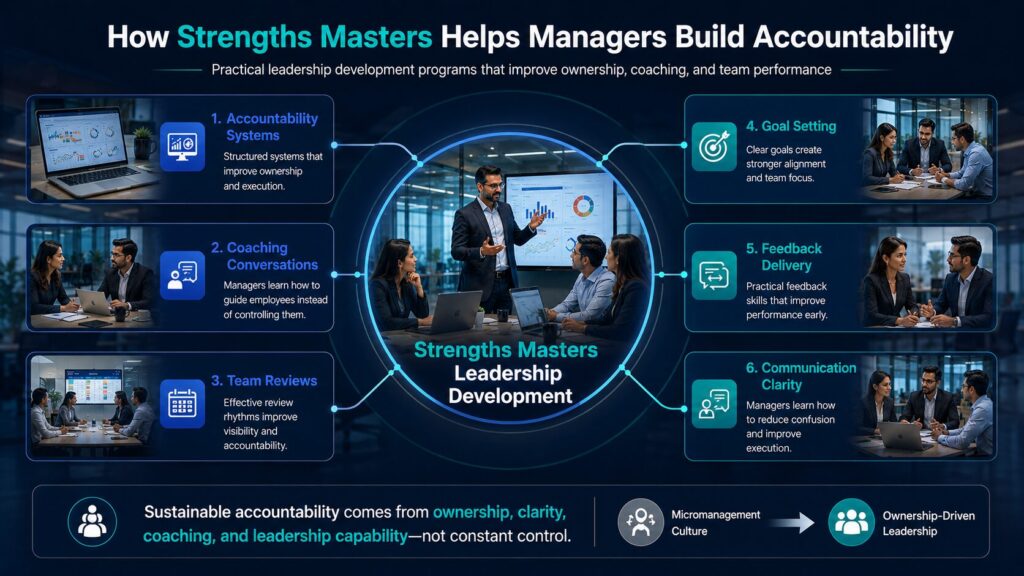
At Strengths Masters, leadership development focuses on practical workplace challenges managers face every day.
Programs like the “5 Skills for First-Time Managers” help leaders improve:
- Accountability systems
- Coaching conversations
- Team reviews
- Goal setting
- Feedback delivery
- Communication clarity
The objective is not simply to improve management theory.
The goal is to help managers build high-performing teams without creating dependency or micromanagement cultures.
Because sustainable accountability comes from ownership, clarity, and leadership capability, not constant control.
Final Thoughts
Micromanagement may create temporary control, but it rarely creates strong teams. Accountability grows when employees understand expectations, feel trusted, receive coaching, and take ownership of outcomes. The most effective managers do not monitor every action.
They create systems, conversations, and leadership habits that help teams perform independently and responsibly. That is what modern leadership looks like. And that is how effective managers build accountability without micromanaging.