
Introduction
Many managers unknowingly become decision-making bottlenecks.
Every day, employees approach them with questions, approvals, problems, and requests for direction. At first, this seems like responsible leadership. Managers provide answers, solve issues quickly, and keep work moving.
However, over time, something unintended happens.
Employees begin relying on the manager for decisions they could make themselves. Initiative decreases. Confidence weakens. Managers become overwhelmed with operational questions while strategic priorities receive less attention.
Research consistently shows that employees who feel trusted and empowered are more engaged, more innovative, and more committed to organisational goals. According to Gallup, employees who have opportunities to exercise judgment and take ownership demonstrate significantly higher engagement than those in highly controlled environments.
The challenge is that many managers want employees to think independently but struggle to create the conditions that encourage it.
The goal of effective leadership is not to make every decision.
The goal is to develop people who can make good decisions without constant supervision.
This is where strong managers separate themselves from average managers. They create environments where employees gain confidence, improve judgment, and solve problems independently while remaining aligned with organisational objectives.
Why Employees Often Avoid Making Decisions
Most managers assume employees avoid decisions because they lack the capability.
In reality, the reasons are usually more complex.
Employees often hesitate because:
- They fear making mistakes.
- They worry about negative consequences.
- Previous managers discouraged independent thinking.
- Approval processes are overly restrictive.
- Expectations are unclear.
- Leaders frequently override decisions.
Over time, employees learn that seeking permission feels safer than taking initiative.
This creates a cycle in which managers become increasingly involved and employees increasingly dependent.
The result is slower execution, reduced innovation, and leadership burnout.
Signs Your Team Relies Too Heavily on Manager Approval
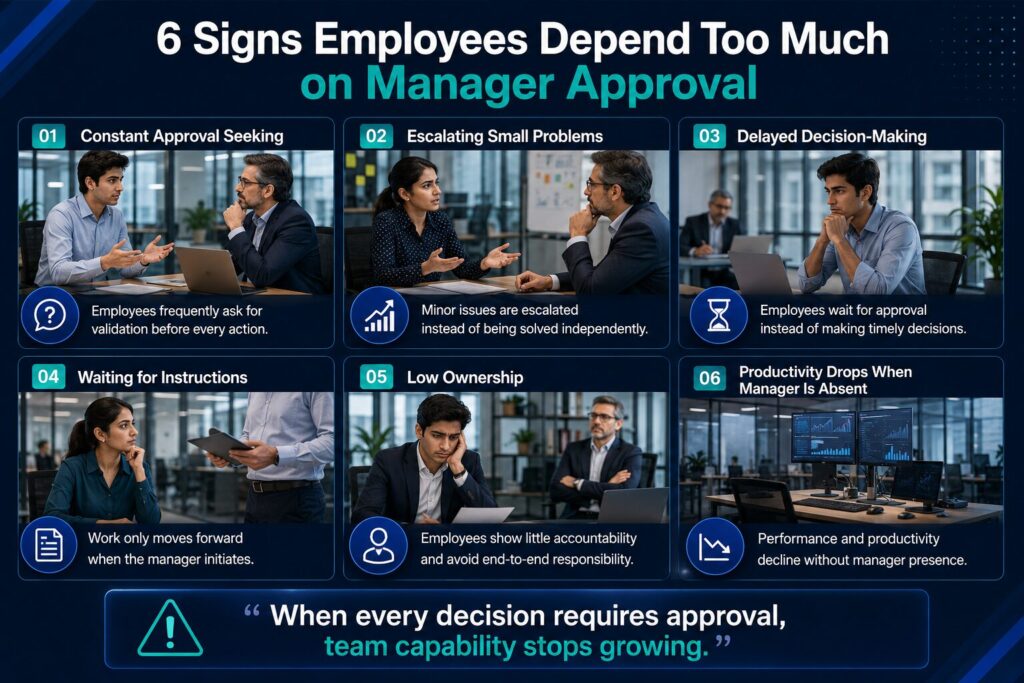
Managers often overlook the warning signs of decision dependency.
Common indicators include:
- Employees constantly seek approval for routine actions.
- Small issues escalate unnecessarily.
- Team members hesitate to act without the manager’s input.
- Projects slow down when the manager is unavailable.
- Meetings focus on obtaining answers rather than discussing solutions.
- Employees present problems but not recommendations.
When these patterns become common, the issue is usually not employee capability.
The issue is often the leadership system surrounding decision-making.
How Effective Managers Improve Employee Decision-Making
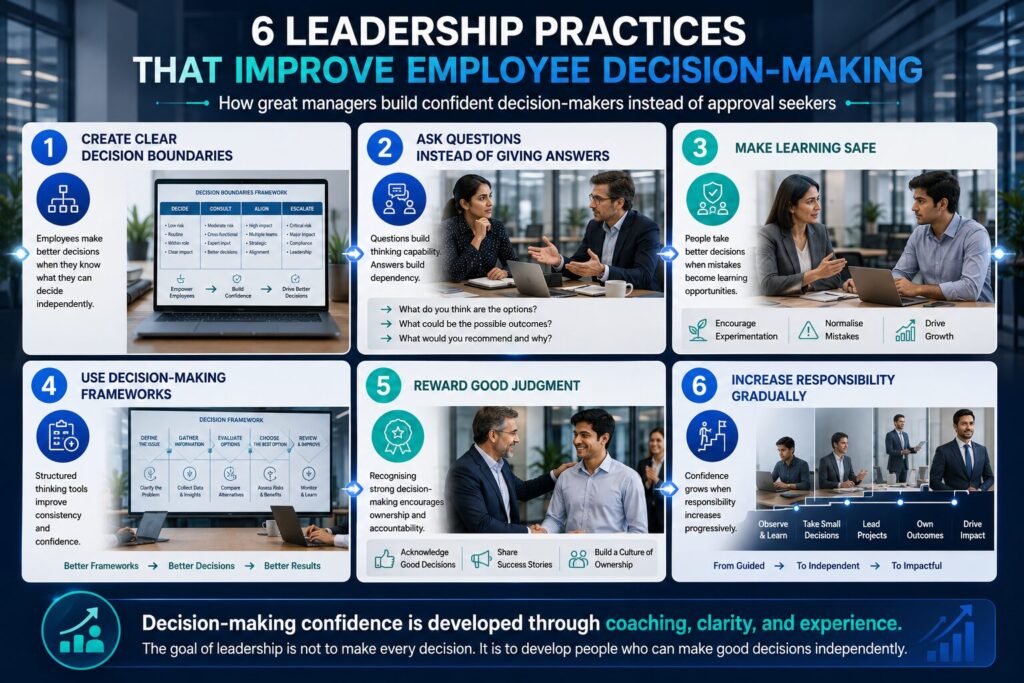
1. They Create Clarity Around Decision Boundaries
One of the biggest causes of hesitation is uncertainty.
Employees need to understand:
- Which decisions can they make independently
- Which decisions require consultation
- Which decisions require approval
Without clear boundaries, employees naturally become cautious.
For example, a customer service team leader might establish:
- Refunds below a certain value can be approved independently.
- Larger refunds require consultation.
- Exceptional cases require management approval.
This clarity reduces confusion and accelerates execution.
When people know their authority level, decision-making improves dramatically.
2. They Ask Questions Instead of Providing Immediate Answers
Many managers unintentionally train dependency by answering every question.
Strong leaders use coaching conversations instead.
Rather than saying:
“Here’s what you should do.”
They ask:
- What options have you considered?
- What outcome are you trying to achieve?
- What risks do you see?
- Which solution would you recommend?
These questions encourage analytical thinking.
Over time, employees begin evaluating situations independently before seeking guidance.
Practical Example
A team member approaches a manager regarding a client complaint.
Instead of immediately providing a solution, the manager asks:
“What do you think is the best approach based on previous situations?”
The employee reflects, suggests a solution, and receives feedback.
The next time a similar issue occurs, confidence is significantly higher.
3. They Make Learning Safe
Employees rarely develop strong judgment if they fear punishment for every mistake.
Effective managers understand that decision-making capability develops through experience.
This does not mean accepting poor performance.
It means distinguishing between:
- Reckless mistakes
- Learning mistakes
When employees know they can learn from thoughtful decisions that do not produce perfect outcomes, they become more willing to take ownership.
Psychological safety is one of the strongest predictors of learning, innovation, and team performance according to extensive workplace research conducted by Google’s Project Aristotle.
Managers who create safe learning environments accelerate employee growth.
4. They Use Decision-Making Frameworks
Strong leaders do not leave decision quality to chance.
They provide simple frameworks that employees can use consistently.
A practical example:
STOP Framework
Situation
What is happening?
Think
What options exist?
Outcome
What are the possible consequences?
Proceed
Which option best supports objectives?
Frameworks reduce uncertainty and improve consistency.
Employees gain confidence because they have a structured process rather than relying solely on instinct.
5. They Reward Good Judgment, Not Just Results
Many organisations celebrate outcomes while ignoring decision quality.
This creates problems because good decisions sometimes produce imperfect results due to factors beyond employee control.
Effective managers recognise:
- Thoughtful analysis
- Sound reasoning
- Risk awareness
- Initiative
When employees see these behaviours being valued, they become more willing to think independently.
Recognition reinforces confidence.
Confidence strengthens decision-making.
6. They Gradually Increase Responsibility
Independent decision-makers are developed, not created overnight.
Strong managers progressively expand employee ownership.
For example:
Stage 1: Employee gathers information.
Stage 2: Employee presents recommendations.
Stage 3: Employee decides with manager review.
Stage 4: Employee decides independently.
This gradual approach builds capability while minimising risk.
Over time, employees become trusted contributors rather than approval seekers.
The Difference Between Empowerment and Abandonment
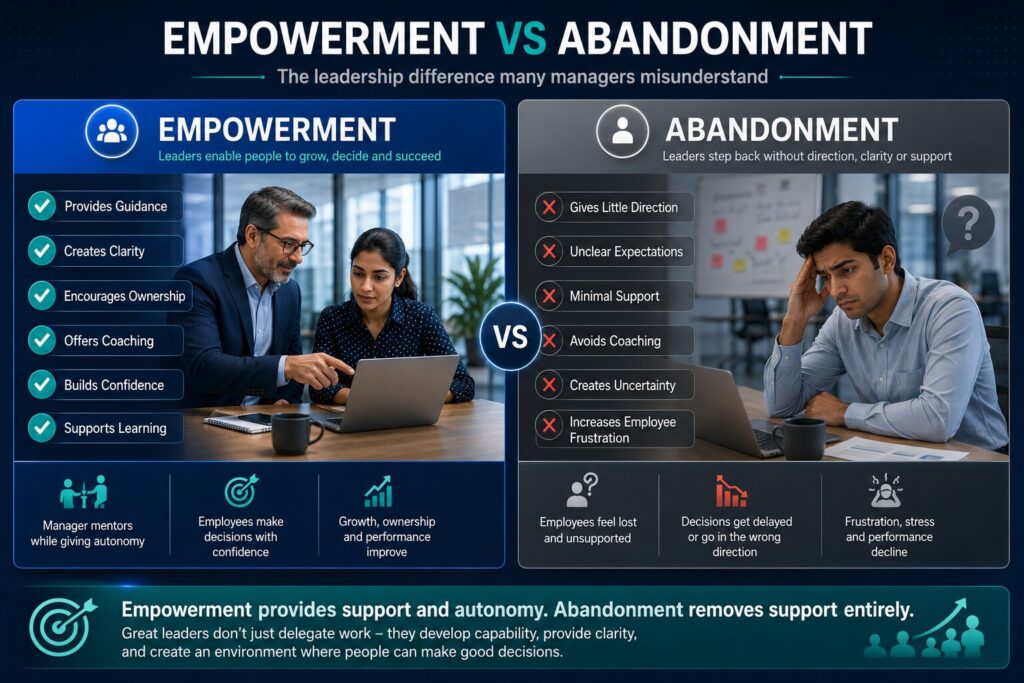
Some managers misunderstand empowerment.
They assume empowerment means stepping away entirely.
This is not effective leadership.
| Empowerment | Abandonment |
| Provides guidance | Provides little support |
| Defines expectations | Leaves expectations unclear |
| Offers coaching | Avoids involvement |
| Encourages learning | Ignores mistakes |
| Creates confidence | Creates uncertainty |
Strong leadership balances support with autonomy.
Employees need coaching, feedback, and clarity.
They do not need constant control.
How Strengths Masters Helps Managers Improve Employee Decision-Making
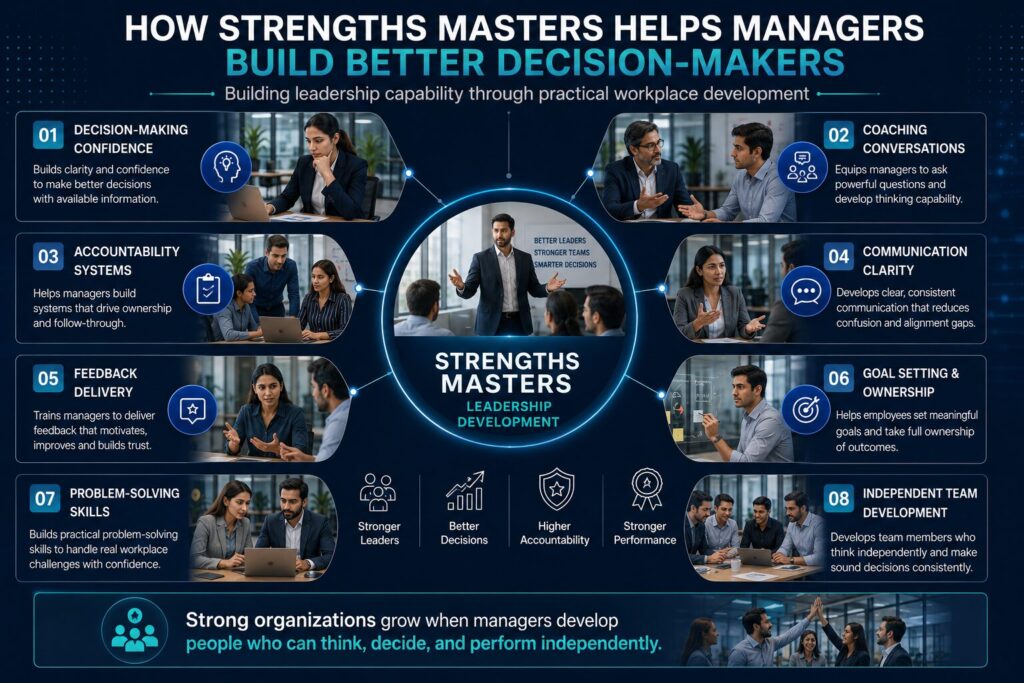
At Strengths Masters, leadership development focuses on helping managers solve practical workplace challenges rather than simply learning management theory.
Many managers struggle with:
- Employee dependency
- Excessive approvals
- Low accountability
- Weak decision-making confidence
- Operational bottlenecks
Programs such as the 5 Skills for First-Time Managers help leaders develop practical capabilities in:
- Coaching conversations
- Accountability systems
- Feedback delivery
- Delegation
- Communication clarity
- Decision-making development
The objective is not to teach managers how to control more effectively.
The objective is to help managers build teams capable of thinking independently, solving problems confidently, and making sound decisions aligned with business goals.
This creates stronger leadership capacity and more sustainable team performance.
Conclusion
Organisations increasingly operate in environments that demand speed, adaptability, and independent thinking.
Managers cannot realistically make every decision themselves.
According to Gallup workplace research, employees who feel trusted and empowered demonstrate higher engagement, stronger performance, and greater commitment to organisational objectives. Similarly, Google’s Project Aristotle identified psychological safety as one of the strongest factors influencing team effectiveness.
These findings support a simple leadership reality:
High-performing teams are not built through control.
They are built through clarity, coaching, accountability, and trust.
The most effective managers gradually shift from being decision-makers to decision-builders.
Instead of solving every problem personally, they help employees develop the confidence, judgment, and capability to solve problems independently.
When this happens, managers gain more time for strategic leadership, employees grow faster, and organisations become more agile.
Ultimately, sustainable performance does not come from creating dependence on leadership.
It comes from developing people who can think, decide, and perform with confidence.
Frequently Asked Questions:
1. How can managers improve employee decision-making without micromanaging?
Managers can improve employee decision-making by establishing clear decision boundaries, asking coaching questions, encouraging ownership, and providing feedback rather than giving answers to every problem. Employees develop stronger judgment when managers guide thinking rather than control every decision. This approach builds confidence, accountability, and long-term team capability.
2. Why do employees depend too much on manager approval before making decisions?
Employees often seek constant approval when expectations are unclear, mistakes are discouraged, or managers frequently override decisions. Over time, this creates a culture of dependency in which employees avoid taking initiative. Effective leadership helps employees gain confidence by gradually increasing decision-making responsibility and autonomy.
3. What are the signs that a team lacks decision-making confidence?
Common signs include frequent approval requests, delayed decision-making, escalating minor issues to managers, low ownership, lack of initiative, and reduced productivity when the manager is unavailable. These behaviours often indicate that employees need more coaching, clarity, and opportunities to make decisions independently.
4. How do effective managers develop independent decision-makers?
Effective managers develop independent decision-makers by using coaching conversations, decision-making frameworks, structured accountability systems, and regular feedback. Rather than solving every problem, they help employees analyse options, assess risks, and make informed decisions confidently.
5. What is the difference between employee empowerment and leadership abandonment?
Employee empowerment provides autonomy with guidance, coaching, and clear expectations. Leadership abandonment occurs when managers delegate responsibility without providing support or direction. Strong leaders balance independence with accountability, ensuring employees have both freedom and resources to succeed.
6. How does leadership training improve workplace decision-making skills?
Leadership training helps managers build coaching skills, communication clarity, accountability systems, and decision-making frameworks. These capabilities enable managers to develop employees who think critically, solve problems independently, and make better decisions that improve team performance.
7. How does Strengths Masters help managers build confident decision-makers?
Strengths Masters helps managers strengthen decision-making capability through practical leadership development programs focused on coaching conversations, accountability, communication, goal setting, feedback delivery, and problem-solving. The objective is to help leaders create teams that can think independently, take ownership, and perform confidently without constant managerial intervention.