

Choosing a career used to be simpler. Students typically considered a handful of professions, followed a predictable path, and made decisions based on available opportunities. Today, the situation is very different. Students are exposed to hundreds of career possibilities through social media, online courses, influencers, career portals, educational institutions, and constant conversations about the future of work.
At first glance, this seems like a positive change. More options should mean more opportunities. However, for many students, the opposite happens. The abundance of choices creates confusion, uncertainty, and decision paralysis.
One day, engineering feels like the right choice. The next day, psychology sounds interesting. Then someone talks about artificial intelligence, data science, digital marketing, entrepreneurship, or finance. Suddenly, every option seems attractive, and making a decision feels impossible.
If you are struggling with how to decide on a career for students, the solution is not to find more career options. The solution is learning how to evaluate options in a structured way.
Quick Answer: How to Decide on a Career When You Have Too Many Options?
The best way to decide on a career is to stop comparing hundreds of job titles and start understanding yourself first.
Students should focus on four factors:
- Their natural strengths
- Their thinking style
- Their long-term interests
- The realities of different careers
Instead of asking, “Which career is best?”, ask, “Which career direction fits me best?”
This simple shift can dramatically improve career decision-making and reduce confusion.
When students combine self-awareness with career exploration, they gain far more clarity than they would by relying only on marks, trends, or opinions.
Why More Career Options Are Creating More Confusion Than Clarity
One of the biggest challenges students face today is information overload.
Research in psychology has repeatedly shown that having more choices does not necessarily lead to better decisions. In many situations, too many choices create anxiety because people become afraid of making the wrong decision.
This is exactly what happens during student career planning.
A student researching career options after school quickly discovers hundreds of possibilities. Every profession has success stories. Every industry claims to have growth opportunities. Every expert seems to offer different advice.
As a result, students start comparing everything to everything else.
- Should they choose engineering or management?
- Should they pursue psychology or design?
- Would finance offer better opportunities than marketing?
- Is AI a safer option than the law?
Instead of gaining clarity, they become overwhelmed.
The real issue is not the number of options. The issue is that most students have never been taught a decision-making framework that helps them filter those options effectively.
Without a framework, every career seems equally attractive and equally risky.
Why Traditional Career Advice No Longer Works
Many students receive career advice that sounds helpful but often lacks context.
They are told to:
- Follow their passion
- Follow their interests
- Choose a high-paying career
- Pick a trending industry
- Go where opportunities exist
While these suggestions are not entirely wrong, they are incomplete.
For example, interest alone is not enough. A student may enjoy watching videos about entrepreneurship but may not enjoy handling uncertainty, managing teams, or making difficult business decisions.
Similarly, choosing a career solely because it offers high salaries can lead to dissatisfaction if the daily work does not align with the student’s natural strengths.
This is one reason why many students struggle with how to choose the right career for students. They focus on external factors while ignoring internal factors.
The best career decisions happen when students evaluate both. They need to understand not only what careers offer, but also what they themselves bring to the table.
The Career Decision Framework Every Student Should Use
When students feel overwhelmed, they often try to choose the “perfect” career. The truth is that no perfect career exists. Every profession comes with challenges, competition, pressure, and continuous learning.
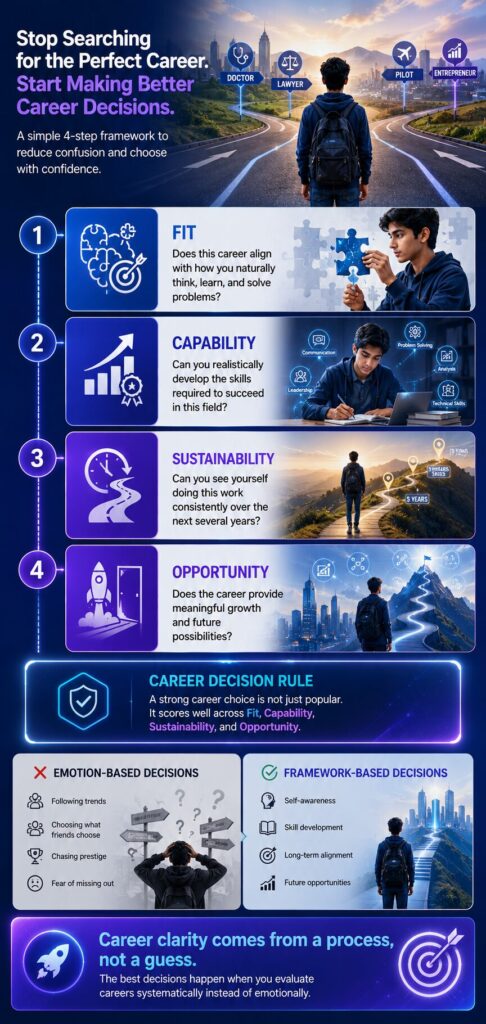
Instead of searching for perfection, students should evaluate careers using four simple filters.
Fit
Does this career align with how you naturally think, learn, and solve problems?
Capability
Can you realistically develop the skills required to succeed in this field?
Sustainability
Can you see yourself doing this work consistently over the next several years?
Opportunity
Does the career provide meaningful growth and future possibilities?
Careers that score highly across all four areas are usually stronger choices than careers selected purely because they are popular or prestigious. This approach shifts decision-making from emotion to clarity.
Why Understanding Yourself Matters More Than Researching Careers
Most students begin career planning by researching professions. In reality, they should begin by understanding themselves. This is especially important for students trying to figure out how to choose a career after 10th or how to choose a career after 12th.
At these stages, students often spend hours exploring streams, colleges, courses, and professions. However, very few spend time understanding their own strengths, preferences, and thinking patterns.
Consider two students who both score 90% in their exams.
- Their marks may be identical, but their natural abilities may be completely different.
- One student may enjoy solving complex logical problems and analysing data.
- Another may enjoy communication, creativity, and working with people.
- Despite similar academic performance, their ideal career directions may be very different.
This is why self-awareness is one of the most important aspects of effective career guidance for students. Without understanding yourself, career research often becomes random exploration.
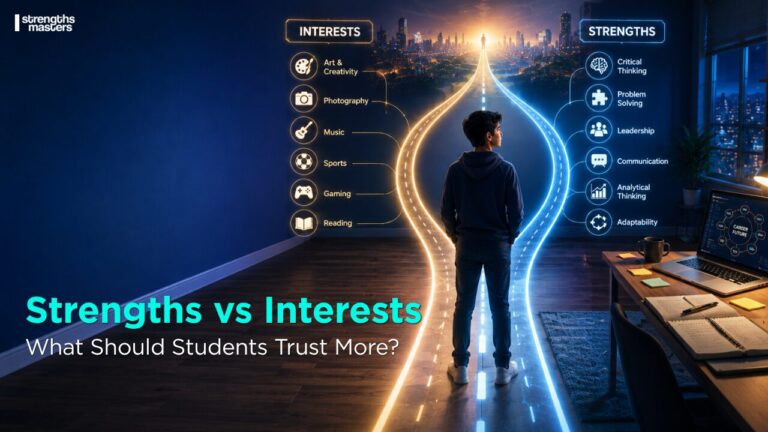
Strengths vs Interest vs Marks: What Should Guide Career Decisions?
This is one of the most misunderstood areas of career planning. Students often make decisions based on marks or interests because these are the factors they understand best.
However, career success involves something deeper.
Marks
Marks measure academic performance within a structured environment. They indicate how well a student performed in a particular subject or examination.
Interest
Interests reflect what students enjoy or feel attracted to. However, interests can change over time and are often influenced by trends, exposure, or environment.
Strengths
Strengths represent natural and recurring patterns in how people think, behave, learn, and solve problems. They tend to remain consistent over time and influence long-term performance.
This distinction is important.
According to research from Gallup CliftonStrengths, people who regularly use their strengths are significantly more engaged and productive in their work.
This helps explain why two individuals with similar qualifications can experience very different levels of success and satisfaction.
- Marks can indicate performance.
- Interests can indicate attraction.
But strengths often provide the strongest foundation for sustainable career growth. This is one reason why strengths-based career planning is becoming increasingly valuable for students.
Stop Choosing Job Titles. Start Choosing Career Directions.
Another common mistake students make is comparing individual job titles.
For example:
- Engineer vs Lawyer
- Designer vs Psychologist
- Marketer vs Entrepreneur
This approach creates unnecessary complexity.
A smarter method is to focus on career directions first.
Students who enjoy logical thinking, analysis, and systems often align with analytical career directions such as engineering, finance, technology, research, and data science.
Students who enjoy communication, collaboration, and helping others often align with people-oriented careers such as psychology, education, counselling, management, and human resources.
Students who enjoy creativity and innovation may naturally gravitate toward design, media, branding, content creation, and marketing.
Students who enjoy planning, leadership, and decision-making often find alignment with business, consulting, entrepreneurship, and strategy-related careers.
When students identify the direction that matches their strengths, the number of possible choices becomes much smaller and easier to evaluate.
Why Real-World Exposure Is the Missing Piece
Many students spend months researching careers online, but never interact with the actual work involved. This is a major reason why confusion persists. Career clarity rarely comes from information alone.
It develops through exposure.
Students should actively seek opportunities to:
- Speak with professionals
- Attend industry webinars
- Participate in workshops
- Take introductory courses
- Work on small projects
- Explore internships
A student interested in marketing may discover they enjoy strategy but dislike content creation. A student interested in psychology may realise they prefer coaching over clinical practice. These insights are difficult to gain through research alone. Experience transforms assumptions into informed decisions.
How Strengths Masters Helps Students Make Better Career Decisions
One of the biggest problems in career planning is that students are expected to make important decisions without fully understanding themselves.
This is exactly the challenge that Strengths Masters was created to solve.
Strengths Masters is a strengths-based career guidance company that helps students gain clarity about their future through self-awareness rather than assumptions. The belief is simple: students should not choose careers based only on marks, trends, social pressure, or limited information. They should first understand their natural strengths and then explore career paths that align with those strengths.
The company’s vision is to help students make more confident and informed educational and career decisions by focusing on who they are before deciding what they should do.
Through the Strengths for Students program, students go through a structured process designed to identify their strengths, understand their thinking patterns, and connect those insights with suitable career directions.
The framework follows three stages:
- Discover – Identify natural strengths and recurring behavioural patterns.
- Decode – Understand how those strengths influence learning, performance, communication, and career potential.
- Design – Create a personalised career direction and action plan based on strengths, opportunities, and future goals.
Students who participate in the program gain clarity about their potential career paths, reduce confusion caused by too many options, and develop greater confidence in their decisions. Instead of guessing, they make career choices based on evidence, self-awareness, and long-term alignment.
You can explore the program here: Strengths for Students
Final Thoughts
The biggest challenge facing students today is not a lack of opportunities. It is the overwhelming number of opportunities available. When students try to evaluate every career individually, confusion is inevitable. However, when they focus on understanding themselves first, the decision-making process becomes much clearer.
The students who make the strongest career decisions are not necessarily those with the highest marks or the most information. They are the students who understand their strengths, evaluate careers systematically, and gain real-world exposure before making important choices.
In a world filled with endless options, clarity does not come from exploring every path.
It comes from understanding yourself well enough to recognise the right path when you see it.
Frequently Asked Questions:
1. How do students decide on a career when they have too many options?
Students can make better career decisions by focusing on their strengths, interests, thinking style, and long-term goals instead of comparing every career option available. A structured decision-making framework helps reduce confusion and identify the most suitable career direction.
2. What is the best way to choose the right career for students?
The best way to choose the right career for students is to start with self-awareness. Understanding strengths, learning preferences, and natural abilities makes it easier to evaluate career options and find a path that offers both success and satisfaction.
3. How can students choose a career after 10th without getting confused?
Students should avoid choosing a stream solely based on marks, peer pressure, or trends. Before selecting a stream after Class 10, they should understand their strengths, career preferences, and future opportunities to make a more informed decision.
4. How can students choose a career after 12th with confidence?
Career decisions after Class 12 should be based on a combination of strengths, interests, aptitude, and career exploration. Researching courses, speaking with professionals, and gaining real-world exposure can help students make confident choices.
5. Are marks enough to decide a student’s career path?
No. Marks indicate academic performance but do not reveal a student’s natural strengths, thinking style, or long-term career fit. Career planning should consider multiple factors beyond exam results.
6. What is strengths-based career planning for students?
Strengths-based career planning is an approach that helps students identify their natural talents and recurring patterns of success, then align those strengths with suitable career directions. This often leads to better engagement, performance, and long-term career satisfaction.
7. Why do students struggle to make career decisions today?
Many students face career confusion because of information overload, too many career options, social pressure, and a lack of structured career guidance. Developing self-awareness and following a clear career decision-making process can significantly improve clarity.
8. What should students focus on first: marks, interests, or strengths?
Students should consider all three, but strengths should be the foundation. Marks show performance, interests show attraction, and strengths reveal where a student is naturally most likely to succeed and thrive over the long term.