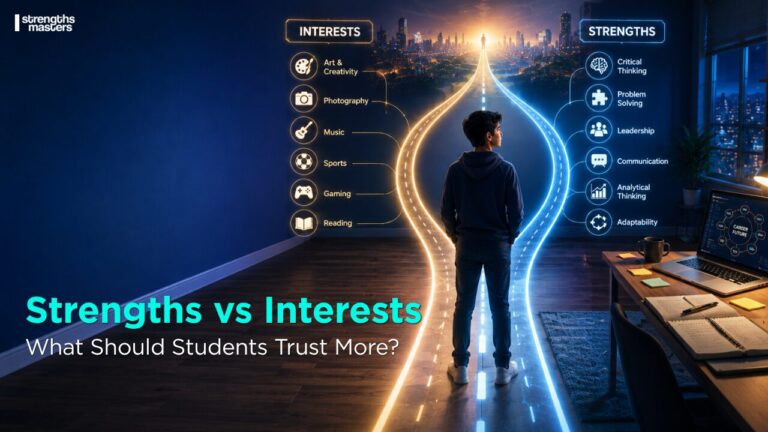


Choosing a career is one of the most important decisions in a student’s life. Yet, most students still rely on one outdated metric, marks.
If you look around, you’ll notice a pattern. A student scores high in science, and suddenly, engineering or medicine becomes the “obvious” choice. Another student performs well in commerce and finance, or CA becomes the default path.
But here’s the problem.
Marks show how well you performed in an academic system. They don’t tell you:
- How you think
- What kind of work do you enjoy
- Where can you sustain effort long-term
And that’s why many students later feel stuck, confused, or disengaged in their careers.
If you’re wondering how to choose the right career for students, the answer lies not in marks, but in strengths.
Why Marks Alone Are Not Enough for Career Decisions

Marks are often treated as the final decision-maker, but they are just one piece of the puzzle.
A student may score high because:
- They had a good teacher
- They followed a disciplined study routine
- They are good at memorization or exam patterns
But career success is not built on exam performance alone.
According to research by Gallup, individuals who use their strengths daily are:
- 6x more engaged at work
- 3x more likely to report excellent quality of life
(Source: Gallup CliftonStrengths)
This clearly shows that long-term success depends more on alignment with strengths than academic scores.
Marks can guide you, but they cannot define your career.
What Most Students Do And Where It Goes Wrong
Before understanding the right approach, it’s important to see what typically happens.
Most students:
- Choose careers based on marks
- Follow trends like coding, AI, MBA, etc.
- Copy the decisions of friends
- Depend heavily on external advice
This leads to confusion later because the decision was never truly aligned.
This is exactly why many students struggle with clarity, something we’ve explained in detail in Why Most Students Get Career Planning Wrong.
What Does It Mean to Choose a Career Based on Strengths?

Choosing a career based on strengths means understanding your natural patterns, the way you think, learn, and perform.
Strengths are not just skills. They are deeper.
They include:
- Thinking style (analytical, creative, strategic)
- Behaviour patterns (structured, flexible, people-oriented)
- Learning preferences
- Energy drivers (what excites vs drains you)
For example:
- A student who naturally enjoys solving logical problems may align well with tech, finance, or analytics
- Someone who understands people easily may do better in psychology, management, or law
- A creative thinker may thrive in design, branding, or media
This approach answers a much deeper question:
Not just “What can I do?” but “What suits me long-term?”
Strengths vs Interest vs Marks
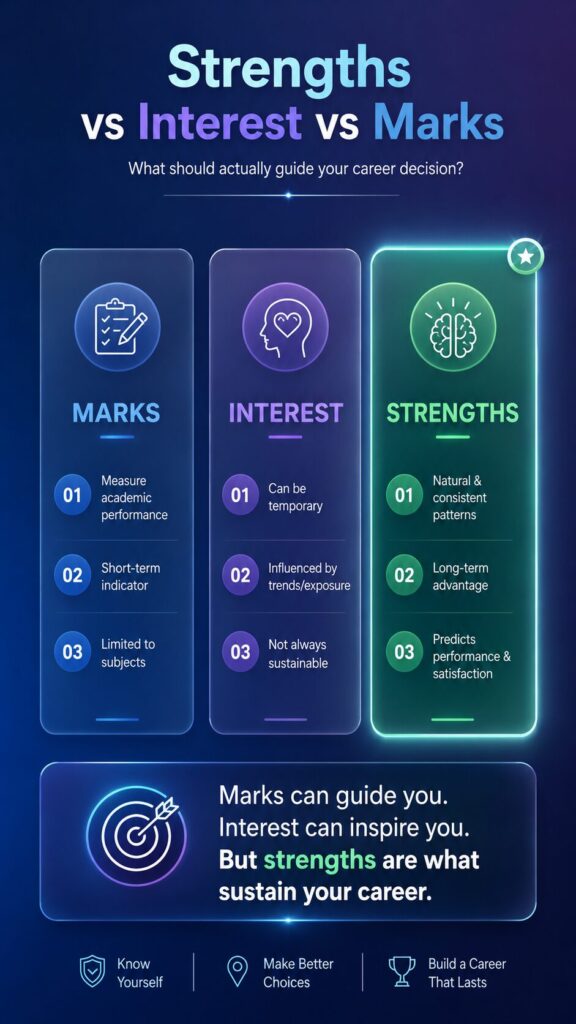
This is where most students get confused.
Let’s simplify it:
Marks
- Measure academic performance
- Short-term indicator
- Limited to subjects
Interest
- Can be temporary
- Influenced by trends or exposure
- Not always sustainable
Strengths
- Natural and consistent patterns
- Long-term advantage
- Predicts performance + satisfaction
For example, you might be interested in business after watching videos. But do you enjoy:
- Decision-making under pressure?
- Handling finances?
- Managing operations?
That’s where strengths matter.
A strong career decision is built on strengths + awareness, not just interest or marks.
How to Choose a Career After 10th Using Strengths
After Class 10, students face their first major decision: stream selection.
Most students ask:
“Science, Commerce, or Arts, which is better?”
But the real question should be:
“Which stream aligns with my strengths?”
Here’s how to approach it:
- If you enjoy logical thinking, problem-solving → Science (especially PCM fields)
- If you like numbers, structure, analysis → Commerce
- If you enjoy understanding people, creativity, expression → Arts/Humanities
This is a much better way to approach how to choose a career after 10th grade.
Because you’re not choosing a final career, you’re choosing a direction aligned with your natural strengths.
How to Choose a Career After 12th Using Strengths
After Class 12, decisions become more specific.
Now, students are not just choosing streams; they are choosing career paths.
At this stage, confusion increases because options multiply.
To approach how to choose a career after 12th, you need clarity in three areas:
- Your strengths
- Career requirements
- Long-term fit
For example:
- Strong analytical skills → finance, engineering, data roles
- Strong communication → law, management, psychology
- Creative thinking → design, media, branding
Instead of asking “Which career is best?”, ask:
“Which career matches how I naturally think and work?”
Step-by-Step Process to Choose a Career Based on Strengths
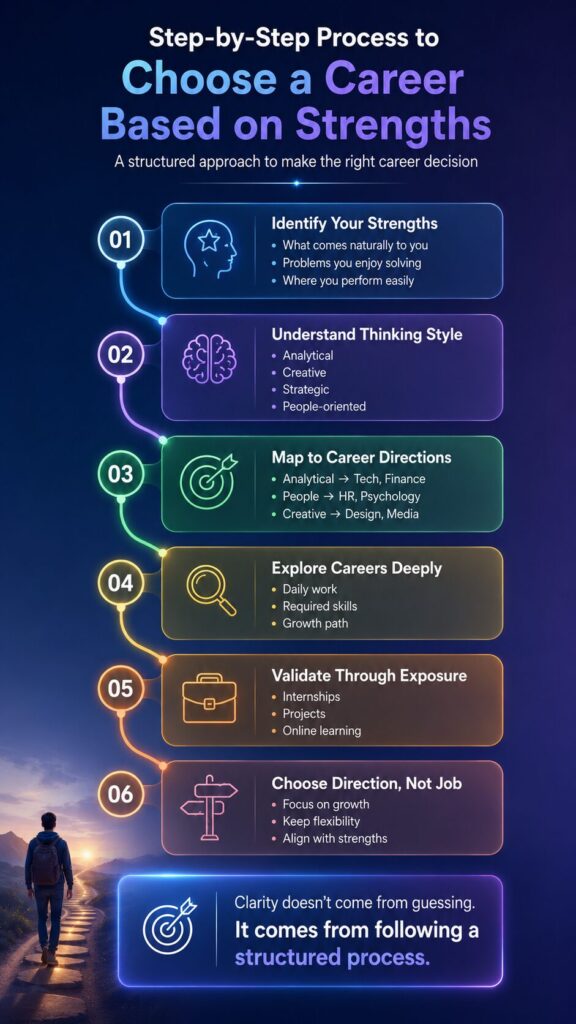
A structured approach makes all the difference.
1. Identify Your Strengths
Start with self-awareness.
Understand:
- What comes naturally to you
- What kind of problems do you enjoy solving
- Where you perform well without excessive effort
2. Understand Your Thinking Style
Are you:
- Analytical?
- Creative?
- Strategic?
- People-oriented?
This determines the kind of work you’ll enjoy long-term.
3. Map Strengths to Career Directions
Instead of choosing a job, choose a direction.
Examples:
- Analytical → finance, tech, engineering
- People-focused → HR, psychology, management
- Creative → design, media, marketing
4. Explore Careers Deeply
Don’t just read lists.
Understand:
- Daily work
- Required skills
- Career growth
Talk to professionals if possible.
5. Validate Through Exposure
Try:
- Internships
- Short projects
- Online courses
This turns theory into real clarity.
6. Choose Direction, Not Final Destination
Careers evolve.
Focus on:
- Growth potential
- Flexibility
- Alignment
This reduces pressure and improves decision quality.
Common Mistakes Students Still Make
Even with awareness, students fall into these traps:
- Ignoring strengths completely
- Choosing based on marks only
- Confusing interest with long-term fit
- Following trends blindly
These mistakes often lead to wrong decisions, something covered in detail under career planning mistakes students make.
The Role of Structured Career Planning
One major reason students struggle is the lack of structure.
Career planning is often:
- Random
- Advice-driven
- Time-pressured
But clarity doesn’t come randomly.
It comes from a structured process:
- Self-awareness
- Exploration
- Alignment
- Decision
When the process improves, the outcome improves automatically.
How Strengths Masters Solves This
Strengths Masters is a career guidance company focused on helping students make clear, confident, and well-aligned career decisions. Unlike traditional career advice that depends heavily on marks, trends, or generic suggestions, Strengths Masters is built on one core belief:
Every student has unique strengths, and the right career should align with those strengths.
Our Vision
Our vision is simple to help students avoid confusion, wrong decisions, and wasted years by giving them early clarity about who they are and what suits them. We aim to shift career planning from guesswork to a structured, insight-driven process, so students don’t just choose a career, but choose the right direction for long-term growth.
Our Program
The Strengths Masters program is a structured, strengths-based career planning system designed specifically for students after 10th and 12th grade.
It includes:
- Scientifically designed assessments to identify natural strengths, thinking styles, and learning patterns
- Detailed reports that go beyond surface-level insights
- Expert-led guidance sessions to interpret results clearly
- Career mapping that connects strengths with real-world career options
- A step-by-step framework to help students move from confusion to clarity
This is not just testing, it’s a complete decision-making process.
How We Help Students
Most students struggle because they don’t know where to start. We simplify that.
We help students:
- Understand what they are naturally good at
- See which careers actually match their strengths
- Avoid decisions based only on marks or pressure
- Build clarity step by step, instead of rushing
The result is not just a decision, but confidence in that decision.
Why Choose Strengths Masters
There are many sources of career advice today, but most are either too generic or too trend-driven.
What makes Strengths Masters different:
- Personalised approach – every student is treated uniquely
- Structured system – not random advice
- Strengths-focused – long-term fit over short-term performance
- Clarity-driven – focus is on decision-making, not just information
Instead of asking, “What should I choose?”, we help students answer:
“What is right for me?”
And that’s the difference between confusion and clarity.
Real Insight: Why Strength-Based Careers Work Better
Research consistently shows that alignment improves outcomes.
According to Gallup:
- People who use their strengths daily are more productive
- They experience higher engagement and satisfaction
Additionally, a Deloitte study highlights that organisations that focus on strengths achieve higher performance and lower turnover.
This applies to students as well.
When you choose a career aligned with your strengths:
- Learning becomes easier
- Effort feels meaningful
- Growth becomes natural
Final Thoughts: The Right Way to Choose a Career
Choosing a career is not about finding the “perfect option.”
It’s about finding the right fit.
Marks can guide you.
Interests can inspire you.
But strengths sustain you.
If you truly want to understand how to choose the right career for students, the answer is simple:
Don’t just ask what you can do
Ask what suits you naturally
Because the right career is not chosen randomly.
It is built on clarity, alignment, and strengths.
Frequently Asked Questions:
1) How to choose the right career for students?
Choosing the right career starts with understanding your strengths, interests, and thinking style. Instead of following marks or trends, students should focus on long-term fit and career alignment.
2) How to choose a career after 10th based on strengths?
After the 10th, students should identify their natural strengths and learning patterns, then choose a stream (science, commerce, arts) that aligns with those strengths for better long-term growth.
3) How to choose a career after 12th if I am confused?
If you’re confused after 12th, start with self-awareness, explore career options deeply, and validate choices through internships or short-term exposure before making a decision.
4) What is the difference between strengths, interests, and marks in career planning?
Marks show academic performance, interest can be temporary, but strengths are consistent patterns that predict long-term success and career satisfaction.
5) Why should students not choose a career based only on marks?
Marks are short-term indicators and don’t reflect real-world skills or long-term fit. Choosing a career based only on marks can lead to confusion and dissatisfaction later.
6) How does strengths-based career planning help students?
Strengths-based career planning helps students identify what they are naturally good at and match it with suitable career paths, leading to better clarity, performance, and satisfaction.
7) What is the best way to decide a career path for long-term success?
The best way is to follow a structured process: understand your strengths, explore careers deeply, gain real exposure, and choose a direction instead of a fixed job.