


When students reach Class 10 or 12, one question becomes unavoidable: “What should I do next?” In that moment of confusion, many students and parents turn to a quick solution: a career aptitude test. It feels logical. Take a test, get a result, and decide your future.
But here’s the real question: Do career aptitude tests actually work, or are they just a starting point that people misunderstand?
The answer is not as simple as yes or no. These tests can be useful, but only if you understand what they can and cannot do. Without that clarity, students often end up depending too much on them and making decisions that don’t truly fit them in the long run.
What is a Career Aptitude Test for Students?
A career aptitude test is designed to evaluate a student’s natural abilities and preferences in certain areas. Most tests assess a combination of factors such as logical reasoning, verbal ability, numerical skills, personality traits, and sometimes interests. Based on these inputs, the test suggests suitable career options or directions.
At a surface level, this seems extremely helpful. After all, if a test can analyse your abilities and suggest careers, it should make decision-making easier.
However, the important thing to understand is this: an aptitude test is a tool, not a decision-maker. It gives you signals, not final answers.
Why Students Rely on Aptitude Tests
The growing popularity of aptitude tests is not random. A very real problem, confusion drives it.
Students often feel lost because they are exposed to too many options and too little clarity. They hear different advice from parents, teachers, friends, and the internet. Everyone suggests something different, and this creates decision fatigue.
In such situations, an aptitude test feels like a shortcut. It promises objectivity. It removes emotional pressure. It gives structured output.
For a student who is unsure about career planning after 12th or even after 10th, this can feel like a relief. But the problem starts when this “starting point” is treated as a conclusion.
Do Career Aptitude Tests Really Work?
To answer this properly, we need to look at both sides where they help and where they fall short.
Where Aptitude Tests Help
Aptitude tests can be useful in initiating the thinking process. Many students have never actively reflected on their abilities or preferences. A structured test pushes them to think about how they approach problems, what kind of tasks they are comfortable with, and where they naturally perform better.
They also help in narrowing down options. Instead of being confused between 20 different careers, a student might get a shortlist of 4–5 directions. This reduces overwhelm and creates focus.
Another important benefit is awareness. Sometimes, students discover abilities they had never consciously noticed. For example, a student may realise they have strong analytical skills or a natural inclination toward communication-based roles.
So yes, aptitude tests can create initial clarity.
Where Aptitude Tests Fall Short
The real issue begins when we expect too much from them.
First, most aptitude tests provide generic outputs. Thousands of students take the same test, and many receive similar career suggestions. This is because the test measures broad abilities, not deep individual patterns.
Second, these tests are based on a one-time assessment. A student’s performance in a 60–90 minute test cannot fully capture their long-term behaviour, consistency, or adaptability. Career decisions, on the other hand, require a much deeper understanding.
Third, aptitude tests often lack real-world context. They might suggest “business” or “psychology” as a career, but they don’t explain what daily work looks like, what challenges exist, or what kind of effort is required to succeed in that field.
Finally, and most importantly, aptitude tests do not fully capture strengths. They measure ability, but they don’t always identify patterns of behaviour that remain consistent over time.
This is where many students go wrong. They take the result at face value and assume, “This is the right career for me.”
What Most Students Misunderstand
The biggest mistake students make is confusing guidance with decision-making.
An aptitude test can guide you toward certain directions, but it cannot decide your career for you. The result needs interpretation, context, and validation.
Another common misunderstanding is assuming that aptitude equals long-term fit. Just because you are capable of doing something does not mean you will enjoy it or sustain it for years. Capability and consistency are not always the same.
This is why many students who choose careers based purely on test results later feel disconnected or unsure. The decision was based on limited insight.
Aptitude vs Interest vs Strengths
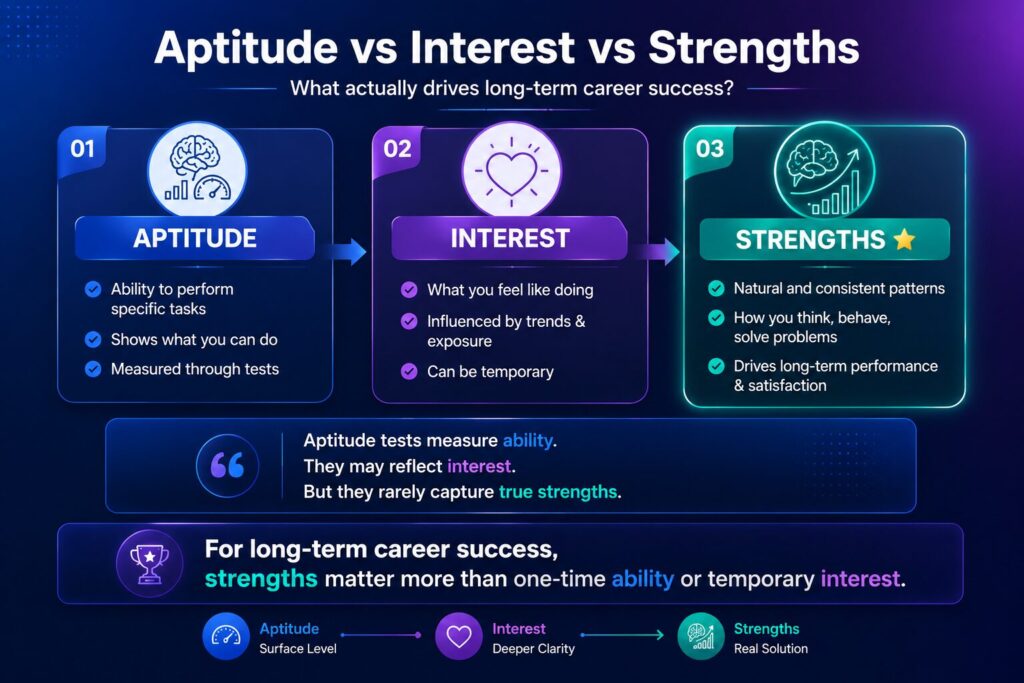
To truly understand the role of aptitude tests, we need to differentiate between three key factors: aptitude, interest, and strengths.
Aptitude refers to your ability to perform certain tasks. It tells you what you can do.
Interest reflects what you feel like doing. It is often influenced by exposure, trends, or environment. However, interest can be temporary.
Strengths, on the other hand, are natural and consistent patterns in how you think, behave, and solve problems. They are not situational. They stay with you over time and influence how you perform in real-world scenarios.
This distinction is critical.
Aptitude tests primarily measure ability. They may partially capture interest. But they rarely go deep enough to identify strengths in a structured and reliable way.
And when it comes to long-term career success, strengths play a much bigger role than one-time ability or short-term interest.
What Actually Works Better for Career Clarity
If aptitude tests are not enough on their own, then what works?
The answer lies in a structured career planning approach.
Instead of relying on a single test, students need to go through a process that includes multiple layers of understanding. It starts with self-awareness, identifying strengths, thinking style, and natural preferences. It then moves to career exploration, where students understand what different careers actually involve.
After that comes alignment, matching personal patterns with real-world career demands. And finally, validation through exposure, such as internships, projects, or conversations with professionals.
This approach takes more effort than taking a test, but it delivers far better clarity. It shifts the decision from guesswork to understanding.
When Should You Take a Career Aptitude Test?
This does not mean aptitude tests should be avoided completely. They can still play a role, but only in the right context.
Aptitude tests are most useful at the early stage of exploration. When a student has no clarity at all, a test can provide initial direction and trigger thinking.
However, they should never be used as the final step. Instead, they should be followed by deeper analysis, discussion, and real-world validation.
In simple terms, think of an aptitude test as the starting point, not the destination.
A Better Approach: Strengths-Based Career Planning
A more reliable approach to career planning focuses on strengths rather than just aptitude.
Strengths-based career planning looks beyond surface-level abilities and identifies consistent behavioural patterns. It helps students understand how they naturally approach problems, how they interact with the world, and what kind of work they can sustain over time.
This approach is more personalised. It reduces confusion because it focuses on what is naturally aligned with the student, rather than forcing them into predefined categories.
When strengths are aligned with career choices, students are more likely to stay consistent, perform better, and feel satisfied with their work in the long run.
Conclusion: What Should Students Actually Do?
Career aptitude tests are not useless, but they are often misunderstood. They can provide direction, but they cannot provide complete clarity.
The real problem is not the test itself, but how it is used.
Students who rely only on test results often make decisions based on incomplete information. On the other hand, students who treat aptitude tests as one part of a larger process tend to make better, more informed choices.
The key takeaway is simple:
A career aptitude test can guide you, but it cannot decide for you. Real clarity comes from understanding your strengths, exploring careers deeply, and following a structured decision-making process.
When students shift from quick answers to deeper understanding, career decisions become less stressful and far more effective.
Frequently Asked Questions:
1. What is a career aptitude test for students, and how does it work?
A career aptitude test for students evaluates abilities like logical reasoning, numerical skills, and personality traits to suggest suitable career options based on performance patterns.
2. Are career aptitude tests accurate for choosing a career?
Career aptitude tests can provide direction, but they are not fully accurate for final decisions. They offer general insights, not deep personalised career clarity.
3. Can aptitude tests decide the best career for students?
No, aptitude tests cannot decide the best career. They are a starting point. Students need a deeper analysis of strengths, interests, and real-world exposure.
4. What is the difference between aptitude, interest, and strengths in career planning?
Aptitude shows what you can do, interest shows what you like, and strengths reflect consistent patterns that predict long-term success and satisfaction.
5. Should students rely only on aptitude tests for career planning after 12th?
No, students should not rely only on aptitude tests. A structured career planning approach that includes strengths analysis and career exploration works better.
6. When is the right time to take a career aptitude test for students?
The best time to take a career aptitude test is during the early stage of career exploration, typically after Class 10 or 12, to gain initial direction.
7. What is a better alternative to aptitude tests for career clarity?
A better alternative is strengths-based career planning, which focuses on natural abilities, thinking patterns, and long-term alignment with career paths.