

Every manager eventually faces a difficult but common challenge: an employee who is not meeting expectations.
Deadlines begin to slip, work quality becomes inconsistent, mistakes increase, and accountability weakens. Over time, the impact extends beyond the individual. Managers spend more time following up, team productivity slows down, and high performers may feel frustrated when they have to compensate for unfinished or lower-quality work.
Handling underperformance is one of the most important responsibilities in people management. Yet many managers either avoid the conversation or respond with excessive control and micromanagement. Neither approach addresses the real issue.
Effective managers take a more practical and constructive approach. They focus on understanding the root cause of underperformance, clarifying expectations, and providing the right support to help employees improve.
In most cases, underperformance is not simply a matter of low effort. It is often linked to unclear goals, skill gaps, competing priorities, low confidence, or insufficient coaching.
When managers address these issues with clarity, feedback, and structured coaching, they do more than solve a short-term performance problem. They help employees build confidence, strengthen accountability, and become more capable contributors over time.
Why Employees Underperform in the First Place
Underperformance is rarely caused by laziness alone. In most corporate environments, there is a practical explanation behind declining results.
Common causes include:
- Unclear expectations
- Insufficient training
- Low confidence
- Poor prioritisation
- Work overload
- Limited motivation
- Personal challenges outside work
- Weak manager support
For example, an employee may appear disengaged when they are actually overwhelmed by competing priorities. Another may miss deadlines because they never fully understood what “good” looks like.
This is why managing underperforming employees requires diagnosis before judgment.
The Business Impact of Ignoring Underperformance
When managers avoid performance issues, the consequences spread beyond the individual.
- High performers become frustrated.
- Team morale declines.
- Deadlines slip.
- Customers experience inconsistent service.
- Managers lose credibility.
According to Gallup workplace research, employees who receive regular feedback and clear expectations are significantly more engaged and productive than those who do not. When expectations are unclear, performance often suffers not because employees do not care, but because they lack direction.
Addressing poor performance early protects both the employee and the team.
The Right Manager Mindset
Before starting any performance conversation, managers should adopt one essential belief:
Most employees want to succeed.
This mindset changes the tone of the discussion.
Instead of asking:
“Why are you underperforming?”
Effective managers ask:
“What is getting in the way of success?”
This approach reduces defensiveness and encourages honest dialogue.
The manager’s role is to:
- Clarify expectations.
- Identify root causes.
- Provide support.
- Build accountability.
- Review progress consistently.
This is the foundation of employee performance coaching.
How to Start the Conversation
The most effective performance discussions are private, factual, and supportive.
A practical opening might sound like this:
“Over the last four weeks, I’ve noticed that two reports were submitted late and there were several errors in the client data. I wanted to understand what challenges you’re facing and discuss how we can improve together.”
This opening does three things:
- Uses specific examples.
- Focuses on observable facts.
- Signals a partnership rather than blame.
15 Practical Questions Managers Should Ask Underperforming Employees
These are realistic questions managers commonly use in one-on-one conversations.
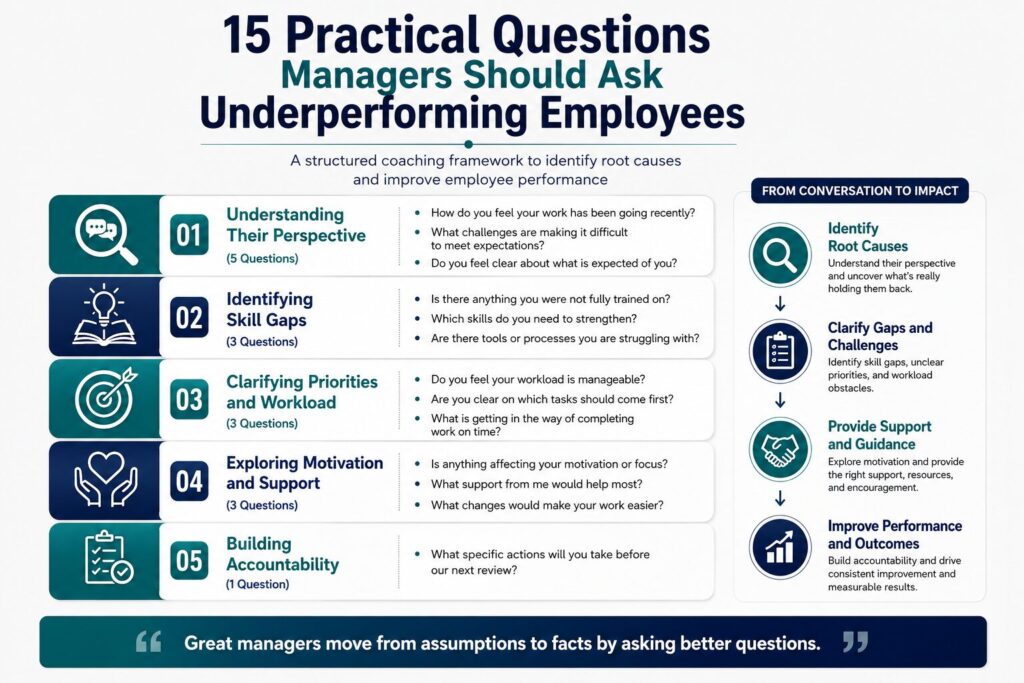
Understanding Their Perspective
- How do you feel your work has been going recently?
- What challenges are making it difficult to meet expectations?
- Which parts of your role feel most difficult right now?
- Do you feel clear about what is expected of you?
- What tasks are taking more time than expected?
Identifying Skill Gaps
- Is there anything you feel you were not fully trained on?
- Which skills do you think you need to strengthen?
- Are there tools or processes you are struggling with?
Clarifying Priorities and Workload
- Do you feel your workload is manageable?
- Are you clear on which tasks should come first?
- What is getting in the way of completing work on time?
Exploring Motivation and Support
- Is anything affecting your motivation or focus?
- What support from me would help most?
- What changes would make your work easier?
Building Accountability
- What specific actions will you take before our next review?
These questions help managers move from assumptions to facts.
Real-Life Example: Turning Around an Underperforming Employee
Rahul was a team leader in a mid-sized services company. One of his analysts, Neha, had started missing deadlines and submitting reports with recurring errors.
Initially, Rahul assumed Neha had become careless. Instead of escalating immediately, he scheduled a one-on-one conversation.
During the discussion, Rahul asked:
“Do you feel clear about what is expected?”
“Which part of your role is most challenging right now?”
Neha explained that a new reporting tool had been introduced, but she had received only minimal training. She was spending hours trying to understand the software and was afraid to ask for help.
Rahul implemented three actions:
- Arranged focused training.
- Created a weekly checklist.
- Conducted short Friday reviews.
Within four weeks:
- Reports were submitted on time.
- Accuracy improved significantly.
- Neha regained confidence.
The issue was not attitude. It was a capability and confidence gap.
This is how managers improve employee performance without demotivating them.
Solutions Based on the Root Cause
If Expectations Are Unclear
- Define measurable outcomes.
- Share examples of good work.
- Confirm understanding.
If There Is a Skill Gap
- Provide training.
- Pair with a mentor.
- Break tasks into smaller steps.
If Prioritisation Is Weak
- Clarify top priorities.
- Use weekly planning.
- Remove unnecessary work.
If Motivation Is Low
- Explore career goals.
- Recognise progress.
- Connect work to purpose.
If Workload Is Too High
- Rebalance responsibilities.
- Extend deadlines where possible.
- Remove low-value tasks.
If Personal Challenges Exist
- Offer flexibility.
- Direct the employee to available support resources.
A Practical 30-Day Performance Improvement Plan
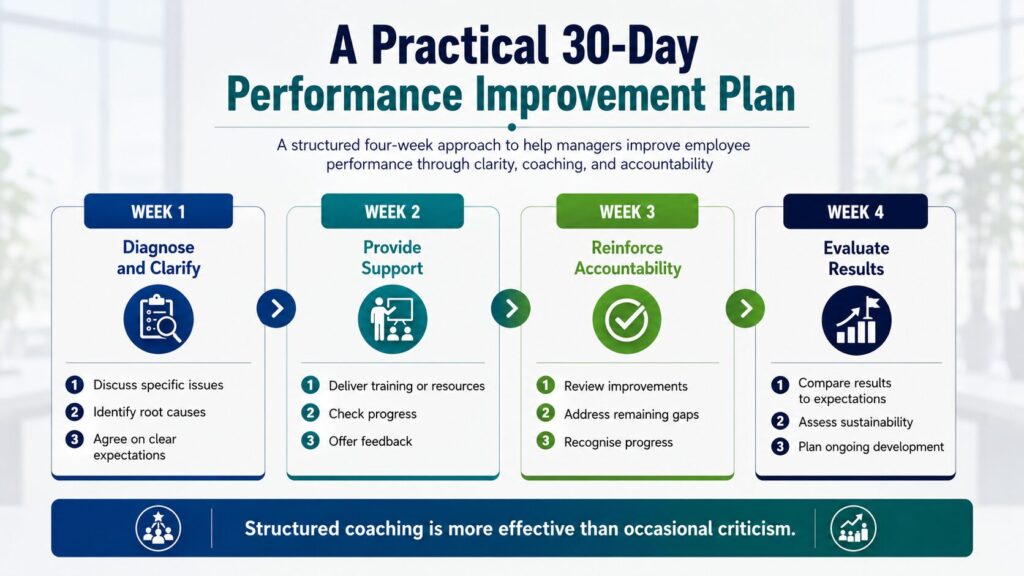
Week 1: Diagnose and Clarify
- Discuss specific issues.
- Identify root causes.
- Agree on performance expectations.
Week 2: Provide Support
- Deliver training or tools.
- Check progress.
- Offer feedback.
Week 3: Reinforce Accountability
- Review improvements.
- Address remaining gaps.
- Recognise progress.
Week 4: Evaluate Results
- Compare performance against expectations.
- Decide whether improvement is sustainable.
- Plan ongoing development.
This structured approach is more effective than occasional criticism.
What Managers Should Avoid
1. Vague Feedback
“Your performance needs improvement” is too general to be useful.
2. Public Criticism
Performance issues should always be addressed privately.
3. Emotional Reactions
Stay factual and professional.
4. Making Assumptions
Ask questions before concluding.
5. Waiting Too Long
Small issues become larger when ignored.
6. Micromanaging
Support the employee without taking over every task.
How Coaching Builds Long-Term Performance
Managers who coach underperforming employees create better outcomes than managers who instruct.
Instructing sounds like:
“Do it this way.”
Coaching sounds like:
“What part of this task feels most difficult?”
“What approach do you think will work best?”
Coaching improves:
- Ownership
- Confidence
- Problem-solving
- Accountability
Over time, employees become more independent and capable.
How Previous Leadership Skills Support Performance Improvement
Helping underperforming employees draws on several core management skills:
- Role Modelling: Employees watch how managers handle difficult conversations.
- Goal Setting: Clear goals eliminate ambiguity.
- Reviews: Regular check-ins track progress.
- Feedback: Specific input guides improvement.
- Coaching: Questions build confidence and ownership.
- Clarity: Employees perform better when expectations are understood.
Together, these skills transform performance management from a corrective process into a developmental one.
Where Structured Leadership Development Helps
Many managers are promoted because of technical expertise, not because they were trained to handle performance issues.
As a result, they often avoid difficult conversations or rely on instinct rather than proven approaches.
Programs like the 5 Skills for First-Time Managers by Strengths Masters help managers build practical capabilities in goal setting, reviews, feedback, coaching, and team clarity. These skills are essential for effectively and confidently managing underperforming employees.
Final Thoughts
Underperformance is one of the most common challenges managers face, but it does not have to become a long-term problem. When managers ask the right questions, identify the real issue, and provide structured support, employees often improve faster than expected.
Great managers do not label people too quickly.
They create clarity. They coach consistently. And they turn underperformers into confident contributors. That is one of the most valuable leadership capabilities any manager can develop.
Frequently Asked Questions:
1) How do managers turn underperforming employees into top performers?
Managers turn underperforming employees into top performers by identifying root causes, setting clear expectations, providing targeted coaching, and using a structured performance improvement plan. With regular feedback, accountability, and support, many employees can significantly improve their performance within 30 to 60 days.
2) What questions should managers ask underperforming employees?
Managers should ask practical questions about workload, skill gaps, motivation, and obstacles. Examples include: “What challenges are affecting your performance?” and “What support would help you improve?” These questions help managers uncover the real reasons behind underperformance and build effective action plans.
3) How can managers coach employees with poor performance?
Managers can coach poor-performing employees by giving specific feedback, clarifying priorities, offering training, and setting measurable goals. Coaching focuses on solving performance problems while maintaining employee confidence and engagement.
4) What are real-life examples of managing underperforming employees?
A common example is an employee missing deadlines due to unclear priorities or insufficient training. Effective managers address the issue through one-on-one coaching, a 30-day improvement plan, and regular progress reviews to help the employee regain confidence and improve results.
5) How do you improve employee performance without demotivating them?
The best way to improve employee performance without reducing motivation is to focus on coaching instead of criticism. Managers should use constructive feedback, recognise progress, and provide clear guidance and support.
6) What is the step-by-step process for managing underperforming employees?
The process includes diagnosing performance issues, identifying root causes, providing support and training, reinforcing accountability, and evaluating results. A structured 30-day performance improvement plan helps managers improve performance systematically.
7) How long does it take to improve an underperforming employee?
Many underperforming employees show noticeable improvement within 30 to 60 days when managers provide clear expectations, coaching, regular feedback, and consistent accountability. The timeline depends on the complexity of the performance issue and the employee’s willingness to improve.